By EdCaptain editorial desk · Published
“A handful of this, a little water, then you’ll know when it’s ready.” A family cook may make a familiar dish beautifully without ever following a written recipe. Your child wants to learn it, but a page that says “some rice” will not tell another cook what to do.
For children aged 6–12, make this a short recording project with a willing adult cook. Capture one dish, its story and the details that need checking. You are preserving someone’s knowledge, not testing their memory or asking your child to certify that a recipe is safe.
Ask for one recipe and one small appointment
Try: “Could we write down how you make this, in your own words? We’d like to keep your name with it. You can decide what you want to share.” A parent, grandparent, neighbour or other trusted cook can take part; the recipe does not have to be old or associated with a special occasion.
Agree whether the result stays in your household or may be shared with named relatives. Ask separately about photographs, audio or video. Written notes are enough. If the cook does not want to share a recipe or story, choose another subject rather than treating family access as automatic permission.
An account from the Abraham Lincoln Presidential Library and Museum describes how recording family recipes can uncover unclear measures, missing steps and memories attached to a dish. Your version can begin much smaller than a cookbook: one useful page.
Set up a recording place
Gather paper, a pencil and any existing recipe card the cook is happy to show. If an adult demonstration is planned, have suitable kitchen scales, measuring spoons or a measuring jug available for the adult to use. Keep original handwritten cards away from water, food and heat; work from a permitted copy where possible.
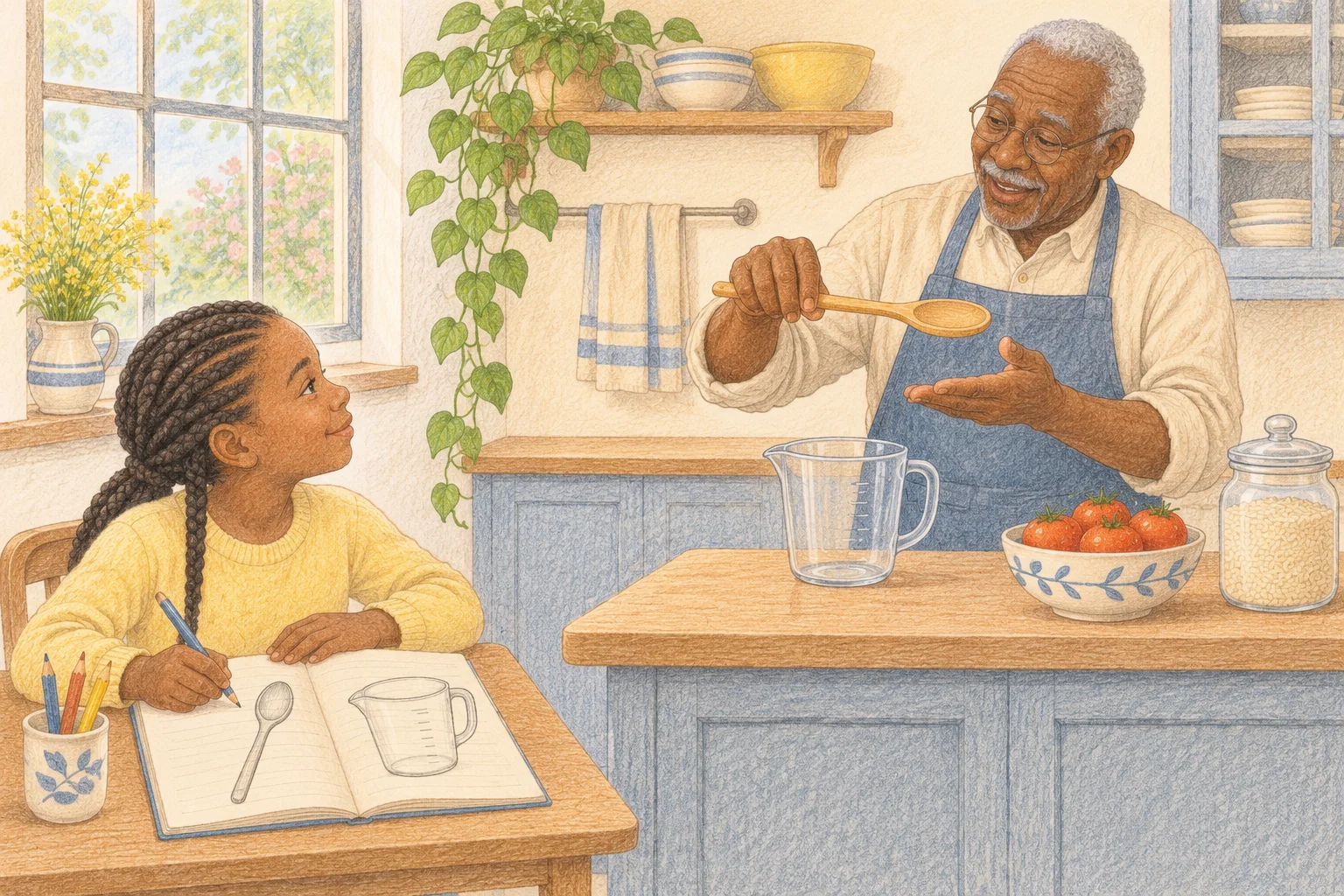
Let the child write at a separate, safe surface. The cook can explain the recipe while everyone is seated; there is no need to prepare food during the first conversation. If you later observe cooking, choose an ordinary, unhurried occasion and keep heat, knives, heavy equipment and raw-food handling adult-owned. Our kitchen safety-zone guide helps define suitable roles.
Build the record in five passes
- Give the dish its own introduction. Record its name, who is explaining it, who taught them if known, and the date. Ask what they call it in their strongest language. Keep that name alongside any translation they approve.
- List ingredients before organising them. Ask the cook to describe a normal batch. Include ingredients that arrive “already prepared”: cooked rice and uncooked rice are different instructions. Note whether an item is drained, chopped or otherwise prepared.
- Follow the order. Write one action per line. Ask, “What happens just before that?” and “Does anything need preparing earlier?” Record tools, pan size and any waiting stage the cook identifies.
- Mark the uncertain details. Circle “a handful,” “a spoon” or “a moderate oven.” Ask which spoon, how full and what oven setting they actually use. If nobody can confirm it, write “needs checking” instead of supplying a plausible number.
- Read it back together. Ask the cook what you missed or misunderstood. Let the child explain one step in their own words, then check that interpretation with the cook.
Keep questions curious: “Can you show us what you mean by a little?” is easier to answer than “Why don’t you measure properly?” An experienced cook’s judgement is real knowledge, even when it is difficult to put on paper.
Turn a demonstration into observations, not guesses
If the cook agrees to demonstrate during an adult-managed preparation, pause only where it is safe. Before an ingredient is added, the adult can measure the amount the cook has selected. Record the unit and method: weight in grams, volume in millilitres, or a clearly identified measuring spoon. Do not silently convert a household cup into a standard cup.
Write “observed in this batch” next to the result. One measurement does not prove that every batch uses that amount. The cook may adjust for ingredient size, weather, equipment or preference. Ask which details are fixed and which they normally adjust.
Describe useful cues such as the mixture’s texture, but keep them separate from safety checks. “It smells ready” is not a substitute for the appropriate safe cooking temperature. Do not invent a cooking time from a photograph or taste something raw to understand the flavour.
Keep food safety outside the child’s job
The CDC’s food-safety guidance uses four steps: clean, separate, cook and chill. If food is prepared, wash hands with soap and water for at least 20 seconds, keep raw ingredients away from ready-to-eat foods, and have an adult use a food thermometer where needed to check the appropriate safe internal temperature.
Do not taste raw dough or batter. Refrigerate perishable food within two hours, or within one hour when the temperature is above 32°C/90°F. Adults should check ingredients against household allergy needs and the person’s existing allergy plan.
A family record is not proof that an old method is safe. If timing, temperature, storage or an ingredient is uncertain, leave the cooking version unfinished until an adult checks reliable current guidance. Keep home canning, fermentation and other specialist preservation methods outside this simple project.
Give the child a role that fits
Ages 6–9: let the child draw the utensils, choose one question or dictate a sentence. An adult can write quantities. Read the child’s words back before changing them.
Ages 10–12: invite the child to organise the ingredient list, number the steps and make a short “questions still to check” section. They can compare the record with the cook’s explanation without becoming responsible for food safety.
Use familiar communication supports, larger print, pictures, signing or typing as needed. A relative joining by phone can explain tools or names while an adult manages the call. Nobody needs to eat the dish to contribute.
Keep the story and the instructions together
Add one optional question: “When do you like making this?” or “Who showed you this part?” Accept a short answer or a pass. Our family interview activity offers a wider conversation if the person wants one.
Keep credit accurate: “As explained by Auntie, recorded with Sam” is different from claiming you created the dish. Note any book, packet or other source the cook identifies, and do not publish copied recipe text or photographs without checking permission.
At the end, ask your child, “Which detail would another cook have missed?” Give the cook the page to correct, agree who gets a copy, and date later changes. A useful first result can be an honest draft—with its gaps visible and its storyteller still recognisable.
Sources and further reading
- Abraham Lincoln Presidential Library and Museum: documenting family recipes and their stories
- CDC: current food-safety steps and safe cooking and storage
Read our editorial policy.