By EdCaptain editorial desk · Published
What would you want to remember about an ordinary week in your family? The breakfast someone keeps requesting, the game played on the way home, or the tree outside the window might be more interesting later than a list of impressive achievements.
Make a small paper time capsule with children aged 6–12, then agree to open it in a few months. Everyone contributes a little evidence of life now. This is a shared activity with room for different answers, rather than a prediction contest or a promise about who a child will become.
Keep this version small
Allow about 20–30 minutes, with permission to finish sooner. You need:
- A clean, dry envelope large enough for a few sheets, or a paper folder.
- Plain paper, including usable scrap paper with no private information on it.
- Pencils or crayons that suit each participant’s grip and access needs.
- A place to store the finished envelope indoors, preferably inside a clean, dry box.
- A calendar or reminder an adult will manage.
Use paper representations rather than collecting treasured objects. Nobody needs to give up the toy they sleep with, a family heirloom or the only copy of a photograph. The National Museum of Australia’s time-capsule activity suggests drawings and photographs as alternatives to including actual objects. Here, drawings and written descriptions are enough.
Keep food, flowers, leaves, liquids, batteries and electronics out. Avoid glass, sharp items and loose small decorations. An adult should check the materials, provide appropriate supervision and keep pencils and other supplies away from younger children who may mouth them.
Make the envelope together
- Choose an opening date. Pick a specific, realistic date perhaps three or six months away. Write today’s date and that date on the outside. If the children want a shorter wait, a month is fine. The adults can check whether everyone is likely to be available.
- Agree what “shared” means. Explain that contributions in this envelope are for the people taking part to see when it opens. Nobody has to include something private. A child can show their page before adding it, leave a prompt blank or decide to pass.
- Give everyone a small space. Offer one sheet or two small cards each, including the adults. A drawing, a few words or dictated sentence all count. Avoid comparing how much each person produces.
- Capture a few ordinary details. Choose two or three prompts from the ideas below. Adults make their own pages too; this is not a worksheet the children complete while grown-ups judge the answers.
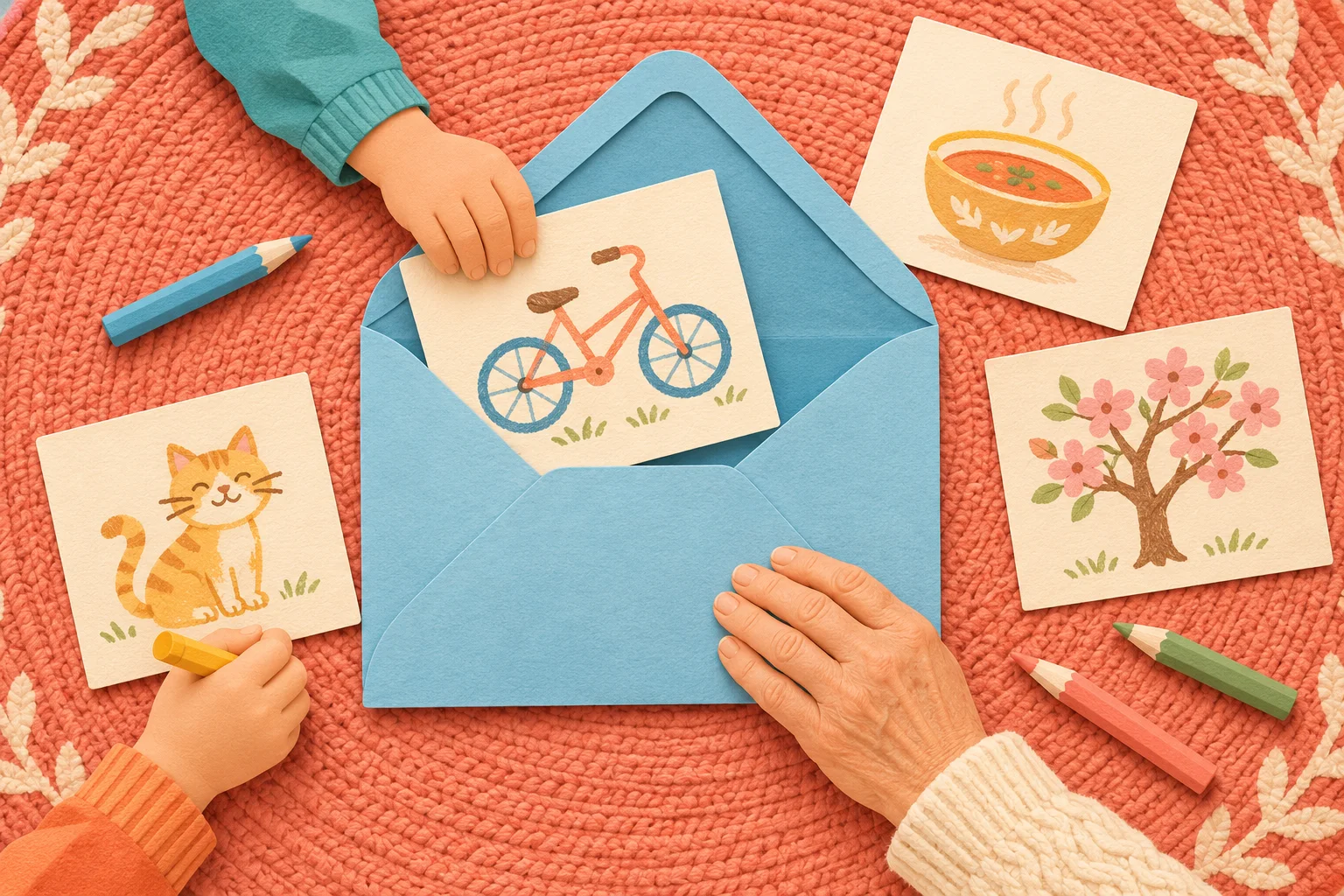
- Add a simple contents note. Record whose pages are included and, with permission, one sentence about why an item was chosen. For example: “The bicycle drawing shows the ride we do after breakfast.”
- Close it and make the plan visible. Fold the flap or close the folder, choose its storage place and put the opening date in the adult’s calendar. Tell everyone where it is. A wax seal, lock, buried container or special purchase is unnecessary.
If a child changes their mind about a contribution, help them retrieve it. A closed flap is part of the game, not a rule that removes their choice about their own words or picture.
Prompts that leave room for real life
Offer choices rather than asking every question:
- Our ordinary soundtrack: what sound do we hear often at home? Draw its source or describe it. It could be a kettle, a neighbour’s dog or someone practising an instrument.
- A small thing we do together: draw one moment from this week. Each person can choose a different moment.
- Something I’m interested in now: a game, book, place, question or hobby. It does not have to be something the whole family likes.
- A message for opening day: “Ask me whether I still…” or “I hope we remember…” Keep hopes optional, with no required goal or achievement.
For example, a child might draw a bowl and dictate, “I keep asking for tomato soup.” An adult might write, “I wonder whether we will still be looking for the missing blue sock.” These are invented examples to show how small the contributions can be.
A difficult week does not need to be rewritten as a happy one. Someone can record “I wanted more quiet” or choose not to describe the week. Do not ask for a confession, a family rating or a promise to behave better.
Help everyone take part in their own way
For ages 6–9, show one concrete example and offer a choice between drawing and dictating. Read a dictated sentence back before writing it down permanently. Accept the child’s wording rather than turning it into a polished adult account.
For ages 10–12, offer independent writing time and a chance to edit before adding the page. They might prefer listing three current interests or drawing a small map of a familiar route. Keep addresses and identifying details out if the envelope might be shown beyond the family.
Use familiar communication supports: signing, a device, pointing, large paper, adapted grips or an adult writing exactly what the person indicates. A child can also choose the envelope colour or help select the opening date without producing a page. Relatives living elsewhere can send a short contribution through an adult-managed route, if they want to join.
Store it for a short wait, not for centuries
The Library of Congress explains that time capsules do not have to be buried. Its preservation guidance recommends careful contents and storage choices, including a stable, relatively dry place away from direct light, heat and likely leaks.
For this small household activity, put the envelope in a dry indoor cupboard or shelf box that an adult can reach safely. Avoid damp basements, hot lofts and outdoor hiding places. Ordinary paper and an ordinary envelope are not a guarantee of long-term preservation. Use replaceable material, and keep anything irreplaceable in its usual suitable storage.
Open it with curiosity
On the agreed day, ask whether everyone is ready to look together. Read or show each person’s contribution with their permission. Try: “What do you notice now?” and “Which detail had you forgotten?”
Skip “You said you’d be better at this by now” or laughing at old spelling. Interests can change. A wish may not have happened. If the contents bring up sadness or someone wants to stop, put the pages aside and offer another time.
Decide together whether to keep the pages, return them to their owners or make a new envelope. Ask separately before photographing or sharing anything. The activity can remain entirely private.
If your family would rather make something that stays open, try a family traditions book. If a one-off project feels too much, choose a small repeatable family ritual instead. The useful part is the chance to notice one another, whatever form fits this week.
Sources and further reading
- National Museum of Australia: time capsules and representing everyday life
- Library of Congress: contents, containers and indoor storage considerations
Read our editorial policy.