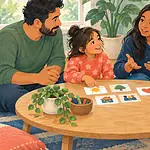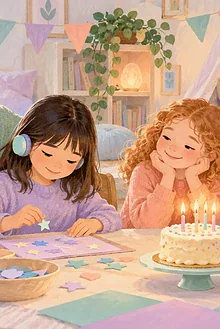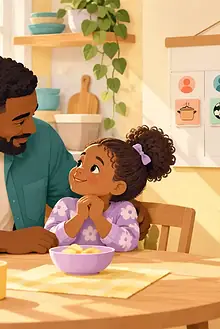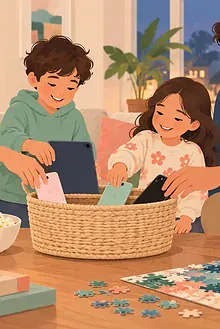
A ritual is not an elaborate holiday production. It is a small action that repeats often enough to say, “This is something our family does.” When work, school, care and travel crowd the week, a five-minute ritual is more likely to build connection than a perfect family night that rarely happens.
Use a cue, an action and a close
Choose a cue that already occurs: waking, coming home, starting dinner, turning off devices or saying goodnight. Add one shared action and a familiar ending. For example: switch on a small lamp, name one part of the day, then high-five.
The American Academy of Pediatrics describes predictable shared activities, conversation, reading, singing and celebrations as ways families can strengthen connection. The power is in repetition and responsiveness, not complexity.
Start with five minutes
Try one of these:
- A baby’s same welcome song after childcare.
- A preschool “three jumps and a cuddle” arrival.
- One question while unpacking school bags.
- A weekly walk to notice one new thing.
- A teen choosing the drive-home song on Fridays.
End before the ritual becomes another demand. A child who does not want to talk can still stir the soup, choose music or sit nearby.
Make it accessible
Adapt for communication, sensory, mobility and cognitive needs. Use a picture cue, sign, switch-activated song, quiet lighting or the same object each time. Avoid rituals built around touch if someone dislikes touch. Participation can be watching, choosing or helping set up.
Let children shape it
Ask, “What tiny thing should be ours?” Offer realistic choices. Children may invent a handshake, a funny toast or a Sunday drawing. Parents keep boundaries around safety, cost and time, but the child’s contribution makes the ritual feel lived rather than assigned.
For a structured space to gather ideas, use a short family meeting.
Do not use the ritual as a test
Missing a ritual because of illness, work or adolescence does not prove the family is drifting. Avoid “If you cared, you would join.” Offer the next opportunity without guilt. A ritual should hold connection, not police loyalty.
Carry one ritual through change
During a move, separation, bereavement or new baby, keep one small familiar action if possible. It might happen by video, in two homes or at a different time. UNICEF parenting guidance encourages maintaining warm routines and traditions during stress.
For children moving after separation, pair the ritual with a concrete moving transition plan.
Choose connection over performance
Photos and matching outfits can be enjoyable, but they are not the ritual’s purpose. Put the phone away for part of the moment. Do not post a child’s words or image without permission. Let the activity be ordinary enough that nobody has to perform happiness.
Review whether it still fits
A toddler’s song may embarrass a preteen. Change the form while preserving the meaning: the bedtime song becomes a private phrase; the weekly game becomes tea after practice. Ask occasionally, “Keep, change or stop?”
Families do not become close through one grand gesture. They become recognizable to one another through small, repeated moments that say: I expected you, I noticed you and there will be another chance tomorrow.
Sources and further reading
Let children help the ritual grow
Ask one simple question every few months: “What part should we keep, change or stop?” A preschooler can choose the song; an older child can select the snack or invent a closing phrase. If a ritual becomes a battle, shrink it. Two minutes of warm attention is more connecting than a long performance everyone resents.
Photographs and keepsakes can be lovely, but do not make recording the event more important than joining it. Some children dislike cameras or public sharing. Ask before posting, and allow the memory to remain private. The repetition—not a perfect picture—is what gives a small ritual its meaning.