Moving after separation can stack several losses together: a familiar room, route, neighbours, school and easy contact with a parent. Adults may be focused on leases and legal decisions while the child wonders where their books will go. A good transition plan makes the unknown more concrete without offering promises adults cannot control.
- Tell the child when the plan is real enough
- Make a change-and-constant map
- Offer choices that are genuinely available
- Prepare the new place before demanding excitement
- Coordinate with school
- Protect relationships where safe
- Expect behaviour to carry feelings
- Mark the transition without erasing the old home
- Sources and further reading
Tell the child when the plan is real enough
Do not announce a possibility as a decision, but do not let a child discover a confirmed move from boxes or overheard calls. Say what is known: “We will move to the new flat next month. We are still checking whether you can stay at this school.” Give a date for the next update.
Cafcass advises reassurance that is specific, honest and ongoing. Name what will not change as well as what will: the parent relationship, contact plan, favourite activities and important people.
Make a change-and-constant map
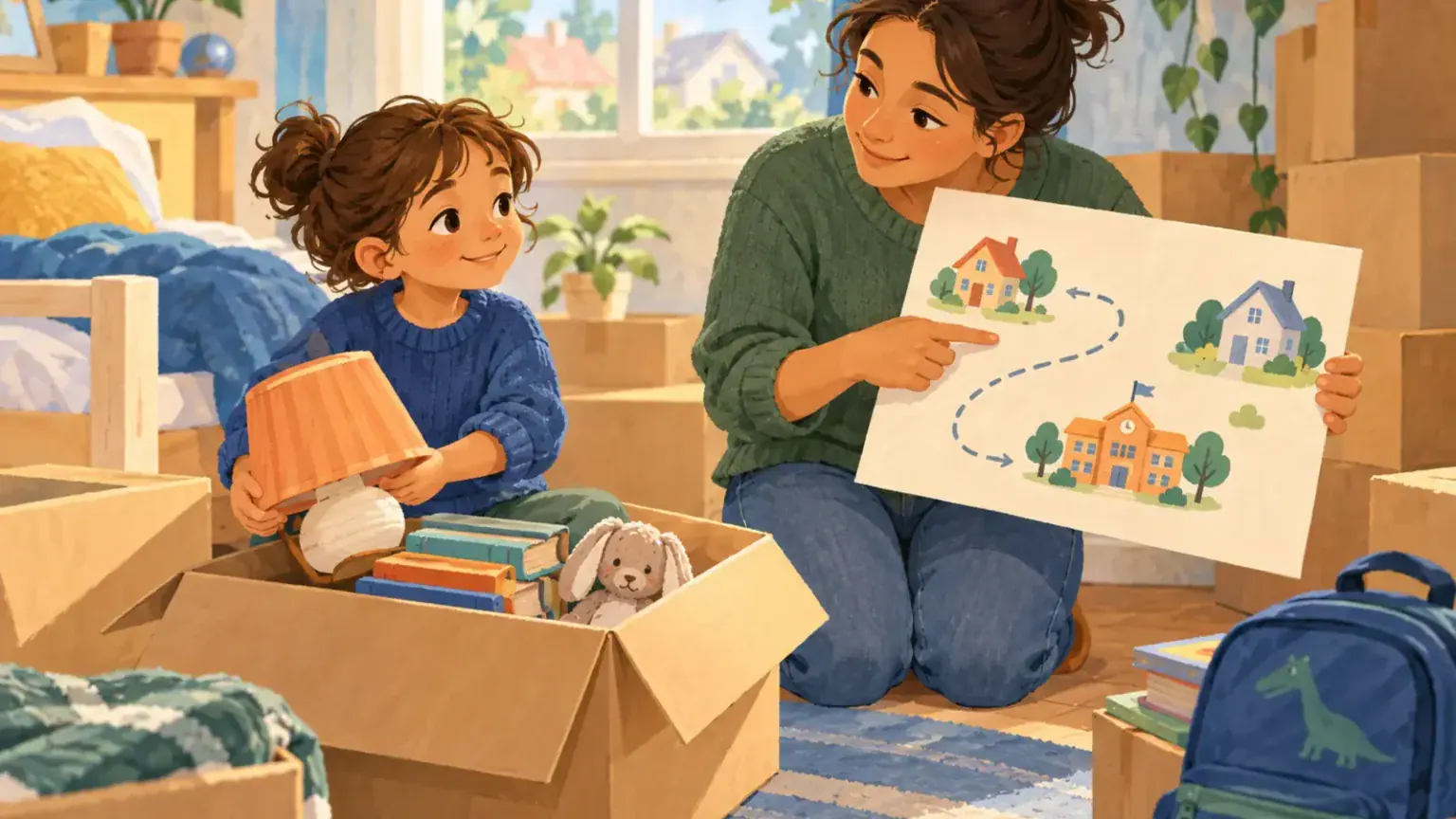
Divide a page into “changing,” “staying” and “not decided.” A young child can use pictures. Include sleep locations, school, transport, pets, friends, grandparents and belongings. This prevents one unknown from making everything feel uncertain.
For children moving between two homes, combine the map with shared bedtime and routine anchors.
Offer choices that are genuinely available
Let a child choose which books travel first, a wall colour from two options or where a familiar lamp sits. Older children can discuss transport and activity priorities. Do not ask them to decide which parent to live with unless a qualified process specifically invites their view. Listening is different from transferring the decision.
Prepare the new place before demanding excitement
Visit if possible or use photographs and a simple route map. Identify the bathroom, sleep space, school journey and where to find the caregiver at night. Pack an arrival box with bedding, medicines, chargers, comfort items, basic food and school clothes.
A child may dislike the new home. Respond to the loss before selling the benefits: “You miss the garden and your neighbour. That makes sense.”
Coordinate with school
If the school stays the same, confirm addresses, collection permissions, transport and emergency contacts. If it changes, arrange record transfer, disability accommodations, medicine plans and a named welcome adult. Tell the child exactly what staff will know.
Use the privacy principles in telling school and health teams about separation. Local admissions and parental-responsibility rules vary, so obtain local advice for disputed decisions.
Protect relationships where safe
Create a realistic plan for contact with the other parent, siblings, friends and relatives. Include travel time and cost. Do not promise weekly visits if the adults cannot sustain them. A predictable short call or monthly visit is safer than repeated cancellation.
When distance grows, the low-pressure ideas in long-distance family connection can be adapted to parents and friends.
Expect behaviour to carry feelings
Young children may regress in sleep or toileting. School-age children may become irritable or clingy. Teens may grieve lost independence and friendships. Keep routines simple and make space for movement, rest and private conversation.
Seek qualified support if distress persists, functioning drops sharply, or the child talks about self-harm. Immediate safety concerns require local emergency help.
Mark the transition without erasing the old home
Take photos, say goodbye to people and places, or make a small memory folder. At the new home, repeat one familiar meal or bedtime ritual. Avoid framing the move as proof that the old family life was false.
A child does not need to love the move immediately. They need accurate information, a voice within safe limits and adults who keep showing how the next day will work.