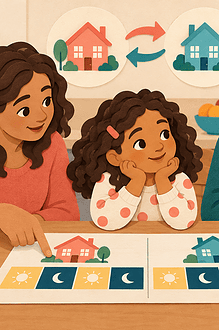
After separation, parents may try to make two households identical or give up because cooperation feels impossible. Children rarely need matching sheets and minute-by-minute schedules. They benefit from a few reliable anchors: when they will eat and sleep, how school items travel, and what happens at a handover.
Choose three shared anchors
Begin with the parts that most affect functioning: a similar bedtime range, regular meals and school attendance. Agree on the child’s usual wake time and enough opportunity for sleep. Keep the sequence recognizable—wash, pyjamas, teeth, story, lights—even if the rooms look different.
The American Academy of Pediatrics notes that inconsistent routines can contribute to sleep problems after separation. It also recognizes that emotional stress may affect sleep. A routine helps, but it should not become a contest over which home is stricter.
Duplicate the small essentials
When possible, keep toothbrushes, basic clothes, chargers, medicines handled according to the child’s care plan, and school supplies in both homes. A young child may benefit from two similar comfort items if the original can be safely duplicated. This reduces the emotional weight of one forgotten bag.
Use a short shared checklist for items that must travel: prescribed medicine, glasses, mobility equipment, school device and a favourite object. Adults—not the child—are responsible for remembering essential items.
Make the handover boring and kind
Confirm time and place through the adult channel. Pack before the transition. Keep greetings and goodbyes warm but brief, and do not discuss money or grievances at the door. A child should not carry messages between homes.
The practical steps in a calm two-home handover can help adults lower the emotional temperature.
Allow a landing period
Some children talk immediately; others need food, movement, a bath or quiet play. Try: “You can settle in. I’m happy to see you.” Do not interview the child about the other home or treat tiredness as evidence that the other parent failed.
For a preschooler, use a picture calendar showing sleep locations. A school-age child can check off the next day. A teen may prefer direct access to the agreed schedule and respectful notice of changes.
Handle different house rules clearly
Homes can differ in meals, chores or screen choices. Explain without criticism: “At this house, devices charge in the kitchen.” Children can learn contextual rules, especially when adults avoid saying that the other home is wrong.
Coordinate essential health, safety and school expectations. When discipline differs, focus on the shared lesson and keep the disagreement private. See co-parent discipline disagreements for a workable conversation structure.
Troubleshoot sleep gently
If a child resists bedtime, ask what is hard: missing the other parent, unfamiliar sounds, fear of forgetting something, or a schedule that does not fit their age. Offer a predictable goodnight ritual and, if appropriate, an agreed brief call that does not delay sleep.
Keep late-night adult conflict out of earshot. Avoid giving melatonin or any sleep product without individual guidance from a qualified clinician. Persistent snoring, breathing pauses, severe anxiety or daytime impairment warrants medical advice.
Review the pattern, not one bad night
Use a simple two-week record of sleep times, wake times and notable difficulties rather than accusations. Consider school workload, illness, developmental changes and travel. Adjust one factor at a time.
If parents cannot communicate safely, use a court-approved or professionally recommended channel and follow local orders. In cases involving abuse or coercive control, ordinary co-parenting advice may be unsafe; seek specialist local support.
A stable routine is not proof that both homes operate the same way. It is a promise that the adults will carry the planning, make transitions understandable and protect the child’s need for rest.