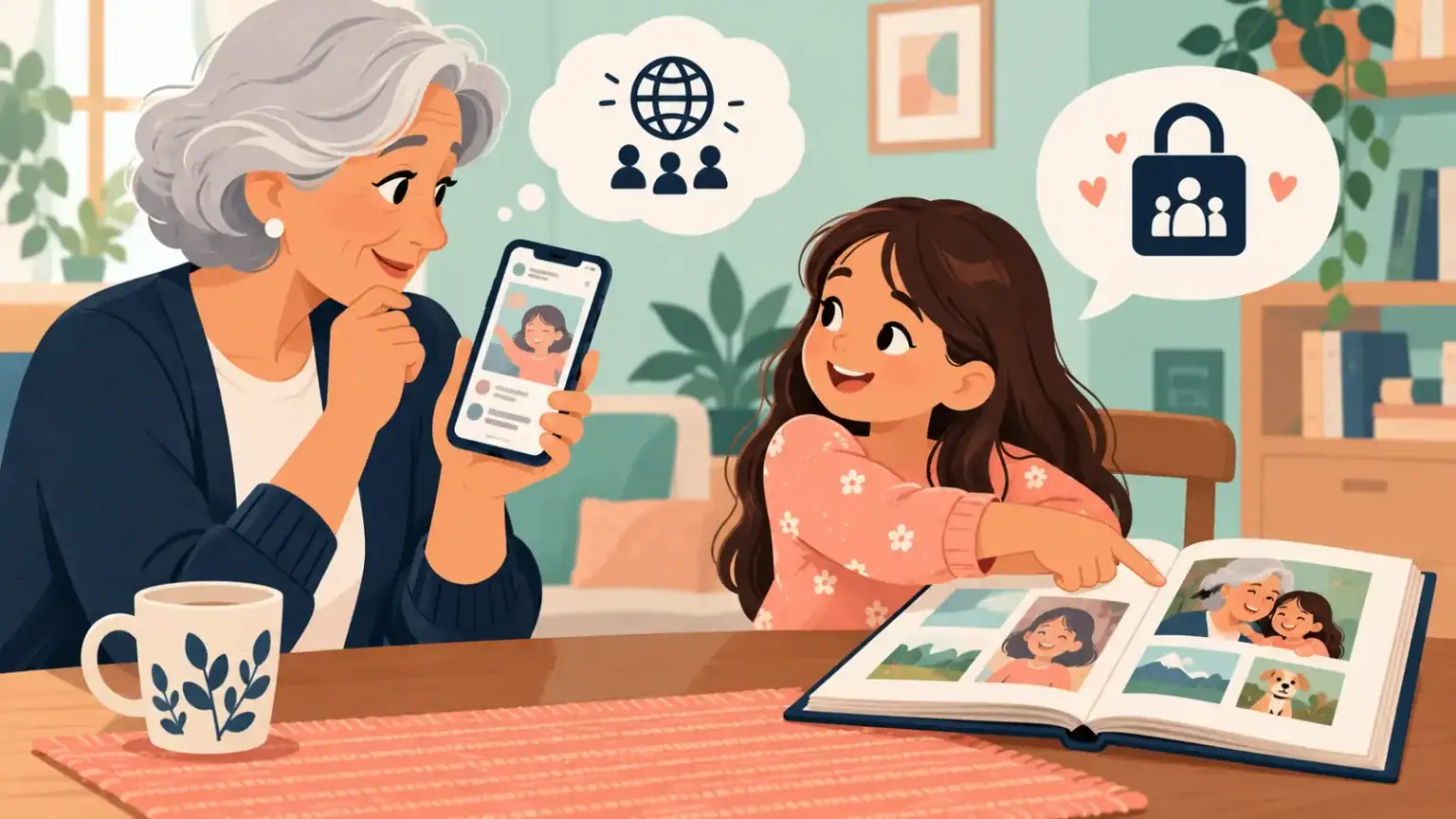
A grandparent may see a photo as a proud family update. A parent or child may see the same post as a permanent record they did not choose. Online sharing can be copied, downloaded, forwarded and viewed outside the audience you imagined. A family agreement before posting prevents hurt and protects the child’s dignity.
Ask the parent every time until a rule is clear
Do not assume that receiving a picture gives permission to publish it. Ask: “May I share this, and where?” A parent may approve a private family chat but not a public social account. Respect a no without asking the child to persuade the parent.
Families can create a standing rule—no face photos, no names, or approval before every post—but revisit it as the child grows and platforms change. Write privacy preferences into a regular care plan if grandparents often take photos.
Include the child in the decision
When a child can understand, show them the exact image and ask whether they want it shared. “Your mother said it is okay, but I want your answer too.” Accept refusal, hesitation and later requests to remove a post. A toddler cannot give meaningful permission, so adults must use extra restraint.
A child who agrees to send a picture to one relative has not agreed to a wider post. Consent is specific. Do not trade access, treats or praise for agreement.
Check what the image reveals
Look beyond the child’s face. A uniform, school badge, street sign, house number, timetable, travel ticket or location tag can reveal routines and places. A certificate may show a full name. A medical image may expose private health information.
Crop or blur identifying details, turn off location metadata where possible and avoid posting in real time from a place the child regularly visits. Privacy settings reduce an audience but do not prevent screenshots or forwarding.
Never post vulnerable moments
Keep bath and toilet images, injuries, meltdowns, punishments, medical crises, nudity and embarrassing stories offline. Do not use a child’s distress for humour or engagement. Ask whether the future teenager would feel respected by the post.
The American Academy of Pediatrics recommends considering a child’s privacy, future feelings and digital footprint before “sharenting.” Its questions are useful for grandparents too: Why am I sharing this? Could it embarrass the child? Is there anyone who should not see it?
Use safer ways to share family joy
- Send a photo directly to a small, agreed family group.
- Share a picture of the craft, cake or landscape rather than the child.
- Create a printed album kept at home.
- Post after the event without naming the location or schedule.
- Tell the story in a private call instead of a public caption.
Even private groups need rules: members should not repost, download or add others without permission.
Coordinate across households
When parents are separated, follow the agreement or legal order that applies. One parent’s approval may not resolve the issue. Do not use social media to signal allegiance or criticize the other household. The child’s privacy is not a tool in adult conflict.
For grandparents supporting a family transition, the neutral approach in supporting a child through parental separation is a helpful companion.
If you posted without permission
Remove the post promptly, including from stories or albums where possible. Ask anyone who reshared it to delete it. Say: “I shared that without checking. I have removed it and will ask next time.” Do not minimize the concern because the post received few views.
Review old albums together and delete material the family no longer wants online. Update account security, use strong unique passwords and enable multi-factor authentication. If an image has been misused or a child is being threatened, preserve necessary evidence and contact the platform and appropriate local authorities.
Grandparent pride does not have to disappear. It can be expressed in ways that let the child keep control of their body, story and identity. Asking first makes the celebration more respectful, not less loving.