Every family carries its own small collection of festivities, rituals, and traditions, often without ever stopping to actually name them. Our Family Traditions turns that quiet, half-noticed collection into something documented, celebrated, and passed on deliberately rather than just absorbed by accident.
What you need
Paper and crayons, or a notebook to build a simple family traditions book over time.
How to play
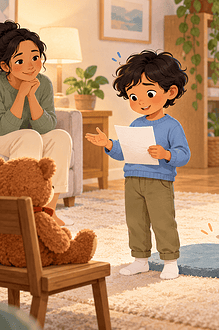
Start with a simple, open conversation: what celebrations or traditions does our family take part in over the course of a year? Let your child list everything they can think of, religious or cultural festivals, birthdays, a particular meal eaten on a certain day, a yearly trip, a smaller, private family ritual nobody outside the house would even know about.
For each tradition your child names, ask them a few follow-up questions: what actually happens during this celebration? What do we eat, wear, or do that’s special for it? Do you know why our family does this, or where it came from? Who taught it to you?
Turn each tradition into a page: your child can draw the celebration, write a short description in their own words, or both. Over time, these pages can build into a simple family traditions book, something to add to each year as new memories and smaller rituals get noticed and recorded.
Extending it: a family wish card
As a lighter, celebratory extension, help your child make a card for an upcoming family celebration or an important day for another family member, writing or drawing their own good wishes. This is a small, low-effort way to actively practise a tradition, rather than only documenting past ones.
Why this is worth doing deliberately
Most traditions get passed down almost invisibly, a child simply grows up doing them without ever being told why, and without ever being asked to put them into words themselves. Asking a child to actually describe and explain a tradition, rather than just participate in it, does real work: it turns something absorbed passively into something understood and, ideally, something they will want to pass on themselves one day.
This is also a genuinely good activity for a family that blends more than one cultural or religious background, since it gives space to name and celebrate traditions from each side explicitly, rather than letting one quietly become the default and the other fade into the background unnamed.
A family’s traditions rarely get written down anywhere, they simply live in what everyone does each year, more felt than discussed. A simple book of drawings and a child’s own descriptions, built up a page at a time, turns something that usually just happens into something a family can actually look back on, and hand down, on purpose.