A hand dryer, school bell or crowded café may feel painfully intense to a noise-sensitive child even when other people cope easily. In other settings, sound may be loud enough to risk anyone’s hearing. The response should match the problem: reduce distress and improve access in everyday environments, and use proper hearing protection for genuinely hazardous noise.
Map sounds and responses
Record the sound, distance, duration, predictability and the child’s response. Is sudden noise harder than steady noise? Can the child cope when they control the sound? Do they also struggle to understand speech in background noise, report ringing, or have ear pain?
Observe across home, school and community settings. A child may hold it together at school and collapse afterwards. Do not test tolerance by creating surprise noises.
Make ordinary environments more predictable
- Warn before vacuuming, blending, flushing or using a hand dryer.
- Choose a seat near an exit and away from speakers.
- Visit shops or venues at quieter times.
- Offer a break signal and a place with lower sound.
- Pair spoken instructions with visual information when background noise makes listening hard.
Give the child some control: they can press the start button, count down, or step outside before a predictable sound. Control can reduce uncertainty, but never force participation to prove the sound is safe.
Use hearing protection for the right job
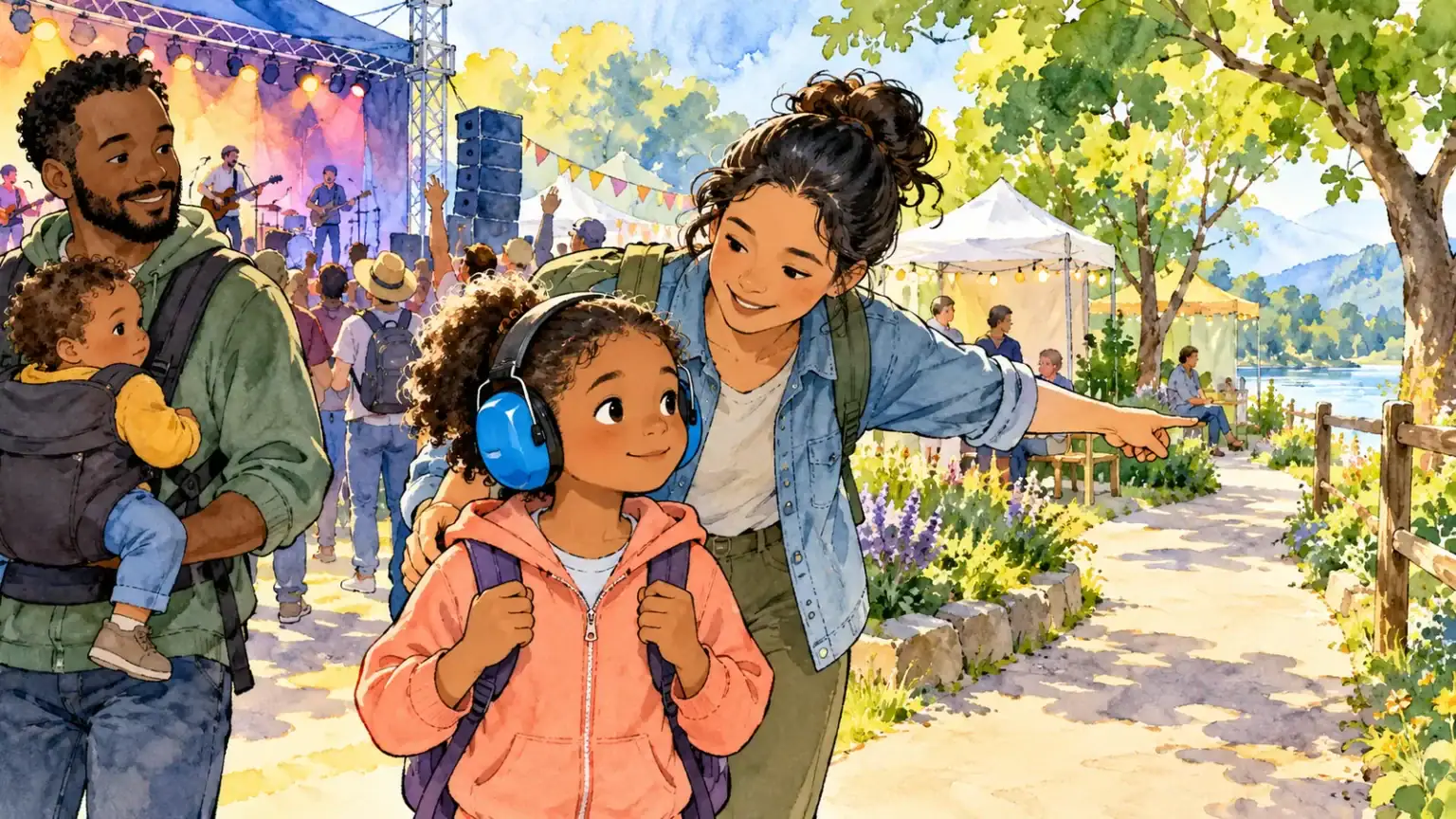
For concerts, fireworks, power tools and other loud activities, correctly fitted protective earmuffs or earplugs can reduce hearing risk. The US National Institute on Deafness and Other Communication Disorders notes that protective earmuffs are often easier for young children because they cover the ears and come in child sizes.
For ordinary safe sounds, some children benefit from short, planned use of earmuffs while entering a difficult setting or recovering. Continuous use everywhere may reduce communication access and can make it harder to learn which environments are manageable. An audiologist or occupational therapist can help build an individualized plan when families are unsure. Never use music headphones as a substitute for certified hearing protection in hazardous noise.
Plan school access
Identify predictable hotspots: assemblies, dining hall, toilets, music, drills and transitions. The plan might include advance warning, a quieter route, seating choice, visual instructions, permission to leave, and hearing protection for specific events. Emergency drills still require a safety plan; the child must be able to receive essential instructions.
Teach a brief self-advocacy phrase or signal: “Too loud—break,” or “Please write it.” Staff should respond before distress becomes a crisis rather than requiring the child to remain until they are overwhelmed.
When to seek assessment
Arrange a hearing and health review for new or one-sided sensitivity, ear pain, discharge, dizziness, ringing, headaches, sudden change, speech or language concerns, or difficulty understanding speech in noise. Urgent care is needed after acoustic trauma with sudden hearing loss or severe symptoms.
Noise sensitivity can accompany many conditions or occur without a diagnosis. An online list cannot determine the cause. Ask professionals to assess the functional pattern rather than dismissing the child because a basic hearing screen is normal.
Protect the child’s social participation as well as their ears. Friends can learn to choose a quieter table, warn before a balloon pops or step outside together. Do not make the child sit alone as the price of accommodation. For older children, agree on discreet signals and let them control when safe, limited protection is used. Review whether supports preserve conversation, safety instructions and enjoyment rather than measuring success only by staying in the noisy place.
Related EdCaptain guides cover sensory overload recovery, auditory processing concerns and hearing and speech development.