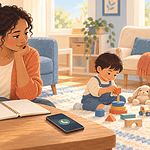
A child who turns towards the vacuum cleaner can still have difficulty hearing parts of speech. Hearing is not all-or-nothing, and it can change after a baby passes newborn screening. That is why hearing belongs in the conversation when speech, understanding or attention to sound seems different.
Patterns worth noticing
- not turning consistently towards voices or familiar sounds;
- watching faces closely but missing words when the speaker turns away;
- responding better in a quiet room than in background noise;
- frequently asking for repetition or increasing device volume;
- speech that is unclear or vocabulary that is not expanding;
- recurrent ear infections, ear pain or discharge;
- progress that seems to stall or a response to sound that changes.
Any one behaviour can have several explanations. The aim is not to diagnose hearing loss at home, but to describe the pattern clearly.
Why clapping behind a child is not a hearing test
A child may notice vibration, movement or a low-frequency sound and still miss quieter speech sounds. They may also predict a familiar routine. Phone apps and whispered-word games cannot replace age-appropriate testing by an audiology professional.
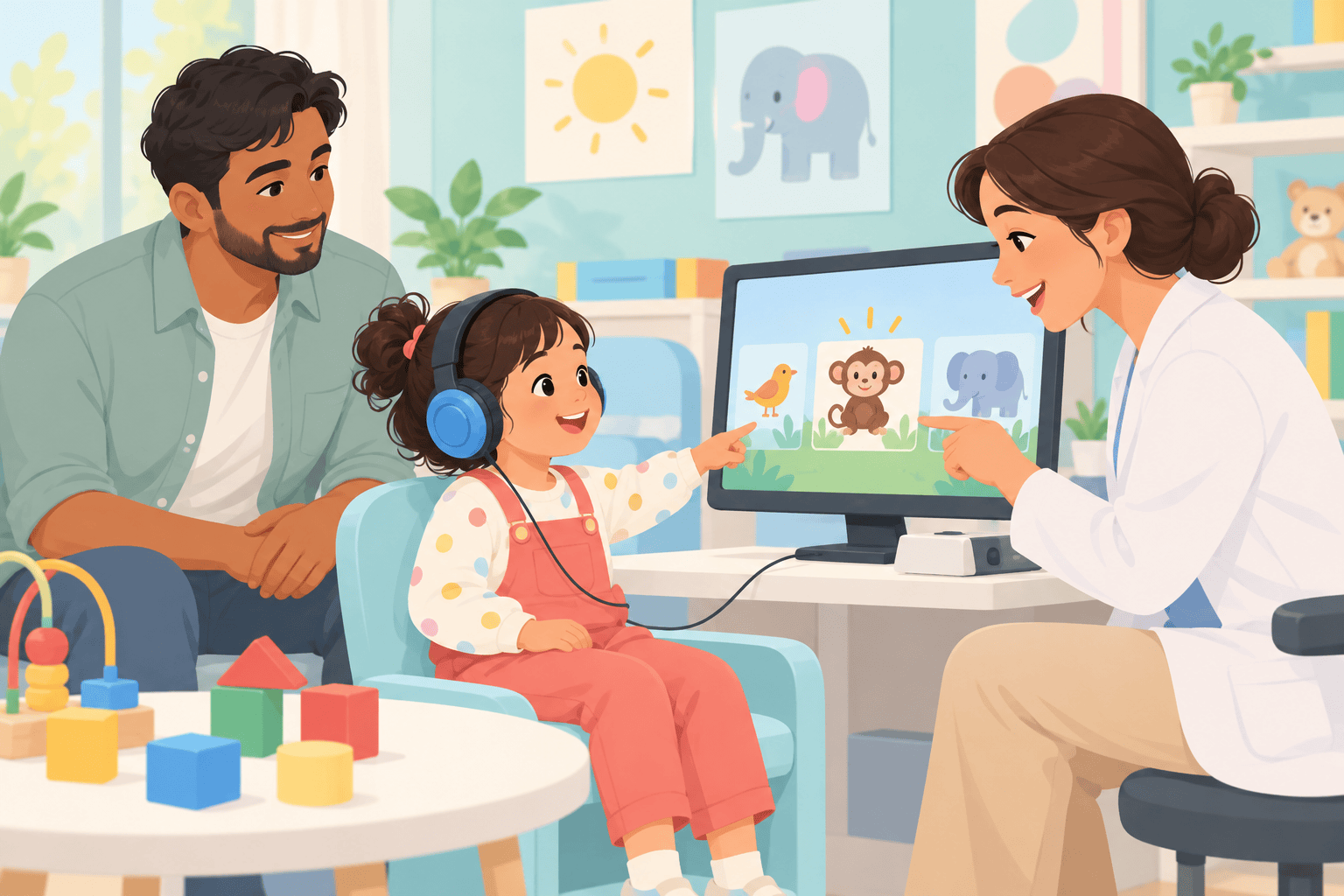
The NIDCD notes that a hearing test is often included when speech and language concerns are evaluated. Depending on age and ability, assessment may look like a game, use headphones or measure the ear’s response without asking a young child to explain what they hear.
Prepare for the appointment
Write down when responses are easiest and hardest. Include ear infections, family hearing history, newborn-screening information, languages used at home and examples from childcare or school. Ask whether both hearing and speech-language development should be assessed.
Keep communication accessible now
Get your child’s attention before speaking, face them, reduce competing noise and use gestures or pictures when helpful. Repeat the meaning naturally rather than demanding that the child prove they heard. Do not stop using your home language.
Seek prompt medical care for sudden hearing loss, severe ear pain with serious illness, discharge after injury, new balance problems or other acute symptoms. For everyday communication, see how to make requests easier to follow and how to notice feelings without guessing.