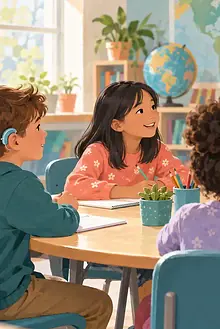
Group conversation moves quickly. A joke starts on one side, two people speak together, and everyone laughs before a deaf or hard-of-hearing child has located the speaker. The barrier is not a lack of interest or friendship skill. Often, the conversation itself has not been made accessible.
The most helpful change is direct peer communication. Adults can teach and model inclusive habits, but they should not become the permanent interpreter of every friendship.
Ask the child what access looks like
Some children use sign language, some spoken language, some captions or hearing technology, and many combine tools. Preferences may change by setting. Ask concrete questions: “Where can you see everyone?” “Would you like me to explain your microphone, or would you rather?” “What should friends do if you miss something?”
Do not assume a device makes every voice clear. Do not assume all deaf children want the same communication method. Choose Communication That Gives Your Child Full Access offers a family-centred way to consider options.
Set up the space for conversation
Small changes can keep the child inside the social flow:
- Choose a circle or curved arrangement rather than a long row.
- Keep faces visible and avoid strong light behind speakers.
- Turn down music during meals, games, or planning.
- Use names, a wave, or another agreed cue when the speaker changes.
- Pause side conversations during important group talk.
- Caption shared videos and make group chats accessible.
At a playdate, one or two friends may offer better connection than a crowded party. That is not a rule to keep groups small forever; it is a way to learn which conditions help this child participate.
Teach peers simple repair, not pity
Peers can learn that communication breakdowns are ordinary and fixable. Useful responses include “I said…,” “Let me face you,” “Sam is talking now,” or typing a key word. “Never mind” closes the door. Shouting can distort speech and feels uncomfortable; repeating clearly or rephrasing is better.
Explain only what the child has agreed to share. A short message is enough: “Make sure Maya can see who is talking. If she asks again, repeat the whole idea.” Then return attention to the game, not the disability.
Practise joining and staying in the conversation
Role-play low-pressure scripts with the child:
- Joining: “What are you talking about?” or “Can you catch me up?”
- Repairing: “I missed who you meant,” or “Say that again while facing me.”
- Changing the setting: “Can we turn the music down?”
- Checking a joke: “I caught the last part—what was the setup?”
For a young child, a tap, picture, sign, or pointing to the speaker can serve the same purpose. Praise effective repair, not silent guessing. If the child is tired, respect the choice to step away.
Build friendship around shared interests
Access matters, and so does having something enjoyable to do together. Cooking, building, drawing, gaming, sport, or collecting can reduce the pressure of continuous talk and give communication a clear context. Let the children lead. Adults can be nearby without narrating every exchange.
If exclusion or bullying is occurring, do not frame the problem as the deaf child needing more social skills. Document what happened, make communication and anti-bullying expectations explicit, and involve school staff. Support Real Friendship and Community Belonging includes broadly useful signs of reciprocal friendship.
Put direct peer access into the school plan
In the United States, IDEA requires IEP teams to consider direct communication with peers and professionals in the child’s language and communication mode. Elsewhere, use the local framework but keep the same practical question: can the child communicate directly during lessons, lunch, clubs, transport, and unstructured time?
Ask the school to observe participation, not only whether the child was physically present. Build an Inclusive School Plan for a Deaf or Hard-of-Hearing Child can help turn that observation into specific supports.
Friendship should not depend on perfect hearing, perfect speech, or an adult standing between children. When peers know how to share the floor, repair a missed message, and use the child’s preferred communication, connection has room to grow.