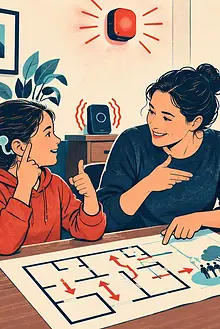
A child with hearing loss in one ear can seem to hear perfectly in one moment and miss important information in the next. That is not inconsistency or inattention. One ear may give good access in a quiet, close conversation, while distance, background noise, several speakers, or a voice from the affected side makes the same words much harder to locate and understand.
The useful goal is not to make the child “try harder.” It is to make spoken and visual information easier to reach, then teach the child how to ask for access in ways that fit their age.
Notice situations, not just test results
Keep a short, neutral record for a week. Note where communication worked and where it broke down: the car, dinner table, playground, assembly, group work, or a noisy shop. Include where the speaker stood and what helped. Patterns are more useful than labels such as “didn’t listen.”
- Does the child turn one side toward a speaker?
- Do they miss the first instruction but follow after seeing other children move?
- Are group conversations, jokes, or names called from across a room harder?
- Do they become tired or irritable after noisy activities?
Share those observations with the child’s audiologist and school team. If hearing seems to change suddenly, or the child has pain, drainage, dizziness, or new balance difficulty, seek medical advice promptly rather than assuming it is part of the known hearing difference.
Arrange access without isolating the child
At home, gain attention before speaking, keep your face visible, and reduce competing sound when the message matters. In a car, pause music and avoid giving complicated instructions while facing away. At a table, ask the child where they hear and see everyone best instead of assigning one permanent “special seat.”
In school, seating should follow the task. A position that works for teacher talk may not work for a circle or partner activity. The child may need the better-hearing ear toward the main speaker, a clear view of faces and visual materials, and distance reduced. A remote microphone or other technology may help some children, but it should be considered with audiology input and never replace accessible communication.
For a broader technology routine, see Support Hearing Technology Without Losing Communication. For assessment questions, use What Happens in a Child Hearing Assessment?.
Make group talk visible and predictable
One-sided hearing loss can make it difficult to tell who spoke, especially when voices overlap. Family and classroom habits can help everyone:
- Use names or a small gesture before changing speakers.
- Keep one person speaking at a time during important discussion.
- Repeat a peer’s comment from the front when it was missed.
- Put instructions, new vocabulary, dates, and homework in writing.
- Check understanding with “What is the plan?” rather than “Did you hear me?”
Do not require the child to sit apart from friends to obtain access. Adjust the arrangement, acoustics, visual information, or technology so participation and belonging stay together.
Teach brief self-advocacy scripts
Young children can use a gesture, picture, or phrase such as “Face me, please.” Older children might say, “I heard the first part; repeat what you said after lunch,” or “Can I move so my right ear is toward the group?” Practise when everyone is calm. The aim is a repair tool, not responsibility for fixing inaccessible environments alone.
Include these needs in the child’s education plan. The United States IDEA rules specifically require teams to consider a deaf or hard-of-hearing child’s language and communication needs and direct communication with peers and professionals; other countries have their own frameworks. Build an Inclusive School Plan for a Deaf or Hard-of-Hearing Child offers a fuller checklist.
Review the plan as demands change
A support that works in a small primary classroom may fail in a large secondary room, laboratory, sports field, or online lesson. Review access after timetable changes, new technology, hearing changes, or signs of fatigue. Ask the child privately what helps and what feels awkward. Their answer should shape the plan.
One reliable ear is valuable, but it does not erase the work of locating sound and separating speech from noise. Clear routines, flexible positioning, visual information, and respectful self-advocacy can reduce that work while leaving the child fully part of the group.