Hearing aids, cochlear implants and remote microphones can improve access, but they are not a test of effort or identity. Devices need professional fitting, regular review and everyday care. They also have limits: distance, background noise, poor fit, fatigue and technical problems can reduce access. A good family routine supports technology without making the child responsible for pretending it always helps.
Create a two-minute morning check
Keep devices, charger, batteries and cleaning tools in one dry, child-safe place. Follow the manufacturer’s and audiologist’s instructions. Check that the correct device is present, the casing and earmold or coil look intact, and the power source is ready. For hearing aids, a listening check or approved test tool may be recommended; ask the audiologist to demonstrate exactly what your family should do.
Look for redness, pressure marks, feedback, loose earmolds or a child repeatedly removing the device. Young ears grow, and fit can change. Do not alter programming, tubing or parts unless the audiology team has trained you to do so. Contact them if sound seems distorted, feedback persists, the device is damaged, or benefit changes suddenly.
Let the child’s experience count
Teach useful ways to report “too loud,” “not working,” “hurts,” “sounds different,” “I need a break” and “use my other communication.” Accept reports without assuming avoidance. A child may need different support in a quiet bedroom than in a cafeteria.
Older children can gradually take on tasks—placing devices, checking a battery indicator, packing the case or telling a teacher about a problem. Independence should be scaffolded, not imposed. If a child is not ready to handle tiny parts safely, an adult remains responsible.
Plan for water, sleep and small batteries
Most devices need specific protection from water and moisture. Confirm what is safe for the exact model. Store devices as instructed during bathing, swimming or sleep, and use an approved drying system if recommended. Button batteries can cause severe injury if swallowed or inserted into the ear or nose; keep them locked away, use tamper-resistant doors where appropriate and seek emergency help immediately for suspected ingestion.
Use remote microphones well
A remote microphone sends a speaker’s voice closer to the child’s device and can improve access over distance or in noise. It does not replace clear teaching or visual access. Agree who wears it, when it is muted, how privacy is protected and what happens in group discussion. Teachers should repeat peer comments or pass the microphone safely rather than transmitting only the adult voice.
At school, name a responsible adult for a quick daily check and a clear troubleshooting pathway. Keep a labeled backup kit. Include captions, written instructions, an interpreter or other communication access as needed even when devices are working. Our guide to assistive technology for learning explains why access tools should sit alongside good teaching.
Keep backup communication ready
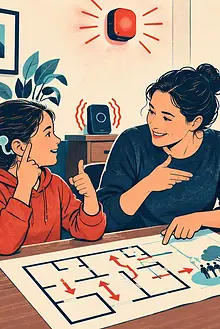
A flat battery, lost processor or repair should not cut a child off from family, education or urgent information. Maintain the signs, captions, text, pictures or AAC the child uses. Tell temporary staff how to communicate. Add visual alarms and emergency instructions where needed.
In noisy places, reduce distance, face the child, improve lighting and take turns. Do not shout; louder is not always clearer and may be uncomfortable. For sound sensitivity or overload, see Noise Sensitivity: Support Comfort and Protect Hearing.
Schedule review before problems grow
Keep audiology follow-ups even when everything seems fine. Pediatric fittings need verification and validation as a child grows and listening demands change. Bring observations from home and school: wear time, difficult settings, comfort, language access and the child’s own feedback. Ask how to recognize a blocked earmold, weak battery or need for repair, and who to contact outside routine hours.
Measure success broadly. Useful technology may help a child follow class, enjoy music, hear a sibling or notice an alarm. It may also be tiring, imperfect or unwanted at times. The aim is reliable access and agency—not maximum wearing time at any cost. When children can report their experience and always have another way to communicate, device routines become safer and more sustainable.