A hearing screening is a quick check that shows whether a child needs more testing. It does not diagnose the type or degree of hearing difference. A full audiology assessment brings together several age-appropriate tests, the child’s history and observations across settings. The tests are generally painless, and there is no answer your child needs to practise in advance.
Before the appointment
Write a short timeline: newborn screening results, ear infections, illnesses, family hearing history, medicines, previous tests, speech and language concerns, and situations in which listening seems easier or harder. Include what nursery or school has noticed. Bring hearing devices if the child already uses them, plus spare parts or a charger.
Tell the clinic about communication, sensory or mobility needs. Ask how long the visit may take and whether the child should be asleep for a particular test. Some infant tests work best during natural sleep; follow the clinic’s instructions rather than changing sleep or food routines on your own.
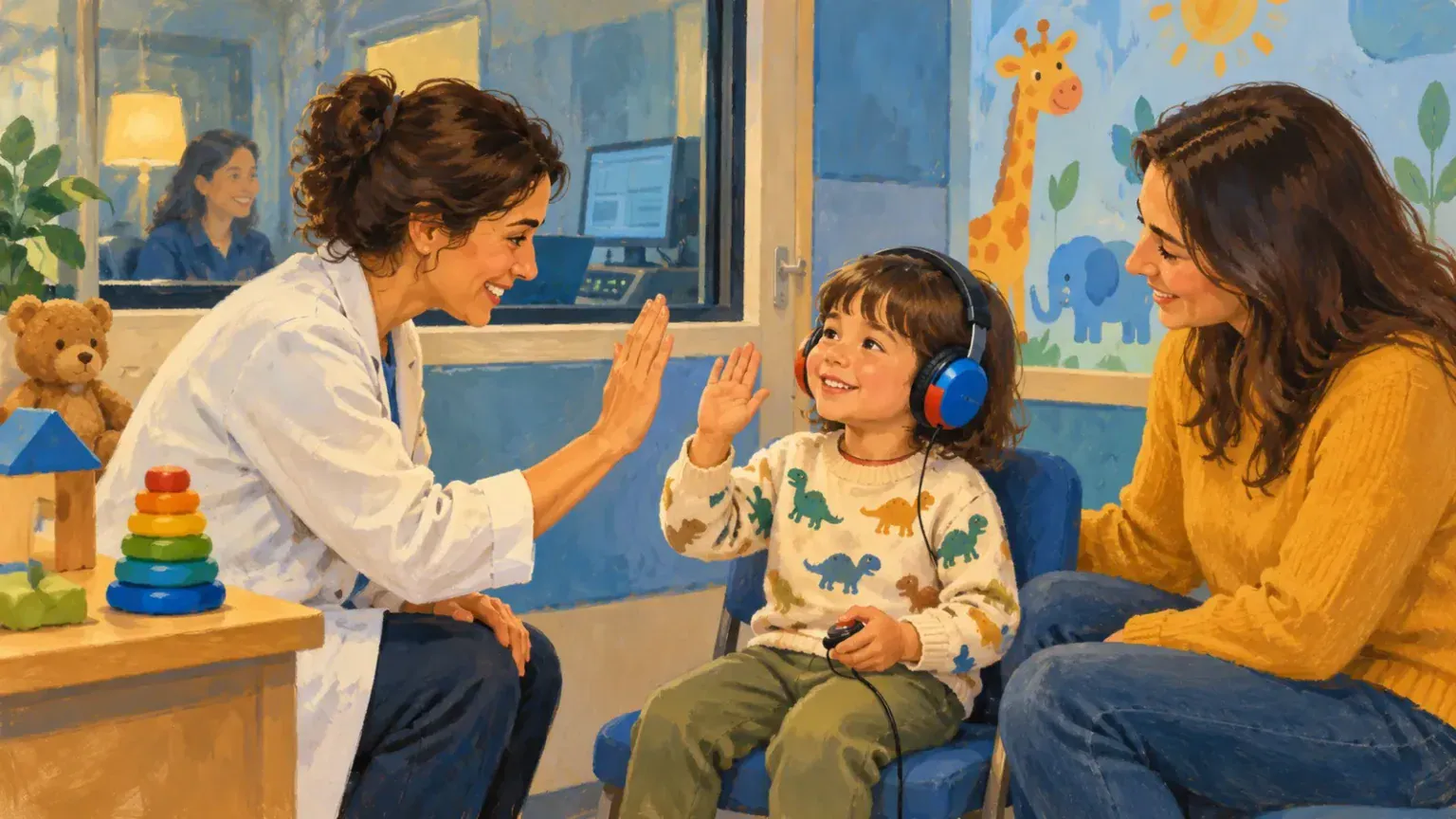
Explain the visit simply: “We are going to meet someone who checks how ears and listening work. You might hear beeps, watch toys or wear headphones.” Avoid drilling the child to raise a hand at every sound. The audiologist needs to see natural, reliable responses.
Tests for the ear and hearing pathway
The audiologist may look into the ear canal with a light. Tympanometry uses a soft tip to change pressure briefly and checks how the eardrum and middle ear move. It can help identify fluid or other middle-ear issues. Otoacoustic emissions, or OAE, use a small earpiece to measure responses produced by the inner ear. The child does not need to press a button.
An auditory brainstem response, or ABR, records how the hearing nerve and brain pathways respond to sound through small sensors placed on the head. Babies may sleep naturally; some children need a different plan depending on age and service protocols. Ask the clinical team to explain benefits, risks and alternatives if sedation is proposed.
Listening tests change with age
For babies, the audiologist may watch for a consistent response or use visual reinforcement: a sound is followed by an animated toy or picture when the baby turns correctly. Preschoolers often use conditioned play, such as placing a block in a bucket when they hear a sound. Older children may press a button or raise a hand. Speech testing can explore the quietest speech a child detects and how clearly they recognize words at different levels.
Results may be shown on an audiogram. It maps the quietest sounds detected at different pitches for each ear. Ask the audiologist to translate the graph into daily life: Which speech sounds may be hard to access? What happens in noise or at a distance? Are results different between ears? How certain are they?
If the results are incomplete
Young children may tire, lose interest or need more than one visit. An incomplete test does not mean the child failed. The audiologist may repeat a test, use another method or compare results across measures. If a child passes a screening but you or school still notice a concern, ask whether a full assessment or monitoring is appropriate; some hearing differences develop or change over time.
The CDC recommends prompt full evaluation after a child does not pass screening. Newborn programmes often use benchmarks for screening by one month, diagnostic evaluation by three months and early intervention by six months, although local pathways vary. If you have concerns, do not wait for a scheduled school screen.
Questions to ask before you leave
- What do the results show for each ear, and how confident are you?
- Is the hearing difference temporary, permanent or not yet clear?
- Does the child need medical review, another audiology test or monitoring?
- What communication and educational supports can begin now?
- When should we return, and what changes should prompt earlier contact?
- Can we have the report in plain language for school and other clinicians?
Hearing assessment is separate from an auditory-processing evaluation. If listening is difficult despite typical peripheral hearing results, our article on auditory processing concerns explains careful next steps. For broader developmental appointments, see how to prepare without overwhelming your child.
The purpose of testing is not to prove how well a child performs in a booth. It is to understand access to sound and communication, identify any health follow-up and connect the child with timely support that fits their family and language needs.