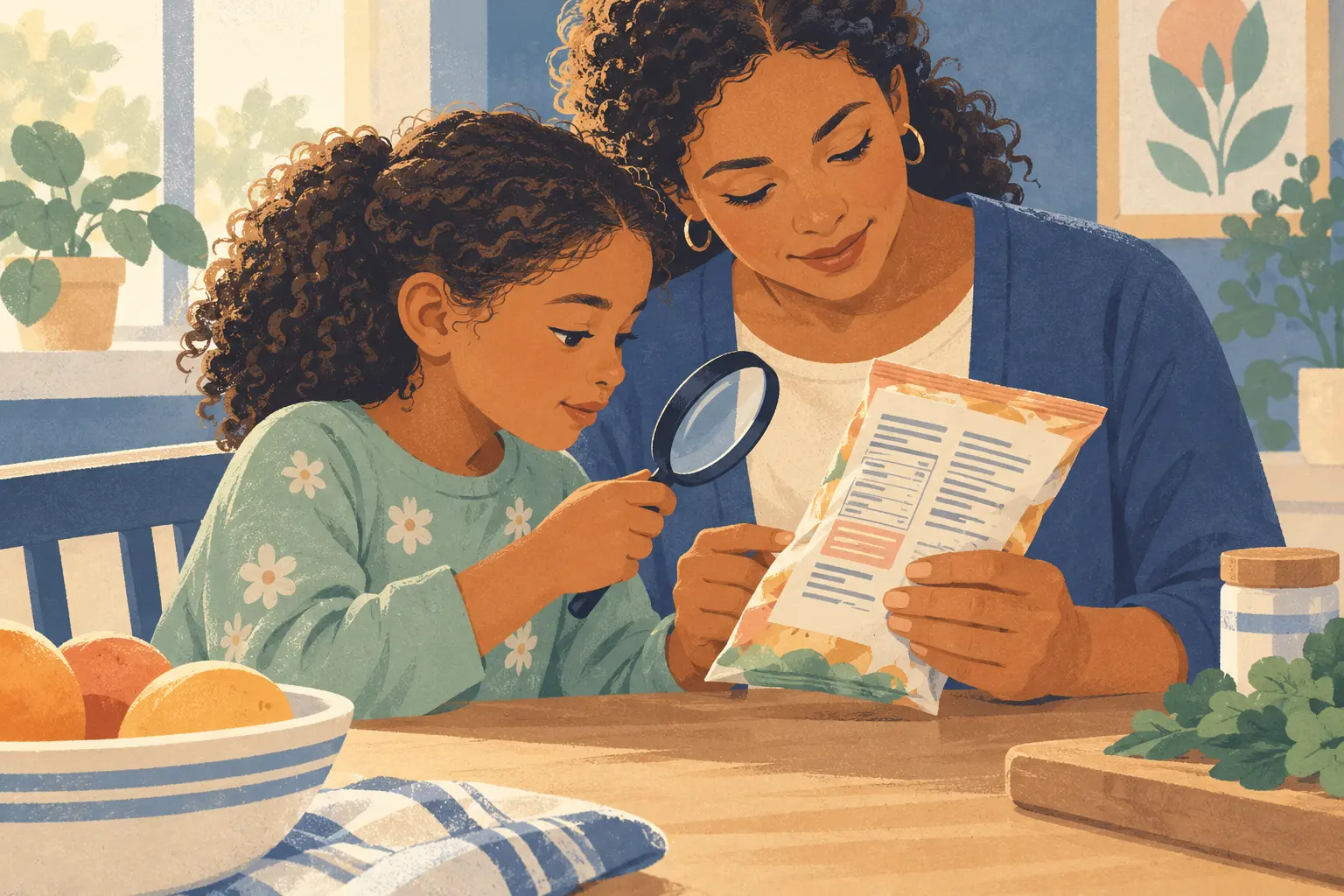
A child with a diagnosed food allergy can learn where to look on a package, but label reading is not a test of independence. Formulas change, rules differ by country and serious reactions can happen. The safe goal is for a child to recognise the label areas, name uncertainty and bring the package to a responsible adult.
Use only sealed practice packages
Choose two or three packages that are not about to be eaten. Cover any identifying family information. Include one clearly labelled example and, if available, one unfamiliar package. Do not bring an allergen into the home or classroom for the sake of the activity.
In the United States, FDA guidance explains that major allergens may be identified within the ingredient list or in a nearby “Contains” statement. It also stresses reading the full ingredient information every time because products can change. Other countries use different legal lists and wording, so local guidance takes priority.
Teach a three-stop scan
- Product identity. Check the exact flavour, size and variety. Similar-looking packages may not have the same ingredients.
- Ingredient list and Contains statement. Find both areas. A Contains statement does not replace reading the full list.
- Advisory and contact information. Notice phrases such as “may contain” or shared-facility wording, then stop and ask the responsible adult what the family’s allergy plan says.
Practise the safest sentence
Give the child a phrase they can use anywhere: “I have a food allergy. I need my adult to check this label before I eat it.” Older children can add the allergen name if they are comfortable. The strongest skill is not memorising every ingredient; it is refusing to guess.
Use a traffic-light worksheet carefully
Instead of labelling foods permanently safe or unsafe, label the decision: red means the known allergen is listed or the plan says no; amber means unclear, incomplete, unlabelled or needs an adult check; green means a responsible adult has checked this exact package now and it fits the child’s plan. A product is never “green forever.”
Important limits
- This activity is for an allergy already assessed by a qualified clinician, not for diagnosing one.
- Never test a suspected food by eating a small amount.
- Restaurants, bakeries and unpackaged foods require different questions.
- Follow the child’s written emergency plan and keep prescribed emergency medicine accessible.
If symptoms of a severe allergic reaction occur, follow the emergency plan and seek emergency help immediately. Continue with planning safer playdates and parties, a neutral Nutrition Facts comparison, and planning a school lunch.
Practise away from a real eating decision
Use an empty, clean package that is already known to be safe for the child, or a fictional label you create for practice. That removes the pressure of deciding whether a hungry child can eat something. Ask the child to locate the ingredient list and any “Contains” statement, then compare the wording with the exact allergen in the family’s care plan. Explain that recipes and manufacturing can change, so a familiar brand still needs a fresh check each time it is bought or served.
Keep adult responsibility explicit. A child can notice and speak up—“I cannot confirm this is safe”—but an adult checks the complete label, cross-contact information and the family’s medical plan. Do not use tasting as a test, and do not rely on package colour, front-of-pack claims or another child’s experience. If a label is missing, damaged, unclear or in an unfamiliar language, set the food aside until a responsible adult can verify it. For a diagnosed allergy, follow the clinician-provided emergency plan and seek emergency help for possible severe reactions.