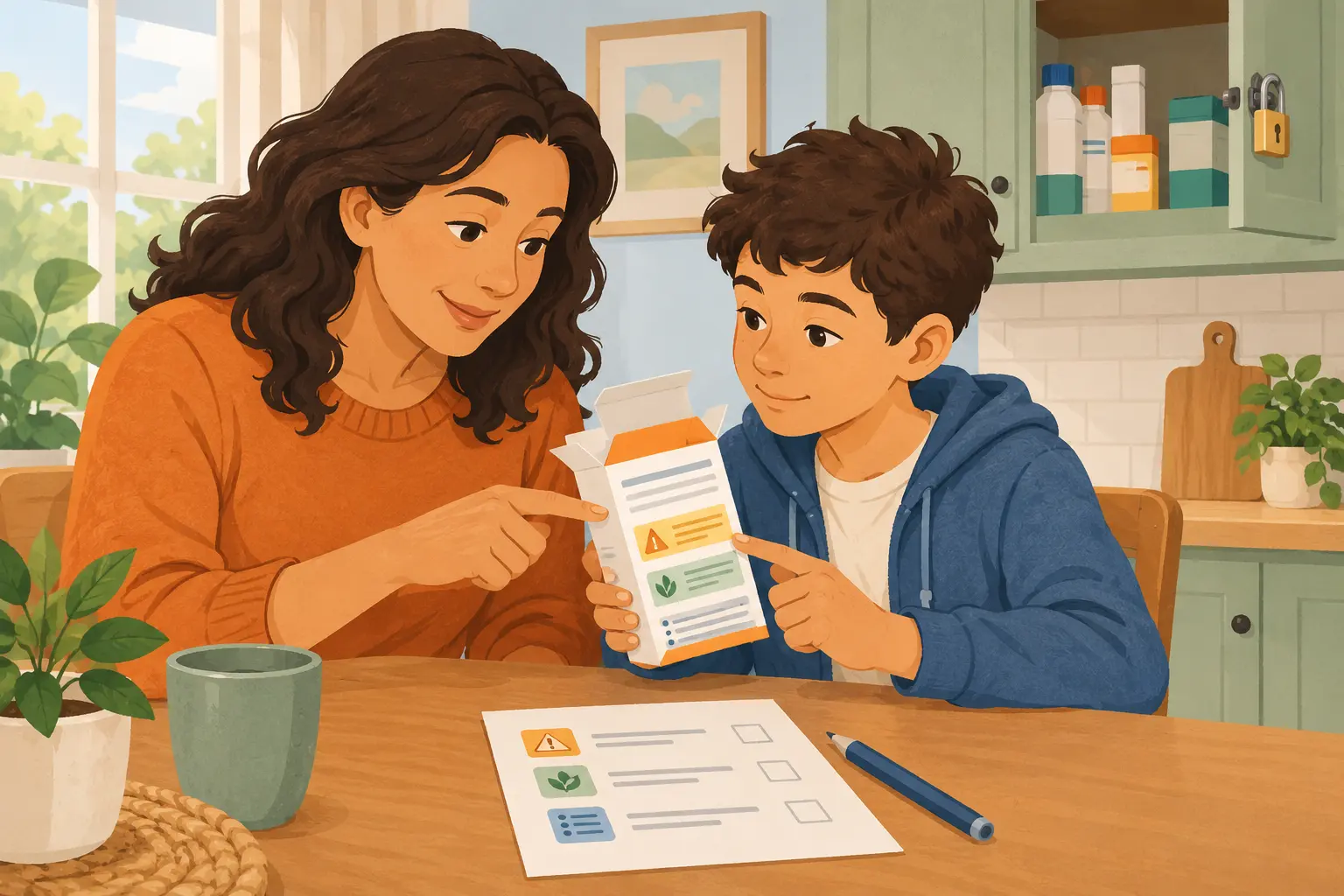
Medicine labels are worth learning to navigate, but a child should not choose, measure or take medicine as part of a lesson. This activity is a tour of the printed information only. Use an empty carton, a clear photograph or a package kept in the adult’s hands. The most important message is: recognising the sections helps you ask better questions; it does not make you the prescriber.
Why the label has a fixed order
The US Food and Drug Administration requires over-the-counter Drug Facts labels to present key information in a standard order. Sections include active ingredient, purpose, uses, warnings, directions and inactive ingredients. Brand names can look similar even when active ingredients differ, so the front of the box is not enough.
Set up safely
- Use an empty, clean package or a printed label image.
- Keep all real medicines locked or stored out of children’s sight and reach.
- Do not open a bottle, handle tablets or pour liquid.
- Have a sheet with the six section headings.
Run the label tour
- Find the active ingredient. Explain that this is the substance responsible for the intended effect. Two products can share an ingredient even if their brand names differ.
- Connect purpose and uses. Purpose describes the ingredient’s type of action; uses describe symptoms or conditions on the label.
- Spend time on warnings. Look for when not to use the product, when to ask a clinician, possible interactions, when to stop, and the reminder to keep it away from children.
- Locate directions without following them. Directions contain dose and timing information, but the child does not calculate or rehearse a dose.
- Find inactive ingredients. These may matter for allergies or sensitivities, and uncertainty belongs with a pharmacist or clinician.
Play “same shelf, different label”
Show photographs of two products intended for a similar symptom. Ask only observation questions: Are the active ingredients the same? Are the age ranges the same? Where do the warnings differ? Do not ask which product the child would take. This reveals why families read every label rather than relying on package colour or a familiar brand.
Teach three stop-and-ask moments
- The label does not clearly cover the child’s age.
- Two products may contain the same active ingredient.
- The child takes another medicine, has an allergy or health condition, or the warning is unclear.
In any of these situations, a responsible adult should ask a pharmacist or qualified clinician. Never use an adult medicine dose for a child unless a clinician specifically directs it. Never call medicine candy, and never use a kitchen spoon to measure liquid medicine.
Close with storage, not consumption
Ask the child to point to the child-safety warning and describe who controls medicines at home. Adults should store products securely and keep them in original labelled containers. Dispose of unused medicine using local pharmacy or government guidance.
For related skills, read preventing medicine mistakes and measuring liquid medicine safely, practising allergy-label reading, and deciding when an adult must take over.
Try one observation round
Give the child an empty carton or a clear photograph of a Drug Facts label while all medicines remain secured by an adult. Ask only observation questions: Where are the active ingredients? Which section explains uses? Where do warnings appear? Can you find the directions heading without reading a dose aloud? Finish by locating the inactive ingredients and the storage information. The child’s job is to navigate the label, not to decide whether the medicine is suitable.
Use a repeatable safety phrase: “Labels give information; an adult and a health professional make medicine decisions.” Even two products with similar front labels may contain different ingredients or strengths, and some products contain more than one active ingredient. Children should never combine products, calculate a dose, use a kitchen spoon, or take medicine without the responsible adult. If a medicine may have been taken incorrectly, contact local poison-control or emergency services promptly rather than waiting for symptoms.