Buying used can save money and keep a useful item in circulation. It also removes the certainty of a sealed package, complete instructions and a known history. Before paying, identify the exact product, check official recalls and decide whether wear, missing parts or changed standards make this a poor item to buy second-hand.
- Get the identity before the story
- Read the official remedy
- Inspect every load-bearing and moving part
- Treat some categories with extra caution
- Check for missing information
- Look through a child-safety lens
- Protect privacy in connected products
- Make the handover traceable
- Know when to walk away
- Consider whether hygiene can be restored
- Sources and further reading
Get the identity before the story
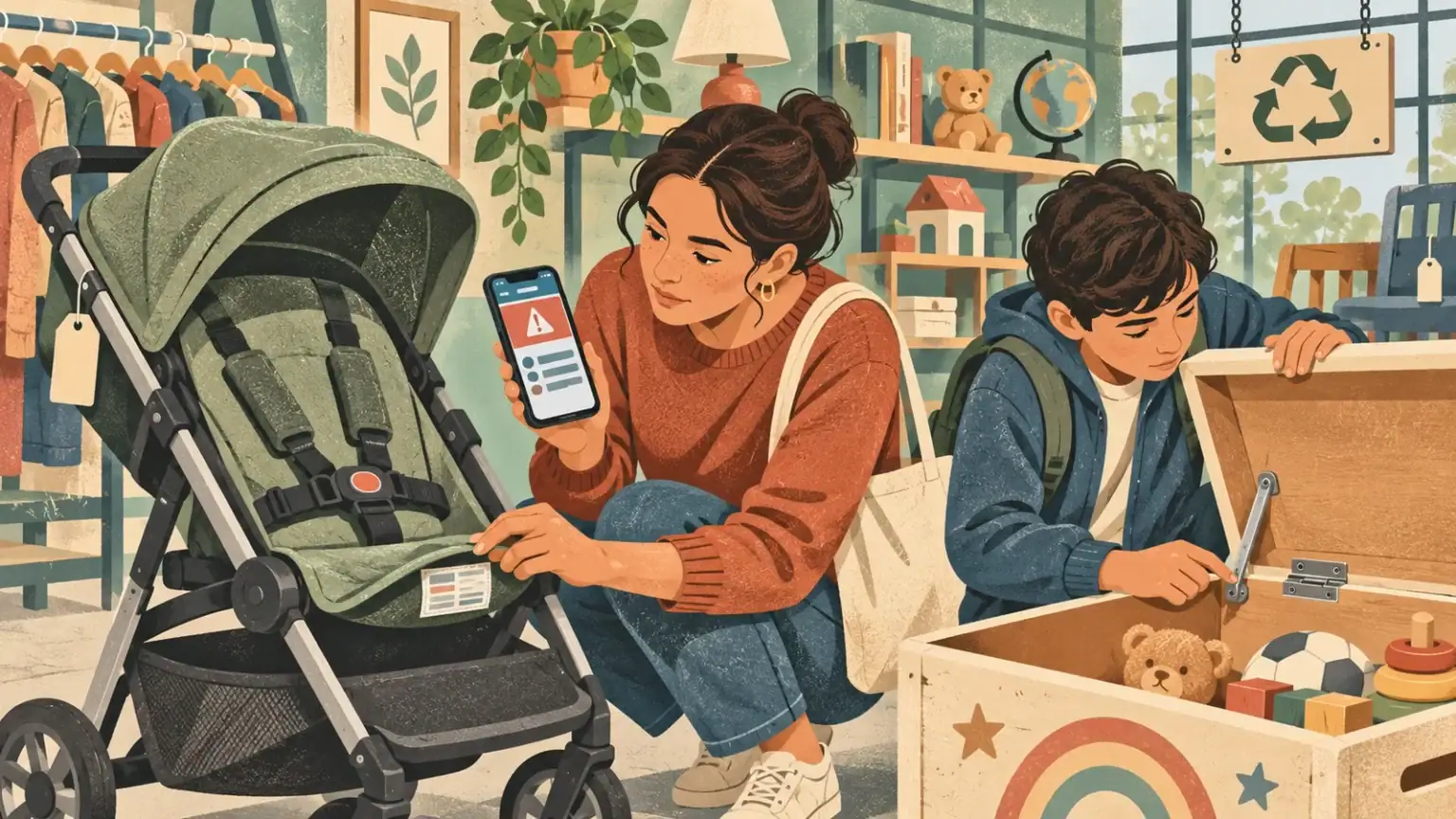
Ask for clear photos of the brand, model, date code, serial number and all labels. “Hardly used” cannot replace these details. Search the exact model in the official recall database for the country where it was sold and where it will be used. A recall may cover only certain dates or batches, so match the notice carefully.
Read the official remedy
A recall notice explains the hazard and whether the manufacturer offers repair, replacement, refund or disposal. Do not accept a seller’s homemade fix. If the product is recalled and the remedy has not been completed exactly as directed, do not use it. Recalled products should not be resold.
Inspect every load-bearing and moving part
- Look for cracks, rust, fraying, loose fasteners and stress marks.
- Test brakes, locks, hinges and adjustment points without a child present.
- Check that straps and buckles are complete and not cut or twisted.
- Compare all parts with the current manual.
- Reject products with improvised screws, tape, glue or replacement cords.
Requesting a demonstration is reasonable, but do not let a child be the test weight.
Treat some categories with extra caution
Cribs, bassinets, sleep products, car seats, helmets and other protective equipment can have changed standards, hidden damage, expiry rules or a history that matters. A product that protected someone during a crash or fall may not be safe to reuse even if it looks intact. Check the manufacturer and relevant national authority for that category.
Check for missing information
Download the current manual from the manufacturer. Confirm the age, weight or height limits and correct assembly. If the identity label is gone, the product cannot be checked reliably. Missing instructions, hardware or anchoring parts are not minor inconveniences when they control stability, restraint or entrapment risk.
Look through a child-safety lens
Inspect for button batteries, strong magnets, water beads, accessible cords, small detachable parts, sharp edges and openings that could trap fingers or a head. Review the water-bead and magnet guide and the button-battery room check when those hazards may be present.
Protect privacy in connected products
For a camera, smartwatch, toy or speaker, confirm that the prior owner has removed the device from their account and factory-reset it. Check whether software support still exists. A cheap connected product that no longer receives security updates may create more risk than value. Use the connected-device privacy audit before setup.
Make the handover traceable
Keep the seller’s message, receipt, model photos and confirmation of any completed recall remedy. Pay through a method with appropriate buyer protection where available. Meet safely and do not let a deadline prevent inspection.
Know when to walk away
Decline the product if its identity is uncertain, safety parts are missing, a recall cannot be resolved or the seller resists basic questions. Saving money is useful only when the item can be used as designed. Sometimes the safest second-hand choice is a simple, non-powered product with a clear model, complete parts and an easy-to-inspect history.
Consider whether hygiene can be restored
Soft toys, fabric seats, mouth-contact items and products used during illness may need cleaning that the material cannot tolerate. Ask how the item was stored and compare the manufacturer’s cleaning instructions with its current condition. Strong fragrance may mask damp or smoke rather than prove cleanliness.
For protective equipment, do not paint, drill or decorate over labels and damage. Cosmetic improvement can hide cracks or interfere with function. If safe cleaning and inspection would cost nearly as much as a traceable new item, the used bargain may not be economical.