By EdCaptain editorial desk · Published
“I can see two circles.” A child may say this while an adult sees a perfectly clear bird through the same binoculars. That is a reason to check the fit and settings before buying a more powerful pair—or deciding the child simply cannot use them.
This research-based buying guide is for families choosing ordinary daytime binoculars for children aged 7–12. It does not report hands-on testing or recommend a particular commercial model. Check the exact product’s age guidance and warnings; a “kids” label alone cannot establish that the equipment fits your child.
One circle starts with the space between the eyes
The distance between the centres of someone’s pupils is called interpupillary distance, often shortened to IPD. Binocular eyepieces must be positioned to suit the person looking through them. A pair adjusted for an adult may be too widely spaced for a child.
Nikon’s central-focusing binocular instructions explain that the two fields should align into one circle when eyepiece spacing is correct. Turning the focus wheel is a different adjustment; it does not move the eyepieces closer together.
When comparing models, ask for the stated IPD adjustment range, especially its minimum. Do not assume that “compact”, “junior” or a small-looking body guarantees a narrow enough setting. If the manufacturer does not publish the range, ask before ordering or arrange a supervised fitting trial.
Use the hinge only as the manual directs. Do not force it past its stop or ask a child to press the binoculars hard against their face to compensate. A pair that works for one sibling may still fail to fit another.
Make the first trial safe and unhurried
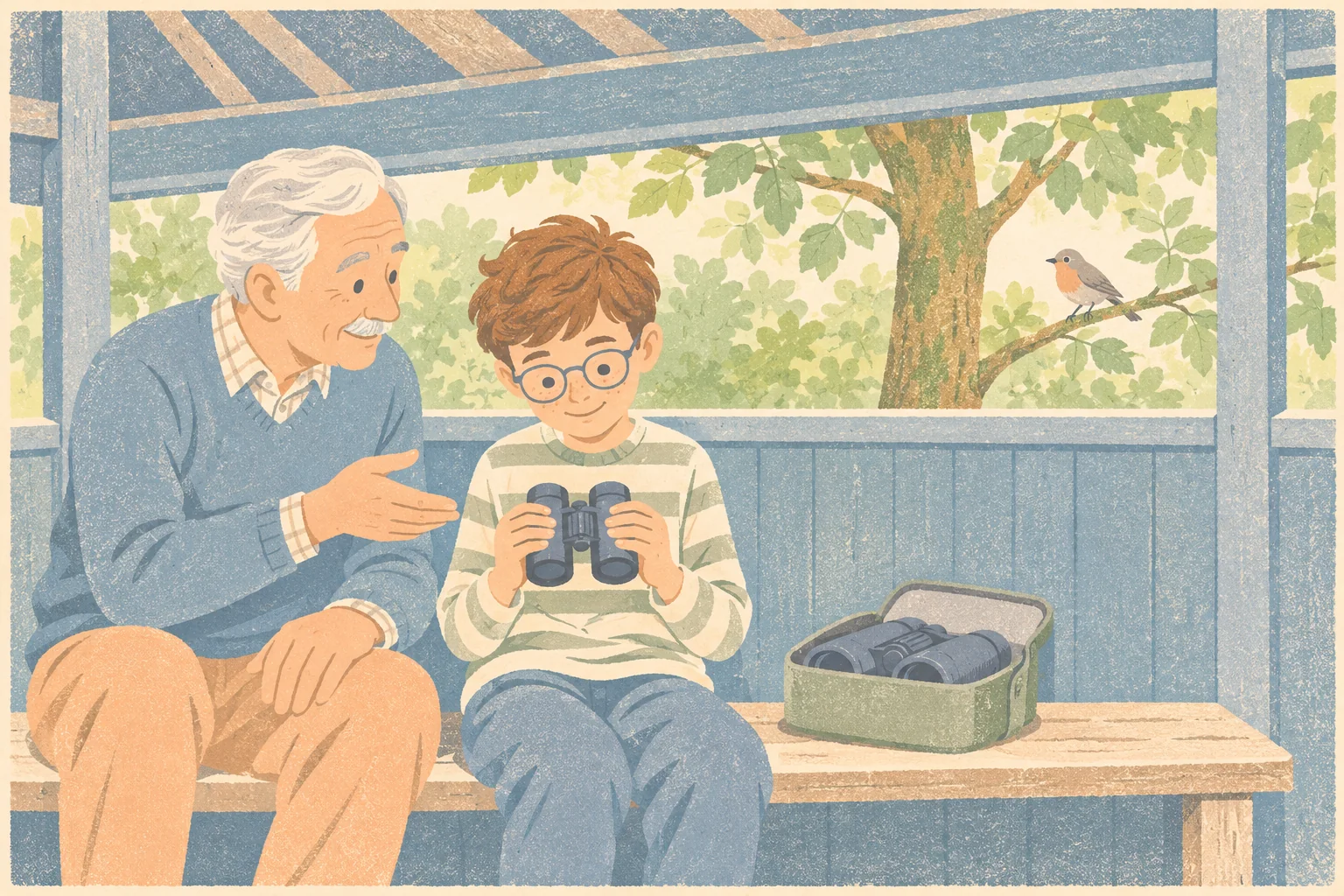
Choose a stationary daytime target at eye level, such as a tree trunk or building detail, well away from the Sun’s direction. Start from a stable seated or standing position away from roads, water and edges. An adult supervises throughout. Put the binoculars down before walking.
Never point ordinary binoculars at or near the Sun. Do not sweep them across the sky to find a target. NASA warns that viewing the bright Sun through unfiltered optics can cause severe eye injury, and that eclipse glasses or handheld solar viewers must not be used with binoculars. This guide does not cover solar viewing, filters or projection experiments.
Have the actual model’s instructions ready. A short try can answer more than a long list of advertised features:
- Set up for the child. Follow the manual for eyecups, spacing and any individual-eye adjustment. Ask a knowledgeable retailer to demonstrate if the sequence is unclear.
- Check the view. Ask whether the child sees one comfortable field or separate circles and dark edges. Avoid repeatedly telling them what they “should” see.
- Check the controls. Can they reach and turn the focus wheel while supporting the binoculars? Can they hold the view briefly without an uncomfortable grip?
- Pause and ask. Put the pair down. “What was easy to see? What felt awkward?” Pointing or a simple choice between responses is fine.
Stop for discomfort or distress. If a model cannot provide a comfortable view after its proper adjustments, do not push through a longer session. Ask the retailer about fit, condition or a different design.
Include the glasses your child normally uses
Try the binoculars with the child’s usual glasses rather than removing them just to make a sale-room view work. Eye relief describes the distance between the eye and eyepiece at which the view is obtained. Eyecup adjustments can help accommodate glasses, but follow the particular model’s manual.
The RSPB buying guide highlights appropriate eye relief for spectacle wearers as well as comfortable holding and an accessible focus wheel. A printed specification can help narrow choices; the child’s own trial still matters.
For a child with known visual needs, ask their eye-care professional about suitable equipment and expectations. Do not use this trial as a vision test or insist that every child must achieve the same binocular view. If visual difficulties also occur in ordinary viewing, seek qualified advice rather than trying to solve them by buying stronger optics.
Power is only one part of the purchase
Higher magnification can make hand movement more noticeable and the view harder to keep steady, as the RSPB guide explains. Avoid choosing the largest advertised number simply because it sounds like an upgrade.
Decide what the family will actually observe. Watching a bird across a park is different from inspecting a plant close to a garden seat. Check the model’s minimum focusing distance against your intended target distance. Ask the child to try a realistic target rather than only looking at the farthest object visible from the shop.
Weight and shape also matter. A pair that folds small may still be awkward to grip, and an adult’s comfortable weight may tire a child. For a seven-year-old, keep the trial brief and let the adult manage the instructions. An older child can compare two models and describe the controls and view, without turning the choice into a technical exam.
A seated child can try from their usual supportive position, with a stable surface for resting elbows if comfortable. Ask about suitable supports where needed. If binocular viewing is inaccessible or unenjoyable, listening, descriptive narration and unaided observation remain worthwhile ways to take part.
Keep a record of the pair that actually worked
Before paying, record the exact model and the answers that mattered:
- Does its age guidance include the child, and are its warnings manageable?
- Does the spacing fit, with the child’s normal glasses if used?
- Can the child hold and focus it comfortably?
- Does it focus at the distances you plan to observe?
- What do the seller’s actual return and warranty terms cover?
If buying online, check those terms before purchase rather than assuming an opened item can be returned. A similar product name or another version may have different specifications. Save the manual and model details for future use.
You can borrow an appropriate pair with permission before committing, or start without equipment. Our small-space nature week offers things to notice from an ordinary familiar place. If you do take binoculars outdoors, pair them with respectful wildlife watching: observing more closely through optics is not a reason to approach or disturb an animal.
The useful purchase is the pair your child can use comfortably for the intended task. If that fit is not established, waiting is a reasonable decision.