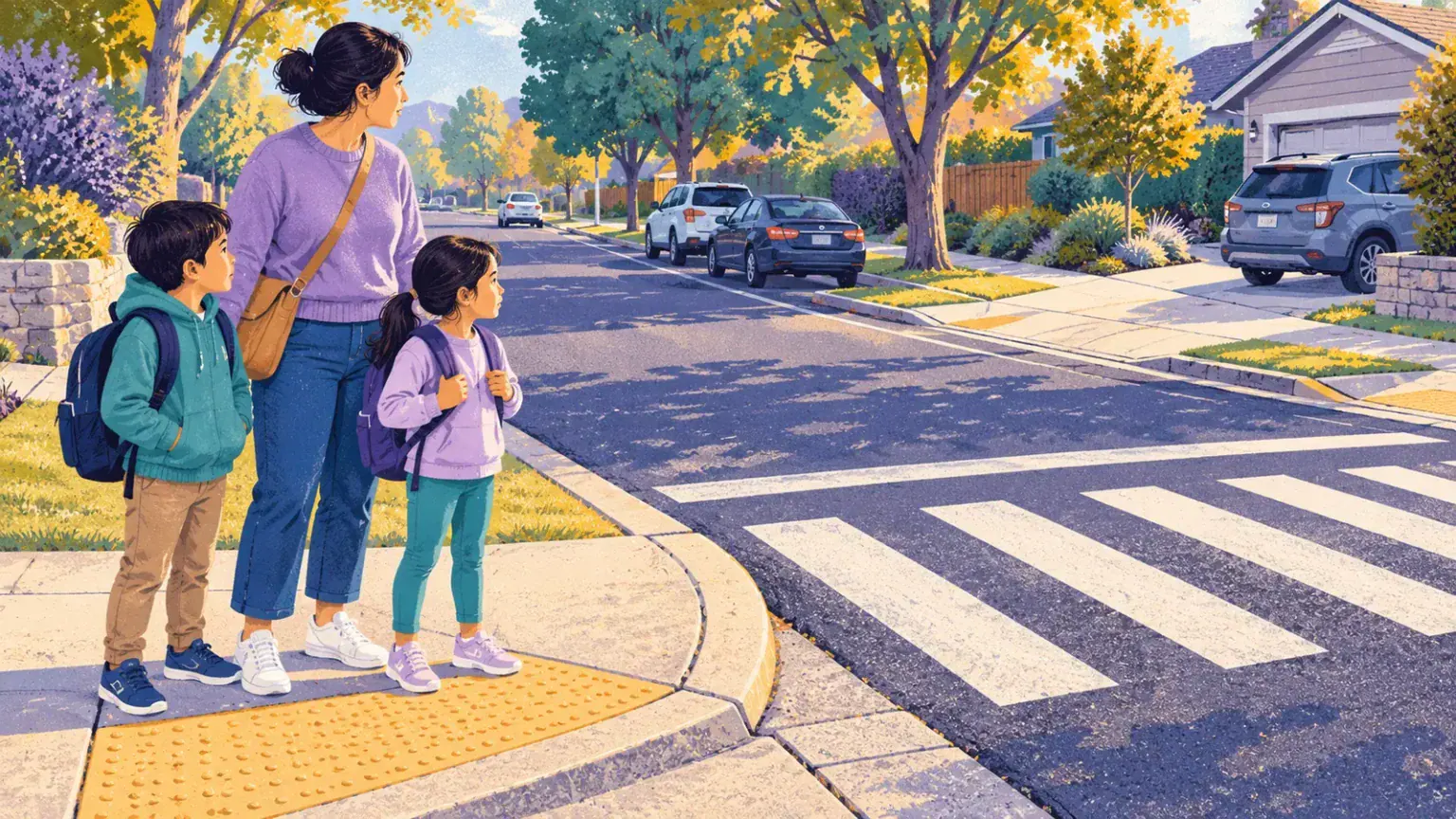
A route that looks simple on a map can feel different at child height. Parked cars block sightlines, driveways cross pavements and a quiet corner may change at school time. Practise when nobody is rushing, and keep the adult responsible for deciding whether a child is ready to walk any part independently.
Audit before bringing the child
An adult walks the proposed route first at the time it will usually be used. Note continuous pavements, formal crossings, signal timing, turning traffic, driveways, construction, dogs, poor lighting and places where a child could become separated. Identify one safer backup route.
Check school arrival rules and local road law. If the route has a hazard you cannot manage, change it rather than expecting a child to compensate.
Plan a 30-minute practice
Choose a calm day, wear the usual shoes and carry the normal bag. Tell the child, “Today the adult makes every crossing decision. You are helping us notice what the route is like.” Preschoolers can point to stopping places; older children can narrate what they see.
NHTSA advises using sidewalks where available, crossing at corners or intersections, watching driveways and backing vehicles, and continuing to scan while crossing. Its guidance also says children under 10 should not cross streets alone. Age is only one factor; route complexity, attention, mobility, judgement and local expectations also matter.
Use the same crossing sequence
- Stop fully back from the edge.
- Look left, right and left again, adapting to local traffic direction.
- Check signals, turning vehicles, bicycles and driveways.
- Wait for vehicles to stop; do not rely only on eye contact or a wave.
- Walk—do not run—while continuing to look and listen.
Practise at each actual crossing. Do not rehearse by stepping into traffic to see whether a driver stops.
Add three “what if” scenarios
Ask what to do if the usual crossing is blocked, a friend calls from the other side or a trusted adult is not at pickup. Keep answers short: stop in a safe place, do not improvise a new route, and contact the named adult or school. A child who is lost should approach a clearly identified safe helper according to your local plan.
Use EdCaptain’s backup school pickup plan and family emergency communication card. Bicycle travel needs separate skills; see the family bicycle safety workshop.
Adapt for access and sensory needs
Test kerb ramps, surface quality, crossing time and rest points for mobility devices. A child with low vision may need orientation and mobility support. A child who becomes overwhelmed by noise may benefit from practising in stages, but hearing protection must not prevent awareness of traffic. Use visual route cards without printing a home address or child’s full name.
Decide independence separately
Successful practice does not automatically mean a child should walk alone. Repeat the route in different conditions and observe whether the child stops without prompting, notices turning traffic, follows the agreed route and responds safely to changes. Consider an adult, walking group or older responsible companion.
Reassess after construction, a move, schedule change or near miss. Adults driving the route also slow down, avoid phone use and expect children near crossings. Pedestrian safety is a shared system, not a test a child passes once.
Practise the return journey too
Afternoon light, traffic and adult availability may differ from the morning. Walk the route in both directions and identify the exact safe waiting place at school. Make clear that a child never leaves with an unexpected adult or follows a changed plan delivered only through another child.
For a teen, discuss headphones, phone use and friends changing the route. Independence should grow in small steps: adult-led practice, walking together, observing from a short distance and only then considering solo travel where local conditions and family judgement support it.