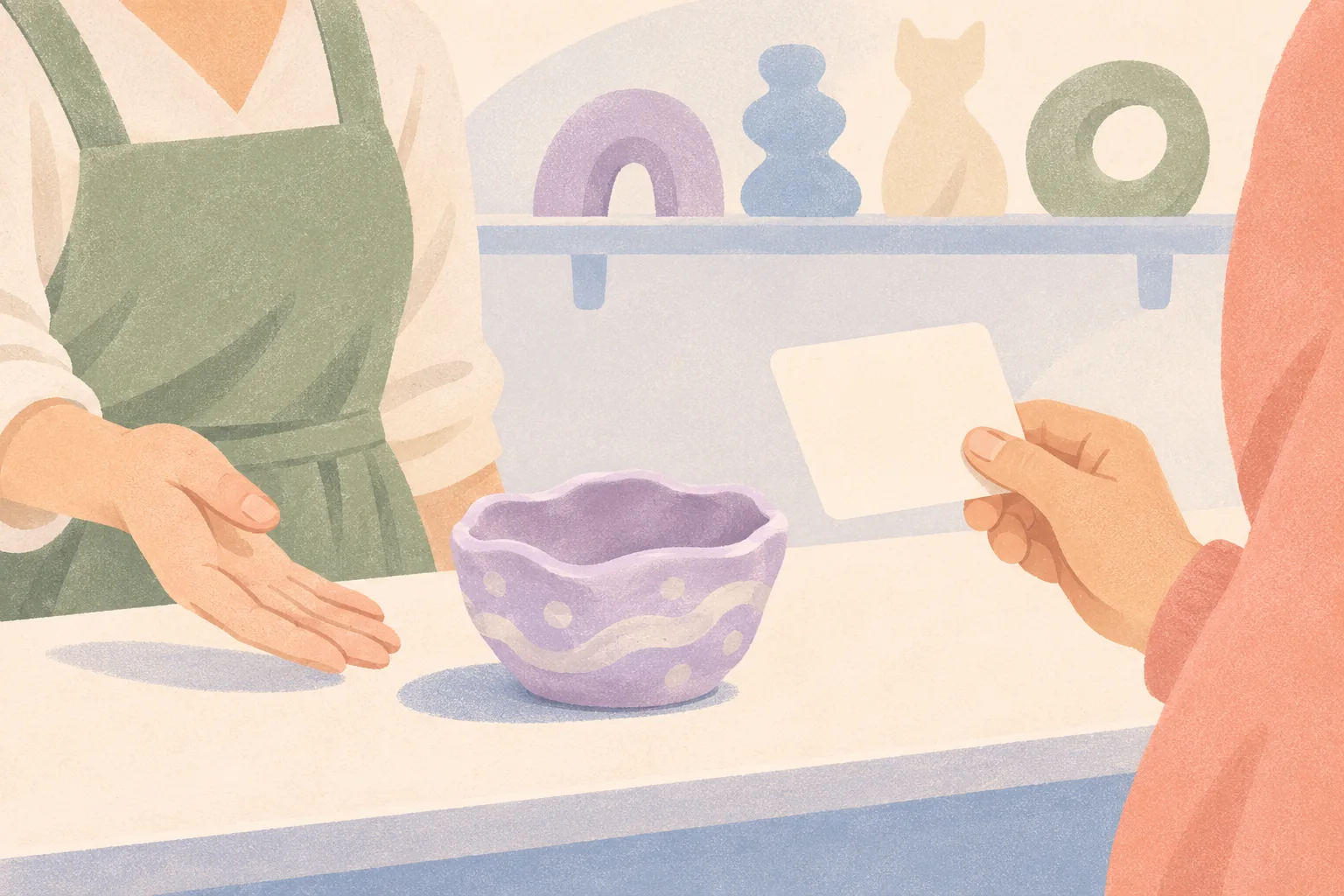
- A bowl shape does not decide its use
- Ask the studio before booking—or before breakfast
- What the lead guidance does—and does not—tell you
- Do not add a coating to make an uncertain piece usable
- Give a decorative piece a proper place
- Check the workshop environment separately
- If the bowl has already been used
- Sources and further reading
By EdCaptain editorial desk · Published
Your child brings home a bowl from a pottery workshop and wants to eat breakfast from it tomorrow. The shape looks right, the colour is lovely, and the class used materials described as safe. Before filling it, ask a different question: was this finished piece made and assessed for contact with food?
Until that is clear, keep it for display. This is a guide for adult caregivers making that decision, not instructions for children to fire, glaze or test pottery.
A bowl shape does not decide its use
A workshop might use air-dry modelling clay, make a kiln-fired ceramic object, or decorate an already-made piece. The word “pottery” on the booking page does not tell you which process produced the item in your hand.
Nor does “non-toxic” on a craft supply settle the intended use of the finished object. Ask about the complete piece: clay, decoration, finish and any firing. Materials suitable for a supervised art activity are not, by that description alone, confirmation that a bowl can hold food.
Health Canada’s art-class safety guidance generally advises that children should not make objects for use with food and drink. Choosing a decorative project from the outset avoids making the class’s success depend on a usable breakfast bowl.
Ask the studio before booking—or before breakfast
Contact the organiser who knows the materials and finishing process. You could write:
“My child wants to use their finished bowl for cereal. Was this project intended for food use, or is it decorative? Please confirm what applies to this specific piece and send its care instructions.”
If the answer is “yes, food-safe,” ask what that conclusion is based on. A useful conversation covers:
- The process: what the piece is made from, how it was decorated and finished, and whether the required stages are complete.
- The intended use: whether it is suitable for food or drink, rather than simply safe to handle or display.
- The basis for the assurance: which manufacturer instructions, production controls or relevant testing support the finished piece’s stated use.
- The limits: any restrictions on hot contents, storage, washing, microwave or dishwasher use.
- The individual item: whether a flaw or change to this piece means the general workshop description no longer applies.
You do not need to interpret a kiln schedule or approve laboratory results yourself. If the explanation remains unclear, ask for a decorative project or keep the existing piece out of food use. A friendly reply is welcome; a vague reassurance still leaves the practical question unanswered.
What the lead guidance does—and does not—tell you
The U.S. FDA’s advice on traditional pottery explains that lead in some glazes or decoration can pass into food and drink when pottery is improperly made. This does not mean every handmade bowl contains lead. It does mean appearance and the word “glazed” cannot settle the question.
The FDA cautions against food use when suitability is uncertain or an item is labelled decorative. Its traditional-pottery guidance does not certify this class project.
Do not turn uncertainty into a home experiment with food. Ask the studio to resolve it or choose display. If a specialist assessment is needed, seek an appropriate qualified service rather than treating a kitchen test as approval.
Do not add a coating to make an uncertain piece usable
A clear finish can look convincing without establishing food suitability. As a specific example, Crayola says sealing its Air-Dry Clay does not waterproof it and recommends indoor display. That statement applies to that product; check the actual material used in your workshop rather than transferring advice between brands.
Do not add varnish, resin, paint or another coating as a DIY route to food use. Do not put a project in a home oven, microwave or kiln unless its actual instructions and a competent provider explicitly support that process. Follow the studio’s plan instead of improvising a finish.
The FDA says washing or boiling does not remove lead from pottery. Cleaning an object does not establish its suitability for food.
Give a decorative piece a proper place
Tell your child, “You made this bowl. We’re checking what it can be used for. For now, let’s choose where to show it.” Avoid calling it a failed bowl or making the child responsible for proving it safe.
Offer a stable display spot away from food preparation and serving items. Keep it out of reach if it is fragile or has sharp edges. A small note underneath or beside it can remind other adults that it is for display, so it does not migrate into the kitchen cupboard.
For a gift, pass on the same intended-use information. A relative should not have to guess whether the child’s mug is for tea. A photograph, title or story about the making can celebrate the work without turning it into tableware.
If your child is disappointed, our guide to handling frustration about artwork may help. Their effort and choices still matter even when the finished object has a limited use.
Check the workshop environment separately
Food-use questions do not replace checking how a class is run. Ask about age suitability, supervision and materials before enrolling. Health Canada recommends wet clay for children, avoiding dry-clay dust, separating eating from art activities and washing hands afterwards. Keep firing and other specialist processes under the provider’s control.
If you do not want an elaborate class at all, supporting creativity without being the crafty parent offers a simpler perspective. A worthwhile creative experience does not need to produce a household utensil.
If the bowl has already been used
Stop food use while checking with the studio. Use alone does not establish poisoning; looking well does not rule out lead exposure. If concerned, ask a healthcare professional about blood lead testing. Keep the piece and material information for that conversation.
The practical default is straightforward: enjoy the artwork, keep uncertain pieces decorative, and leave food-use assurances to the people responsible for the finished product.
Sources and further reading
- Health Canada: chemical safety in art classes
- FDA: lead-glazed pottery, food use and exposure concerns
- Crayola: limits of sealing Air-Dry Clay
Read our editorial policy and health-information guidance.