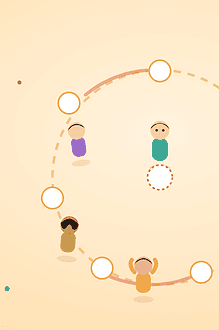
Four stations, four challenges, several teams rotating through in sequence, and a scoreboard that adds it all up at the end. The Challenge Circuit turns a handful of smaller games into one structured tournament with a genuine overall winner.
What you need
Enough open space for four separate stations. Whatever equipment the chosen challenges require (for example: a skipping rope, something to throw for arm strength, a flat area for forward rolls, a ball for standing volleys). An exercise book or slate and a pen per station, for scoring. Several teams of around five players, with one referee per station.
How to play
Choose four challenges suited to your group and equipment, for example: skip rope 100 times without stopping, do 20 arm presses, perform a forward roll, or complete 20 standing volleys with a ball. Set up one station for each challenge, with a referee at each to record scores. Teams send players through the circuit one at a time, moving from station to station, while the rest of the team waits its turn. Each station has its own simple scoring rule (for example, one point for reaching the target, with two attempts allowed before moving on). Once every player on every team has completed all four stations, referees total the scores, and the team with the most points overall wins.
Variations
Build a themed circuit instead, all four stations built around one sport, or all four built around a shared skill like leg strength or balance.
Safety notes
Check that each station is genuinely safe to run simultaneously alongside the others, with enough separation that one station’s activity does not spill into the next. Adapt the specific challenges to the age, capacity, and gender mix of your group rather than using a fixed list.
Why it works
Breaking a tournament into several short, varied stations keeps any one challenge from dominating the day, and because the format rewards a team’s combined performance across four quite different skills, it tends to reward well-rounded teams rather than any single standout athlete.