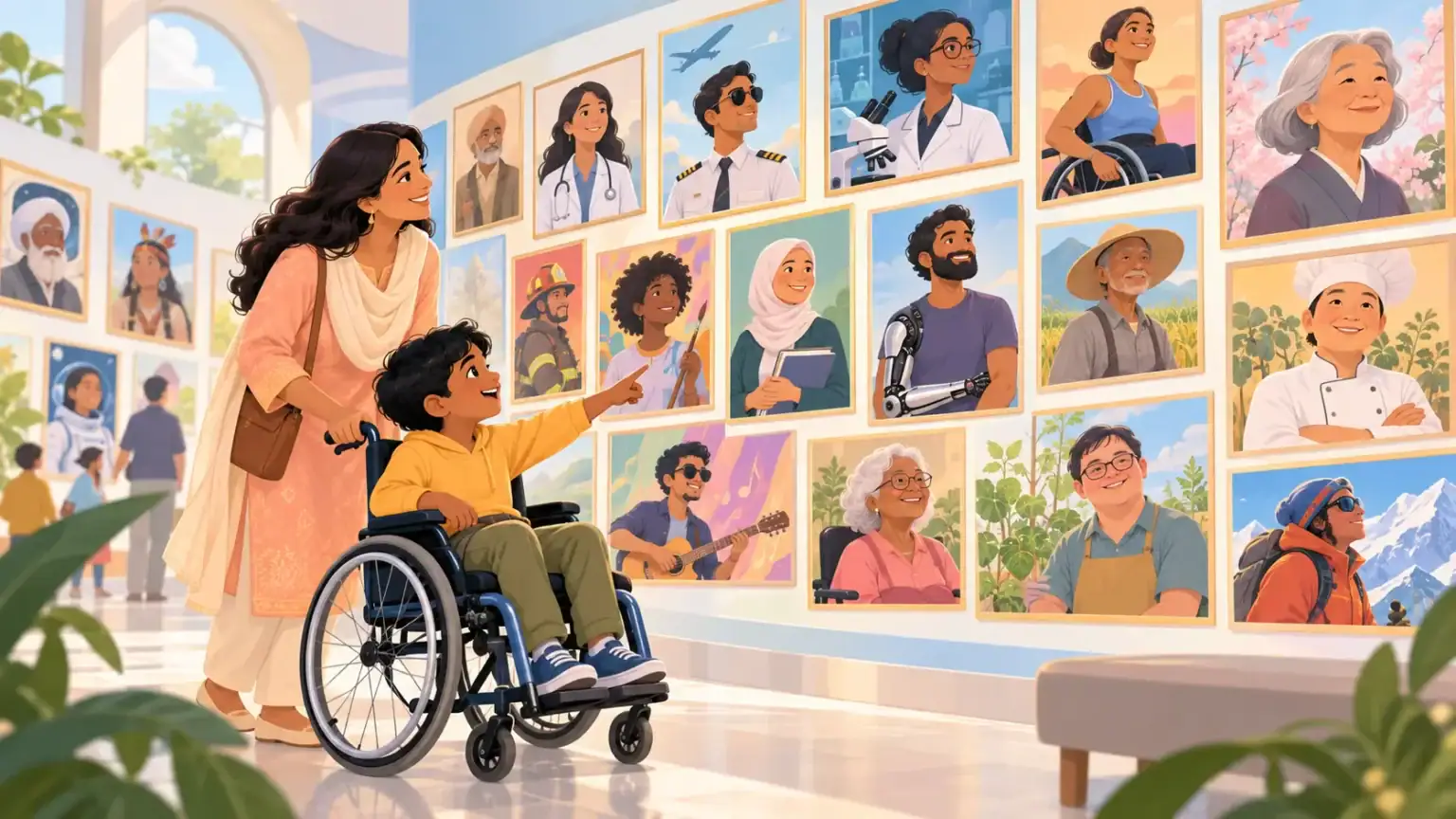
Seeing someone who shares your culture, disability, language or family structure can make possibility feel concrete. Yet representation should not become a new box: a child does not have to admire only people who resemble them. A rich set of role models offers both mirrors—people in whom a child recognises part of themselves—and windows into lives different from their own.
Start with what the child wants to explore
Ask, “What would you like to see someone like you doing?” or “Whose work are you curious about?” The answer may be a job, a skill, a way of communicating or a family experience. Let the child define which parts of identity matter in that moment. Adults can offer options without announcing that one person represents the child.
For example: “I found two illustrators who use different tools. One also talks about drawing with limited hand movement. Would you like to see their work?” This keeps disability relevant without making it the person’s only feature.
Build a constellation, not a single perfect hero
Choose several people who model different qualities. A local gardener may show patience, an athlete may show disciplined practice, and a disabled engineer may expand ideas about who belongs in technology. Include living people, historical figures, relatives and community members. Notice support teams and access: success rarely happens through individual effort alone.
UNICEF’s work on disability inclusion stresses removing barriers and including people with disabilities in decisions that affect them. Translate that into a family habit: seek work and stories created by people themselves, not only stories told about them.
Check the story for stereotypes
- Is the person presented as a whole human being or only as an identity label?
- Does the story treat ordinary participation as heroic simply because the person is disabled?
- Is hardship glorified while barriers and support disappear?
- Does one person appear to speak for an entire culture or community?
- Can the child see joy, mistakes, teamwork and everyday life as well as achievement?
If a book or video falls short, it can still prompt reflection: “What part of this person’s life is missing?” “Who helped?” “What barrier should have changed?”
Make discovery a child-led routine
Create a small “people who teach us” shelf or digital folder. Add a picture, one verified fact, the quality the child noticed and one question still unanswered. Libraries, museums, professional associations and disability-led organisations can broaden the search. When possible, use primary interviews or the person’s own work.
Connect the search with finding everyday role models close to home. A child may discover that an older cousin, community artist or coach offers the most useful, reciprocal example.
Respond when a child says, “People like me cannot do that”
Do not dismiss the concern. Ask what makes it feel impossible. The child may have noticed a real barrier, experienced prejudice or simply never seen an example. You might say, “That barrier is real, and people are working to change it. Let’s find someone who has navigated it and what support helped.” Avoid promising that effort alone overcomes every obstacle.
Adapt by age
- Ages 3–5: Offer books and play materials showing varied families, bodies and cultures in ordinary roles, not only special lessons.
- Ages 6–9: Compare two people who share a skill but have different backgrounds. Ask what each needed to participate.
- Ages 10–12: Discuss who gets visibility, who is left out and how media framing shapes a story.
- Teens: Explore self-representation, tokenism, structural barriers and the difference between inspiration and pressure.
The aim is not a perfectly balanced poster. It is a growing sense that identity can be a source of recognition without becoming a limit. The guide to choosing role models for values rather than fame and the article on cross-cultural curiosity without stereotyping offer useful next conversations.