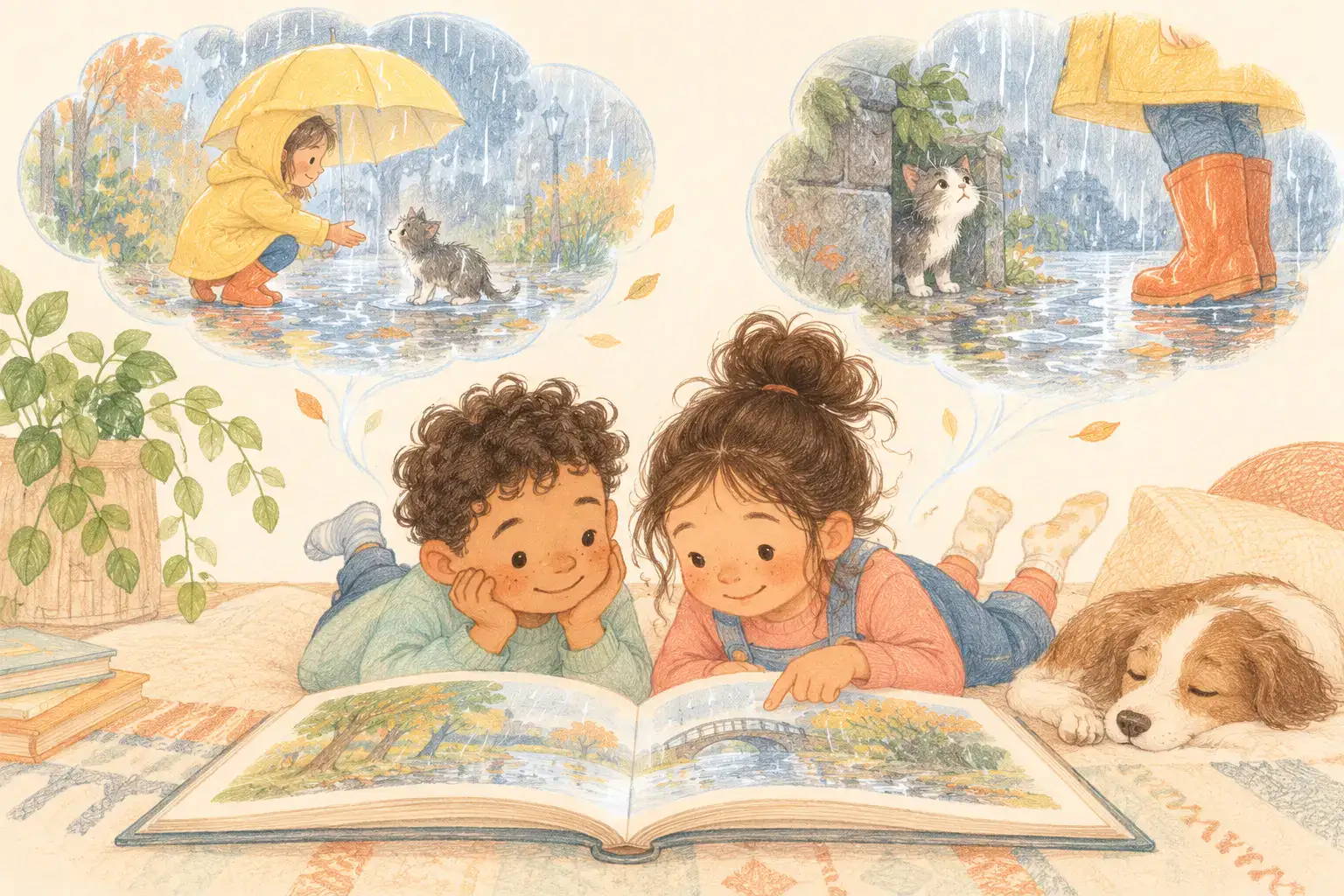
Two characters can stand in the same rain and want entirely different things. One hopes the match will continue; another hopes the dry garden will finally get water. A story gives you room to explore both viewpoints without deciding that one person must be entirely right.
Choose a story that fits
Use a picture book, an audiobook, a short story or a novel your child wants to read. Check its themes and age suitability first. You do not need an adult novel with distressing scenes to have a thoughtful conversation.
Allow ten minutes after a short section, with paper or drawing materials if wanted. Children can join by speaking, signing, drawing, pointing or using a communication aid.
Pause at one interesting moment
- Ask what actually happened in the story. Separate the events from what you think a character intended.
- Choose a character. Ask, “What might they be feeling or hoping for? What in the story makes you think that?”
- Look at the same moment through another character’s eyes. They may have different information, needs or worries.
- Leave room for uncertainty. “We don’t know yet” is a useful answer; expressions and actions are clues, not direct access to someone’s thoughts.
- Imagine a different response. What could the character say or do next? What might happen to the other person?
Understanding is not excusing harm
A character may have a reason for being angry and still be responsible for hurting someone. Ask, “What support might they need, and what boundary would keep others safe?” You can understand another viewpoint without accepting bullying, abuse or pressure.
Avoid requiring a child to identify with a frightening character or disclose a painful personal experience. If a scene feels too much, stop, choose another book or talk about something ordinary.
Make the activity playful
- Draw two speech bubbles for what the characters say and two thought bubbles for what they might think.
- Retell a scene from the viewpoint of a quiet background character.
- Use toys to try two possible endings, keeping participation optional.
When discussing real people, switch from guessing to asking. “I wondered if you felt left out. Is that right?” leaves the person room to disagree. A story conversation is practice in considering possibilities, not proof that a child has become more empathetic.
Finish with one detail you each noticed. You can return to a character later as the story gives you more information; changing your mind is part of reading closely.