A child repeats a joke from a video: “People from that country are all…” The words may land hard even if the child has not considered what they mean. Responding matters, but a long angry lecture can push the lesson underground. A better sequence is short enough to use in the moment: stop, ask, correct, repair and keep checking.
Stop the stereotype clearly
Start with a firm boundary: “That is a stereotype, and we don’t describe a whole group that way.” If someone targeted by the comment is present, protect them from becoming the teacher. Change the subject or move away, then address your child privately. Do not ask the harmed child to confirm why the remark was hurtful.
Calm does not mean vague. Avoid laughing nervously or saying only “That’s not nice.” Name the problem: the claim takes one image or story and treats it as true of millions of different people.
Find the source before you debate
Ask, “Where did you hear that?” and “What did the video want you to feel?” The source may be a meme, influencer, game chat, advertisement, classmate or adult. Knowing the route helps you respond. A child who misunderstood a history lesson needs a different conversation from a child testing a slur for laughs.
Then ask what evidence would change the claim. “Could one short clip show every family in a country?” “Who made it, and are people from that community speaking for themselves?” Children can learn that popularity, humour and repetition do not make a statement accurate.
Replace the claim with a fuller truth
Simply banning words leaves the underlying story intact. Offer a specific correction:
- “People in the same country have different languages, jobs, beliefs and family lives.”
- “That tradition is important to some families, but not everyone practises it in the same way.”
- “One person behaving badly does not represent their culture.”
Use “some,” “many,” “one family” and “in this source” instead of “they always.” If you do not know enough, research together using a museum, university, government or community organisation. First-person accounts can add perspective, but no single creator represents everyone.
Look at how media builds the shortcut
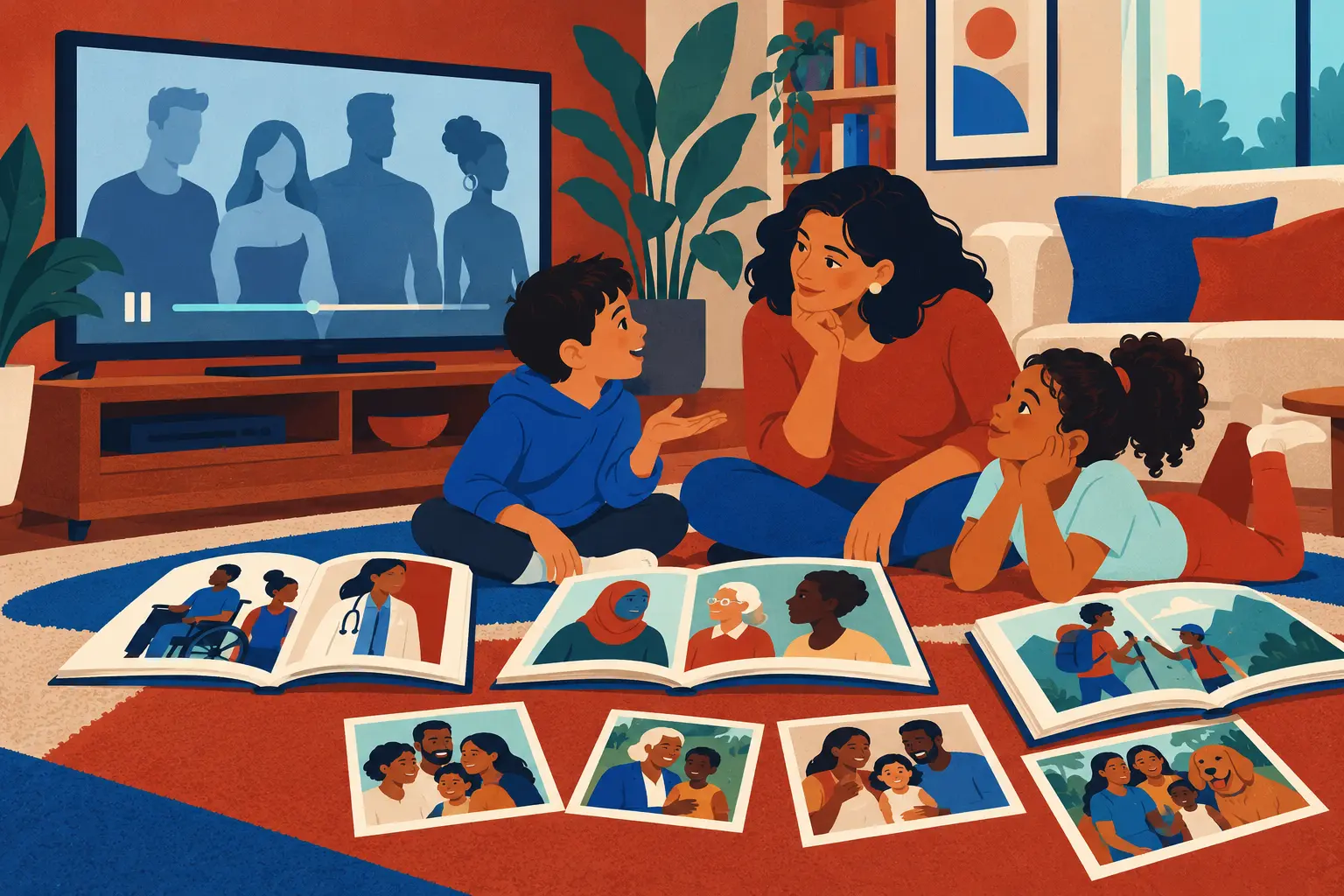
Pause the clip and inspect it. Who gets to be clever, modern, funny or powerful? Who is silent, dangerous or only a costume? What music, editing or captions tell the viewer how to feel? What ordinary parts of life are missing?
UNICEF advises families to choose books and media that portray children in their diversity and avoid stereotypical representation. Add, rather than merely subtract: seek stories where people from the community are inventors, neighbours, parents, athletes, artists and protagonists with different personalities.
Repair harm without performing an apology
If the comment reached another person, help your child make a brief, specific repair: “I repeated a stereotype about your culture. It was wrong, and I’m sorry.” Do not add “if you were offended” or ask for immediate forgiveness. The most convincing repair is changed behaviour: deleting the post, refusing to repeat the joke, correcting a friend, or telling a teacher about a hostile group chat.
If a pattern becomes teasing or exclusion, use the practical guidance in talking with children about racism. Repeated targeting at school needs adult documentation and follow-up, not only peer-level conflict resolution.
Adapt the lesson by age
- Ages 6–9: Use a simple analogy: one child’s favourite food does not reveal what an entire class eats. Practise “That’s not true for everyone.”
- Ages 10–12: Compare two portrayals of the same place and notice who made each one. Check dates and sources.
- Teens: Discuss algorithms, engagement and how provocative posts can be rewarded. Ask what responsibility comes with sharing, liking or staying silent.
Keep your own media habits open to review. If you laugh at stereotypical jokes or make sweeping comments about neighbours, children notice the contradiction. You can model correction: “I just generalised. Let me say that more accurately.”
This connects with learning to ask about cultural differences respectfully. Curiosity seeks detail; a stereotype closes the story too soon. Teach the child to reopen it.