“At home I’m too different, and at school I’m not enough.” A child who moves between cultures may feel proud of having more than one way to belong—and tired of being asked to choose. The most helpful response is not to insist that the two worlds are identical. It is to show that the child does not have to erase part of themselves to be loved.
Listen for the conflict underneath
“Caught between cultures” can mean many things: different expectations about independence, clothing, dating, food, language, school success, respect for elders or how openly feelings are discussed. Ask for the specific moment: “What happened?” “Who expected what?” “What were you worried would happen if you said no?”
Reflect before solving. “It sounds exhausting to explain yourself in both places.” “You want to respect Grandma and also fit in with your friends.” This makes room for mixed feelings. Pride, embarrassment, loyalty, anger and grief can all coexist.
Separate values from one fixed method
Families often share a value but express it differently. Respect might mean immediate obedience to one adult and honest discussion to another. Family connection might mean attending every gathering, or it might mean checking in regularly while protecting study time.
Name the value, then explore more than one way to live it. “We care about family connection. Could you attend the first hour, call your cousin later, or help prepare beforehand?” Negotiating the method does not automatically reject the value.
Give your child usable language
- “My family does this differently, but I can still join the game.”
- “I need to check with my caregiver before I agree.”
- “Please don’t make my lunch or my name into a joke.”
- “I understand why this matters to you. Can we find an option that works at school too?”
For a child who freezes under pressure, agree on a private signal or a message they can send. They do not have to give peers a full family history. If language is the flashpoint, help them respond to accent or language teasing and involve the school when it persists.
Keep heritage available without making it a test
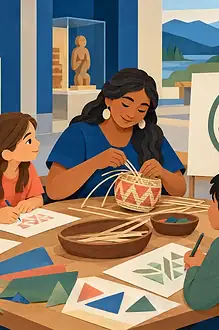
Offer regular, low-pressure access to relatives, stories, music, food, celebrations and community groups. If possible, support the family language through conversation, books or calls with loved ones. UNICEF notes that learning in a familiar language can support participation and a sense of identity and belonging. Still, avoid using fluency, clothing or enthusiasm for traditions as a measure of loyalty.
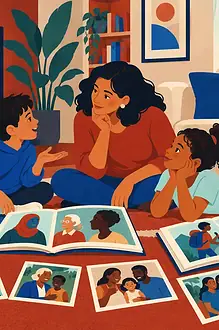
A child may connect intensely with one part of their background for a while and step back later. Adolescence often brings fresh questions. Keep the door open: “You can ask about our history, and you can have your own relationship with it.” The article on helping children feel proud of their cultural roots offers more everyday ideas.
Make family expectations discussable
Choose a calm time and write down the tension without assigning blame. For example: “The school event ends at 8:30; our usual curfew is 8:00; transport takes 20 minutes.” Let the child propose options. Adults still set safety boundaries, but explaining the reason invites problem-solving.
In two-caregiver or extended-family homes, avoid asking the child to carry messages between adults. Agree privately on the boundary, then present it together when possible. If relatives make dismissive comments—“You’re becoming too Western,” “You don’t sound like us anymore”—step in. “Their identity is not a loyalty contest. Please speak about it respectfully.”
Watch for pressure that needs more support
Seek help from a trusted school counsellor, culturally responsive family therapist or community professional if the child withdraws for weeks, is bullied, feels unsafe, or is under intense pressure around relationships, dress, education or family honour. If there is any threat of violence, forced marriage or being taken somewhere against their will, treat it as a safeguarding concern and contact appropriate local services.
Return to a steady statement: “You belong in this family. You are allowed to learn from every part of your life. We can talk about difficult differences without making you pick one side.” The goal is not a perfectly blended identity. It is a child who can build an identity with dignity, choice and reliable support.