Age guide: 4–9 years. Adapt the activity to your child’s interests and abilities.
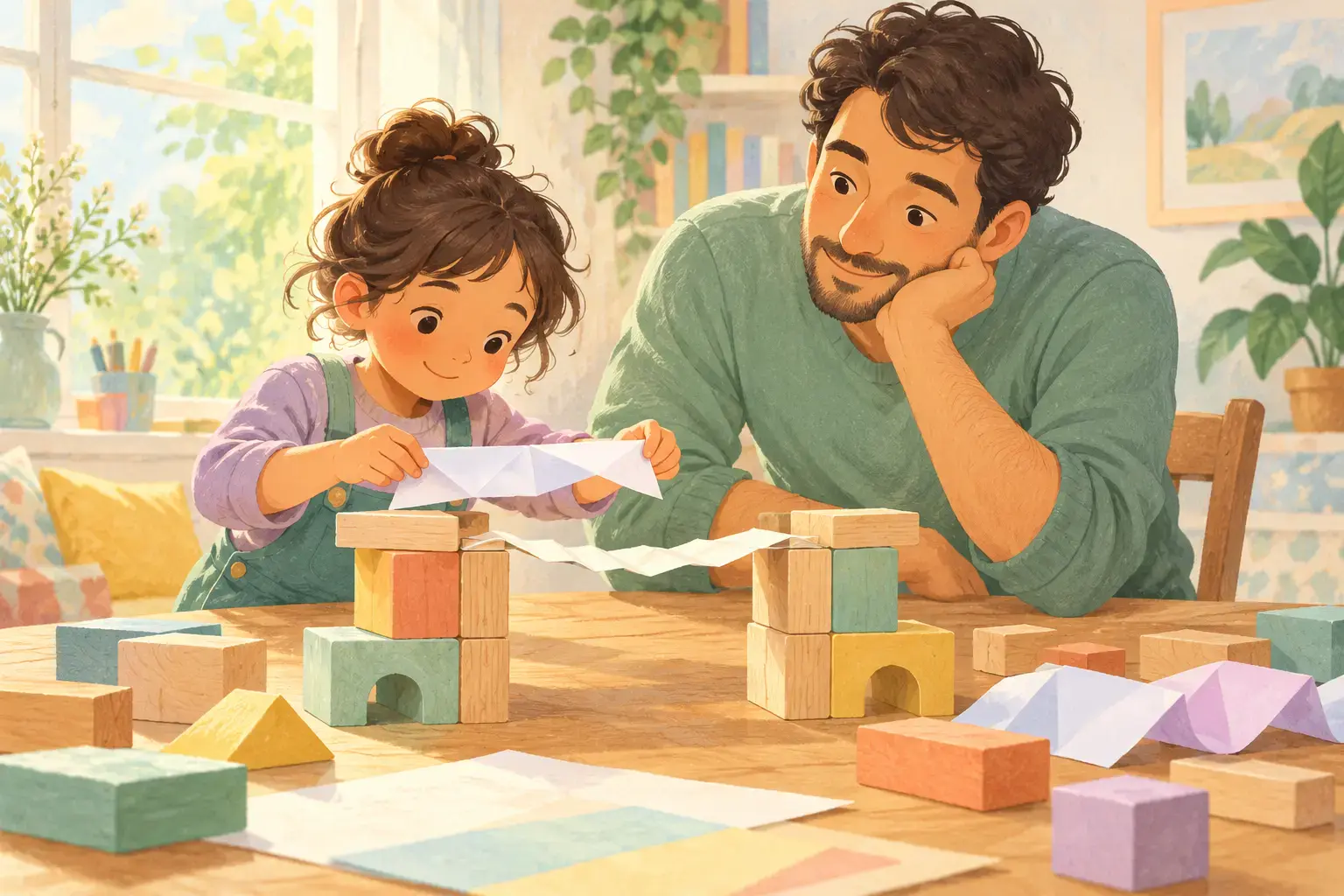
Your child lays a paper bridge between two blocks. The toy goes on. The bridge folds in the middle. Your hands may already be moving towards the paper, ready to make a stronger version.
Before stepping in, ask whether your child wants help. The next useful moment might be a new attempt. It might also be a short break.
1. Start with a small, safe experiment
Use a sheet of paper, two large stable blocks and a light, age-appropriate toy. Keep everything low on a clear surface. The bridge is for the toy; nobody stands or climbs on it. Keep small parts away from younger children.
Ask: “Can we make a way for this toy to cross?” There is a purpose to explore without a finished model to match.
2. Notice what happened before offering a solution
Try: “It bent in the middle when the toy went on.” Give your child time to look. They might notice something different, such as the paper sliding off one end.
A useful question follows the actual problem: “What could stop it sliding?” is more helpful than a stream of hints about folds if sliding is what bothered them.
3. Change one thing and look again
- Move the blocks a little closer.
- Try a fold in the paper.
- Add another sheet.
- Choose a lighter toy.
Let your child choose a possibility. Testing one change makes it easier to notice what happened. These are suggestions to explore, not steps that guarantee the best bridge.
If they ask you to show a fold, show one on another sheet or make it together. Hand the next decision back: “Shall we try this one?”
4. Stay a partner when frustration arrives
The Exploratorium’s tinkering guidance encourages adults to support exploration without taking over every decision. In family life, that can mean holding a block steady, bringing fresh paper or helping a child describe the snag.
It can also mean saying, “You wanted that to work. Shall we leave it for a bit?” Repeated failure is not automatically valuable when a child is exhausted or upset. Make the task smaller or stop.
5. Remember something useful from the attempt
When the mood is right, compare two versions: “What changed?” Your child can point, tell you or show you. There is no need to produce a written report.
A bridge that still wobbles may have led to a good discovery about a fold or a gap. A bridge abandoned today may be interesting again tomorrow. Your job is to make room for the next idea, with help available when it is wanted.
Try next
- Dolls, blocks and dragons: every child gets the whole toy box
- Creative play, smaller clean-up: art that fits real family life