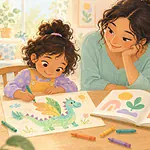
Age guide: 3–9 years. Adapt the activity to your child’s interests and abilities.
One child wants to build a detailed town. The other wants to stick every scrap onto one enormous piece of paper. Put them together without a plan and the first disagreement may arrive before the glue.
Shared creative time can work without requiring siblings to make the same thing. Begin with enough room for two ideas.
1. Choose materials everyone can safely share
Set out large sheets, crayons, cardboard and age-appropriate glue. Keep small pieces and tools unsuitable for the youngest child out of the shared area. An older child’s detailed project may need a separate session or a secure workspace.
NAEYC’s home makerspace guidance suggests starting with everyday materials. You can use that principle without buying equipment or filling every part of the table.
2. Give each child some protected space
A sheet, tray or clearly agreed area can mean “this is mine to work on.” Put shared materials between the spaces. Explain that another person’s work needs permission before it is changed.
Try: “You can ask to add something. They can say yes or no.” If one child keeps reaching across, sit nearby and help protect the boundary rather than asking the other child to tolerate it.
3. Offer a shared project with separate parts
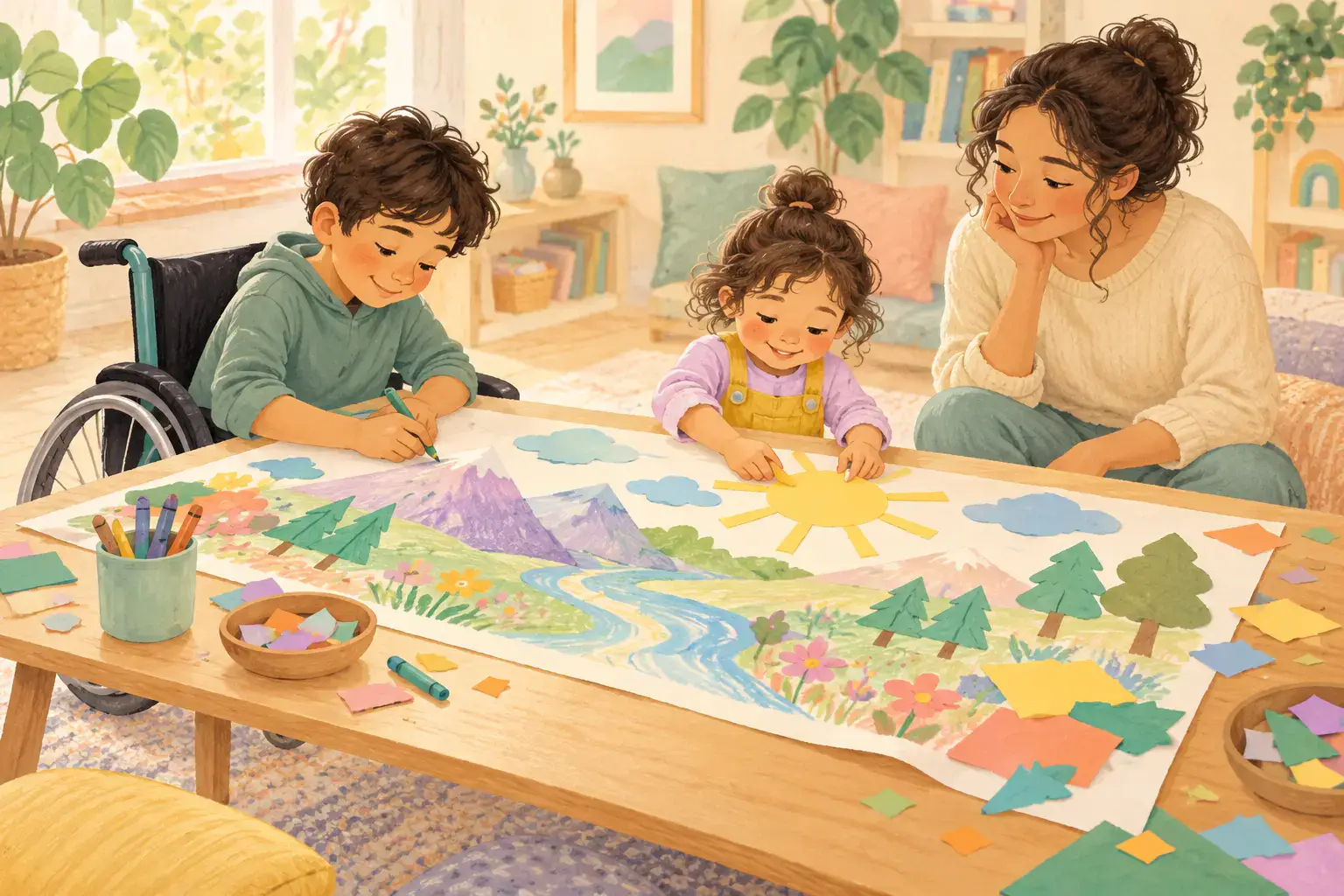
A paper neighbourhood is one option. Each child makes a place, then they decide whether to connect them with roads. A mural can also have separate sections that meet in the middle.
- Let each child choose their part.
- Offer different ways to contribute: drawing, choosing colours, arranging pieces or describing an idea.
- Keep the surface and materials within comfortable reach.
- Let a child work separately if that is what they prefer.
The older child does not automatically become the teacher or supervisor. Both children deserve time for their own interests.
4. Help them solve one practical disagreement
If both want the same crayon, name the problem plainly: “There is one green and two people want it.” Offer a brief turn, a second colour or a way to work on another part while waiting. Stay close enough to help follow through.
If the disagreement is about a design, separate the decisions: one child can make a round house while the other makes a tall one. A shared project need not have a single correct style.
5. Finish before togetherness becomes a test
Watch for tiredness, crowding or one child losing all say. Pause, move to parallel play or end the activity. You have not failed because they enjoyed ten minutes rather than an afternoon.
At the end, let each child tell you about their own contribution if they want to. There can be pride in making something together and relief in having a piece that is entirely your own.
Try next
- The bridge fell. What shall we try next?
- “I can’t draw”: help your child find a way back to the page