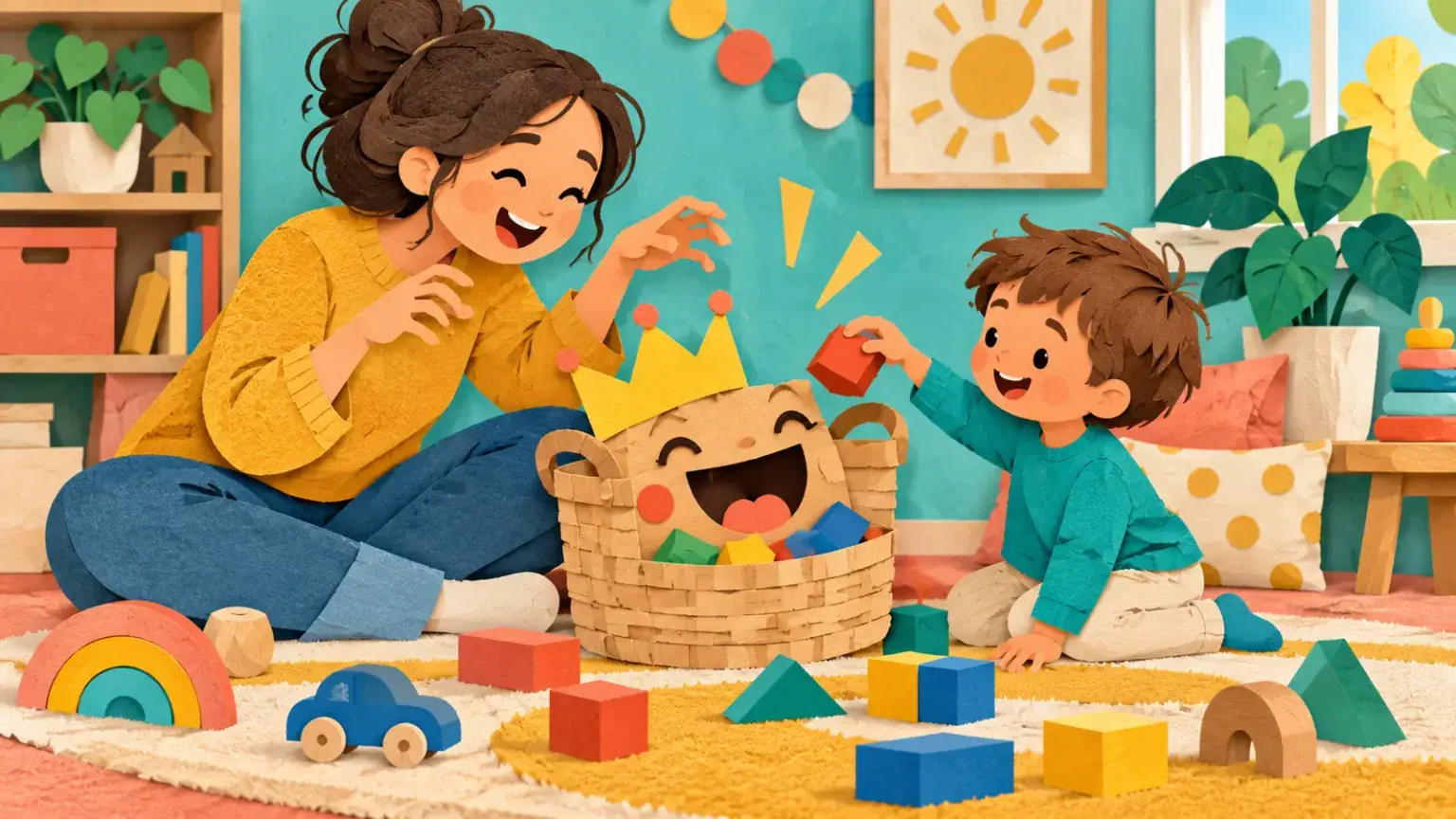
When a child is tired, “Put the blocks away” can sound like one demand too many. Playful humour may make the next step easier: perhaps the basket is “hungry” for square blocks or the pyjamas are searching for their person. The limit stays; the route becomes lighter.
State the expectation first
Humour is clearest when the child knows what must happen. Say, “It is cleanup time. Shall we race the song or feed the basket?” Two acceptable options create participation without pretending the task is optional. If the child says no to the joke, return to a calm direction.
Choose play that helps the task
- Cleanup: sort toys by a ridiculous category, such as “things a tiny dragon could carry.”
- Dressing: let a sock politely ask which foot it belongs on.
- Teeth: hunt for imaginary crumbs while brushing properly.
- Leaving: walk to the door like slow robots, then put shoes on normally.
- Homework: use one absurd example before returning to the real problem.
The joke should not add ten minutes, mess or risk. Skip chasing games near roads, water or stairs. Never hide essential medicine, a mobility aid or a child’s comfort object as a prank.
Match age and regulation
Babies and toddlers enjoy repetition and expressive faces, but need simple transitions. Preschoolers often enter pretend play quickly. School-age children may prefer choices and challenges. A preteen who finds a silly voice patronizing may respond better to dry wordplay—or to no humour at all. Watch whether play organizes the child or makes them more wound up.
Do not make resistance the punchline
Avoid imitation, filming, nicknames or “jokes” about being lazy, messy or babyish. The behaviour may reflect fatigue, hunger, sensory discomfort, an unclear instruction or a need for help. Ask once: “Is something about this hard?” Then solve the barrier. Warmth is not a substitute for listening.
Keep safety limits plain
Some moments need direct language: “Stop. The road is dangerous. Hold my hand.” You can reconnect with play after everyone is safe. Similarly, humour should not disguise a consequence or trick a child into unwanted touch. The respectful boundary in family greetings without forced affection applies during play too.
Use a three-step reset
- Connect: get close and acknowledge the feeling—“You wanted more play.”
- Clarify: state the limit—“The toys still need to be put away.”
- Invite: offer one playful path—“Cars first or animals first?”
If the invitation fails, help without escalating: reduce the task, work alongside the child, or pause briefly. A family routine should not require a parent to be an entertainer every night.
Notice what the routine is telling you
Repeated resistance may mean the schedule is unrealistic. If screens make stopping especially hard, use this family screen-time reset. If a child becomes overwhelmed by high-energy events, the ideas in this low-pressure birthday plan can help you think about sensory load and recovery.
End with competence
After the task, name the useful action rather than crediting the joke: “You put the blocks away even though stopping was hard.” That lets humour remain a bridge, not the only reason the child can cooperate.
Keep a non-playful route available
A child may be too hungry, overwhelmed or literal for pretend play. Offer the ordinary version without disappointment: “No game today. I will help you put five blocks in, then you choose the next five.” Children should not have to perform delight to receive patient help. The purpose of humour is flexibility, so the adult must be flexible about dropping it.
When a playful approach works, keep it available but not compulsory. Rotate ideas so the routine does not depend on one game, and slowly hand older children more control over how they start and finish the task.