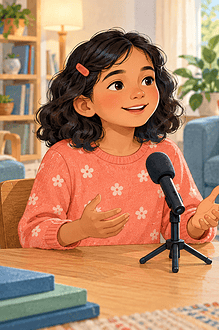
A problem turned over silently in your own head for days can feel enormous, impossible, unsolvable. The same problem, said out loud to another person, often sounds smaller the moment it’s actually spoken. Say It Out Loud is a genuinely simple idea worth teaching a child directly.
Why this matters
Many children, and plenty of adults, sit with a difficult feeling or a brewing conflict privately for far longer than necessary, partly because voicing it feels like it makes the problem more real. In fact, the opposite tends to happen: putting a problem into actual words, to a friend, a parent, or even just alone out loud, often reveals that it’s more manageable than it felt while it was only a vague, circling worry in their head.
How to use this idea
When your child is clearly carrying something unspoken, a worry, a brewing disagreement with a friend, gently encourage them to say it out loud, to you, to another trusted person, or, if the issue feels too private to share, simply to themselves, genuinely out loud rather than silently in their head. Resist jumping immediately to solving it the moment they start talking, let them finish getting the whole thing out first.
Notice and name the shift when it happens: “Does it feel a little different now that you’ve said it out loud?” This helps a child start to recognise the pattern themselves, rather than only experiencing it without understanding why it helped.
Why speaking something changes how it feels
There’s a real difference between a worry that exists only as a vague, looping feeling, and one that’s been turned into actual, specific words. Putting something into language forces a bit of structure onto it, which tends to make an overwhelming feeling considerably more concrete and considerably less all-encompassing than it felt while it stayed unspoken.
When the problem is too private to share
Not every worry feels safe to share with another person, and that’s worth respecting. For those situations, encourage your child to try saying it out loud to themselves, alone, genuinely speaking the words rather than just thinking them. It sounds like a small difference, but many people find it does real work even without another listener present.
Why this is worth teaching as a first step, not a last resort
Children, like adults, often reach for “talking it through” only once a problem has already grown large and unmanageable. Teaching this as an early, routine first step, said out loud before it’s had time to grow in the silence of your own head, tends to keep problems from building up as much in the first place.
A problem spoken out loud rarely vanishes entirely, but it reliably starts to feel more workable, and a child who learns to reach for this simple step early has a genuinely useful habit for handling difficulty for the rest of their life.