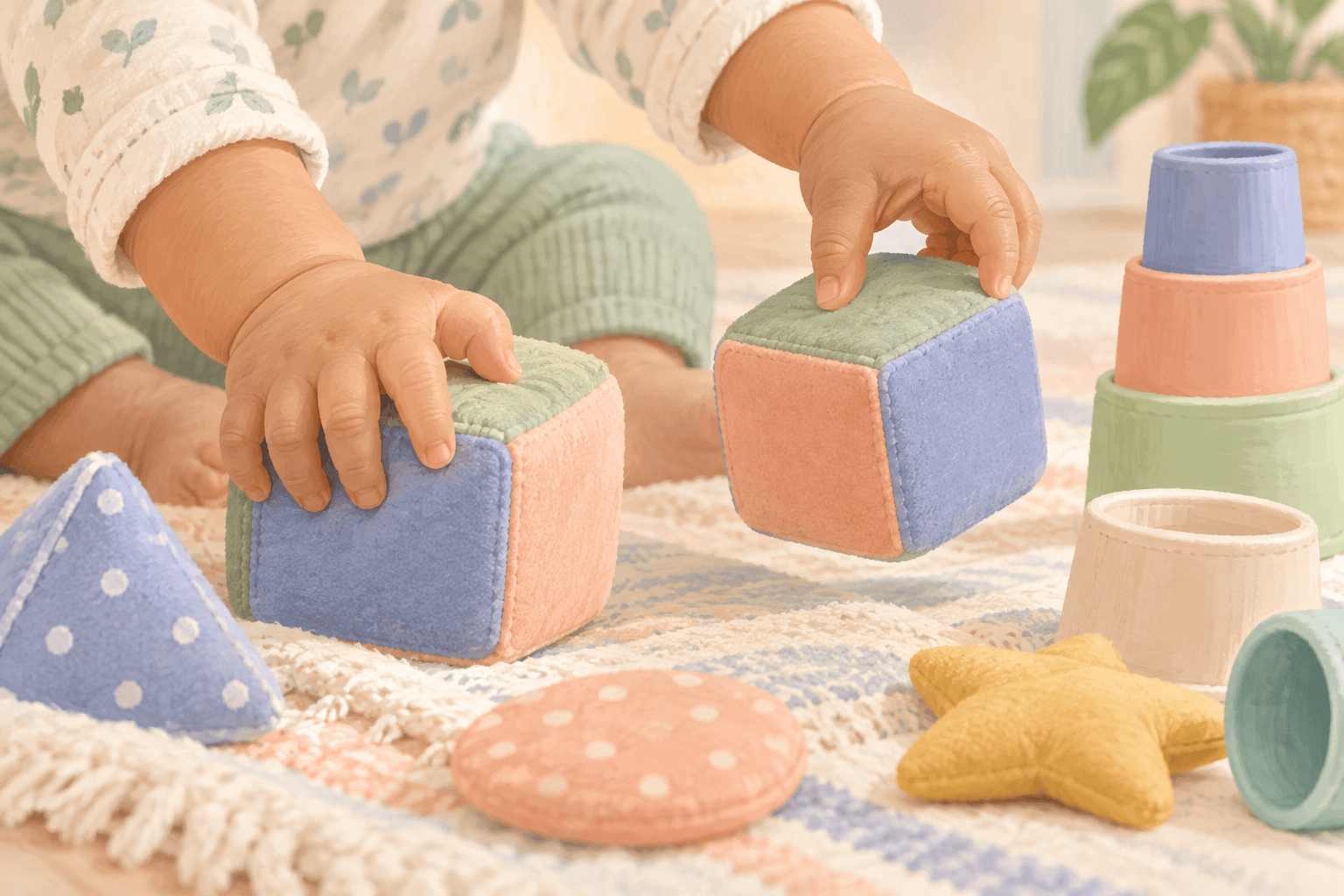
Fine-motor development is easy to overlook because it happens in tiny movements: a whole-hand grab becomes a finger-and-thumb pick-up; an accidental drop becomes deliberate release. Babies practise these skills through ordinary play and meals, not special worksheets.
Try a container game
You need: a low bowl or box and three to five objects too large to swallow, such as soft blocks, fabric squares or wide stacking rings.
- Sit your baby securely on the floor or in a supported position appropriate for them.
- Place one object within easy reach and let your baby explore it.
- Show a slow “in” movement, then wait.
- If the object goes into the container, tip it out and begin again.
- Stop when your baby turns away, mouths everything repeatedly or becomes tired.
There is no correct grip. The point is reaching, holding, transferring, releasing and trying again. A child with limited movement may participate by touching, choosing between two objects or activating an adapted toy.
Mealtimes can be practice too
When a baby is developmentally ready for complementary foods, safe finger foods can offer grasping practice. Food must be soft, appropriately prepared and suited to the child’s feeding abilities. Seat the child upright and supervise closely. Round, hard or coin-shaped foods can be choking hazards.
If your child has swallowing difficulty, poor head control, a history of choking or a feeding plan, follow advice from their qualified clinician rather than general online suggestions. Non-food play gives the same hands a chance to practise without adding feeding risk.
Change the challenge gently
- Offer a larger object before a smaller safe one.
- Use containers with wide openings.
- Try both hands and place objects at the centre.
- Add a spoon only after scooping and releasing are enjoyable.
- Let mess be information, not misbehaviour.
Speak with your child’s health professional if hand use seems consistently one-sided, very stiff or floppy, if reaching or grasping is not progressing, or if a skill is lost. A checklist can guide observation but cannot diagnose the reason.
For broader participation, explore life skills by age and ability. If you want another open-ended activity, see how to help a child start their own game.