By EdCaptain editorial desk · Published
The bow is almost there, then one loop disappears and your child is holding two loose ends again. That is a useful clue: they may need help with keeping a loop in place, rather than another demonstration of the whole knot at full speed.
This lesson is for children aged 6–12 who want to practise tying ordinary shoelaces with a caregiver. It is not an age deadline. A child can use manageable footwear and keep learning this skill separately.
Find the point where the bow falls apart
Ask your child to show you what they already do. Do they cross the ends but lose the first knot? Make a loop but let go while wrapping? Pull a loose end instead of the second loop? Name that movement: “You kept this loop. The next part is finding the folded bit on the other side.”
Choose one bow method for now. The directions below use a first loop, a wrap and a second loop pushed through. If your child already uses another workable method, you do not need to replace it. Avoid switching instructions halfway through an attempt.
Set up where both hands can see the job
You need a clean shoe with sound, ordinary laces, a stable table and comfortable seating. Put the shoe off the foot first, heel towards the child and toe pointing away, as it would look when worn. Let them reposition it if reaching is awkward.
Leeds Community Healthcare’s shoelace advice recommends flat laces, enough length to make a bow and practising with a shoe within easy reach. A very short or slippery lace adds a problem that repeating instructions will not fix.
Keep loose laces away from babies and younger siblings. Never practise by tying cords around fingers, wrists, legs or necks. The shoe is the practice object. An adult handles any changes to the lacing; avoid adding loose beads or other small decorations as teaching aids.
Show one slow bow
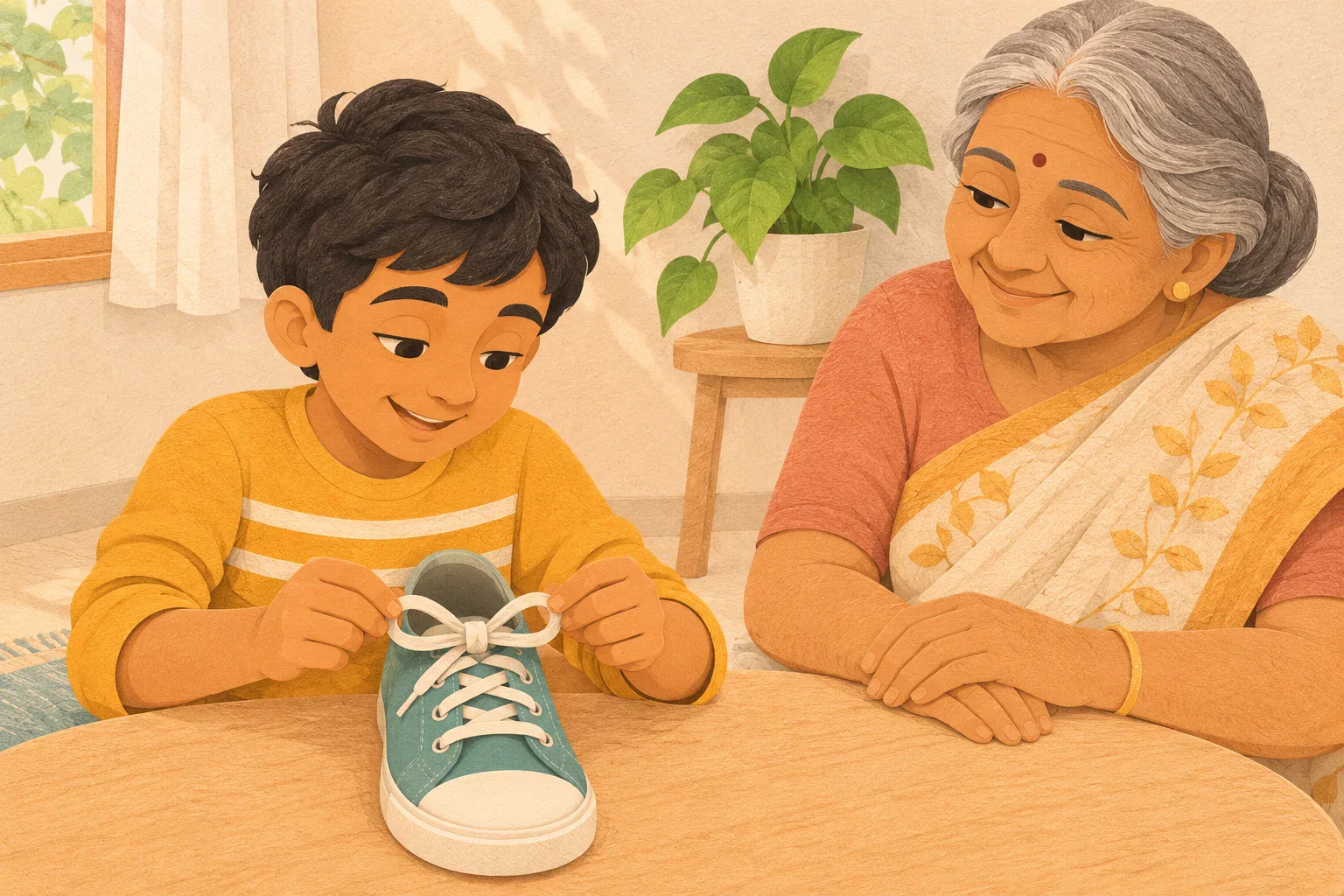
Sit alongside your child so your demonstration faces the same way. Agree which hand will hold the first loop; either can do that job. Demonstrate on the shoe without moving their hands for them.
- Make the starting knot. Cross the two lace ends, tuck one end under the crossing and pull the ends outward so the shoe closes comfortably. This is the starting half knot, before the bow.
- Fold a first loop. Fold one lace back on itself. Pinch the loop near its base, leaving a loose tail. Keep holding that pinch.
- Wrap the other lace. Bring the free lace around the base of the first loop. Show the small opening left by the wrap; do not tighten it closed yet.
- Push a fold through. Fold a section of the wrapping lace and push that folded section through the opening. Do not feed the whole loose end through. There should now be a loop on each side.
- Pull the loops. Hold one loop in each hand and draw them apart to snug the bow. Keep both tails outside the knot. An adult checks that the bow holds and is not uncomfortably tight.
The Betsi Cadwaladr NHS shoelace handout breaks this sequence into teachable movements and describes starting with the final pull. Its guidance is a teaching aid, not a promise about when a child will master the skill.
Hand over the finish, then one earlier movement
Make the bow yourself until both loops are ready but loose. Offer them to your child: “These are the two loops. Pull these apart.” If a loop slips through, calmly rebuild that position. There is no need to restart the whole lesson.
When that finish feels manageable, let your child take over finding and holding the second loop before pulling. Later, they can push the folded section through while you steady the first loop. Keep returning to the same bow method.
This is backward chaining: the adult does the beginning and gradually hands over more of the end. Just One Norfolk’s dressing guidance explains the approach and recommends practising when nobody is rushing. Your child still sees the whole sequence; they are only responsible for a manageable part of it.
Try asking, “Would you like me to hold the loop or show it again?” That gives a concrete choice. Keep practice brief enough to finish willingly, rather than setting a target number of perfect bows. Helping with school shoes on a busy morning does not undo the practice.
Change the support to match the learner
Ages 6–9: Start with the prepared final pull or one loop-holding job. Say one short cue, then pause. The child can point to the opening while you demonstrate pushing the fold through. Notice the action: “You held that loop while the other lace moved.”
Ages 10–12: Ask which movement needs a closer look and offer private practice. A child may want to make a few drawings of their own shoe sequence or describe it in their own words. Give help without calling the task easy or comparing them with younger children.
Colour contrast may help some learners distinguish the two lace paths; the NHS handout suggests different colours. If colour is not useful, rely on position, touch and the child’s preferred cues. Read instructions aloud or demonstrate silently, depending on what helps. For persistent grip, vision or movement barriers, ask an occupational therapist about an individual setup rather than forcing a standard hand position.
Keep daily footwear practical
Once the off-foot practice works, try the shoe while worn, with the child safely seated. The angle changes, so restore help if needed. Before walking, an adult checks fit, the fastening and whether loops or ends could trail underfoot. Stop and ask for help if a lace comes loose; do not try to retie it while moving.
Leeds lists alternatives such as hook-and-loop fastenings and elastic laces. Choose footwear and any fastening system suitable for the child and activity, following its instructions. An alternative is a useful daily solution, not a reward to withhold until a child learns a bow.
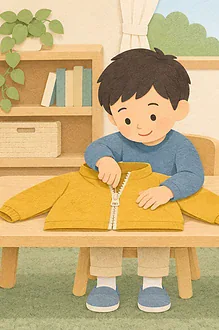
Ask afterward, “Which part stayed in your fingers today?” Keep that answer for next time. If clothing discomfort is also getting in the way, our sensory-friendly dressing guide addresses that separate barrier. Our coat-zip lesson offers help with a different fastening.
Seek individual advice if dressing difficulties regularly limit participation, or if there is pain or a new loss of a skill. Keep practical help available while you find support.
Sources and further reading
- Betsi Cadwaladr University Health Board: shoelace sequence and backward chaining
- Just One Norfolk: supporting dressing practice
- Leeds Community Healthcare: shoes, shoelaces and adaptations
Read our editorial policy and review methodology.