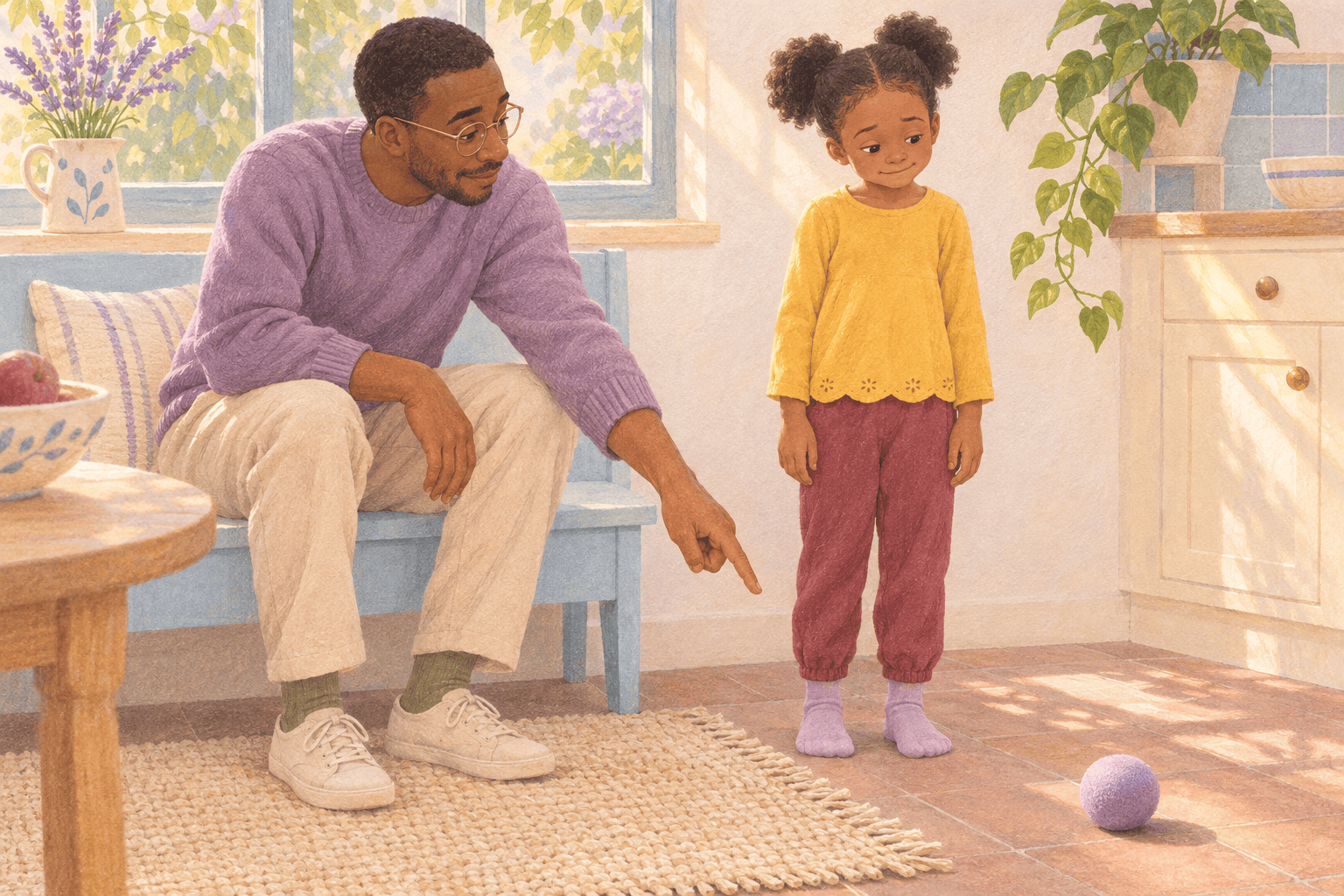
You ask your child to stop bouncing a ball in the kitchen. They catch it, look up at you and giggle. For a second, the laugh feels like the whole problem. Look at their hands. If the ball has stopped, your child has already done the first thing you needed.
A grin during a correction can be hard to read. Your child may still be in a playful mood, feel awkward, or think you’re joining the game. You can hold the limit without deciding what the laugh meant. Start with what needs to happen now.
Give the ball somewhere to go
If the ball is still bouncing, move close enough for your child to hear your ordinary speaking voice. “Put the ball on the rug, please.” Point to the spot and give them a moment to act. If they put it down while smiling, a simple “Thanks for putting it down” is enough. You can move on together.
If the bouncing continues, check that they heard the instruction and understood what you meant. If it’s safe to give them another chance, say what will happen if the bouncing continues. Then follow through calmly. “I’m putting the ball away for now. We can bounce it outside later.” If there’s an immediate risk, move the object out of reach first. Keep the explanation brief.
UNICEF’s positive discipline guide suggests making directions specific and setting expectations your child can manage. You might notice a difference between “Stop messing around,” which leaves several things to figure out, and “Put the ball on the rug,” which gives them a next step they can see.
What to say when a laugh changes the conversation
- They stop the action but keep giggling. “The ball’s down. Thank you.” Give the giggle room to pass. You can go back to making lunch or helping them find something else to play with.
- They laugh and start the same action again. “The kitchen is for rolling the ball. I’m putting it away now.” Follow through on the ball instead of adding a separate consequence for the laugh.
- Another child is hurt or upset. Stop the action and check on the child who was hurt first. When everyone can listen, help your child find a practical way to put things right. “Your sister’s tower fell when the ball hit it. Shall we pick up the blocks together?” Ask the sibling if they want help rebuilding or would prefer space.
- You can feel yourself getting louder. If everyone is safe, take a moment before speaking again. If you snapped, you can come back to it. “I shouted at you. I’m sorry. The rule is still that we bounce the ball outside.” EdCaptain’s guide to apologising after yelling has more examples.
Match your words to the child in front of you
For a two-year-old, show them where the ball goes. A palm held low over the rug and “Ball here” may be enough. A preschooler may be able to choose between rolling it on the rug or taking it outside with you when there’s time. For a school-age child, save the longer conversation for later and invite their account. “I thought we were still playing, and then you got mad” gives you something concrete to work with. Next time, you can say “Game’s over” before giving the direction.
If your child needs more time to process speech or uses signs, pictures or a communication device, use the cue they already understand. Stand where they can see or hear you comfortably. You can check whether your message landed by seeing what they do or how they respond in their usual way. A child can understand the direction while looking elsewhere.
Notice what happens just before the giggle
If the same scene keeps playing out, look for one detail you can change. Does it happen as you’re ending an energetic game, when siblings are watching, or when you call a direction from the next room? Try walking over before you speak, stepping aside together, or giving the next direction before the game gets louder. EdCaptain’s guide to connecting before correcting a refusal can help when the bigger issue is getting an instruction through.
Later, if your child is up for talking, “What did you think was happening when I asked you to put the ball down?” leaves space for an answer. If they don’t know, you can still agree on what to do next time. Look for the ball going down sooner, or a child asking “Can I take it outside?” Those are changes you can build on even if the odd giggle still slips out.