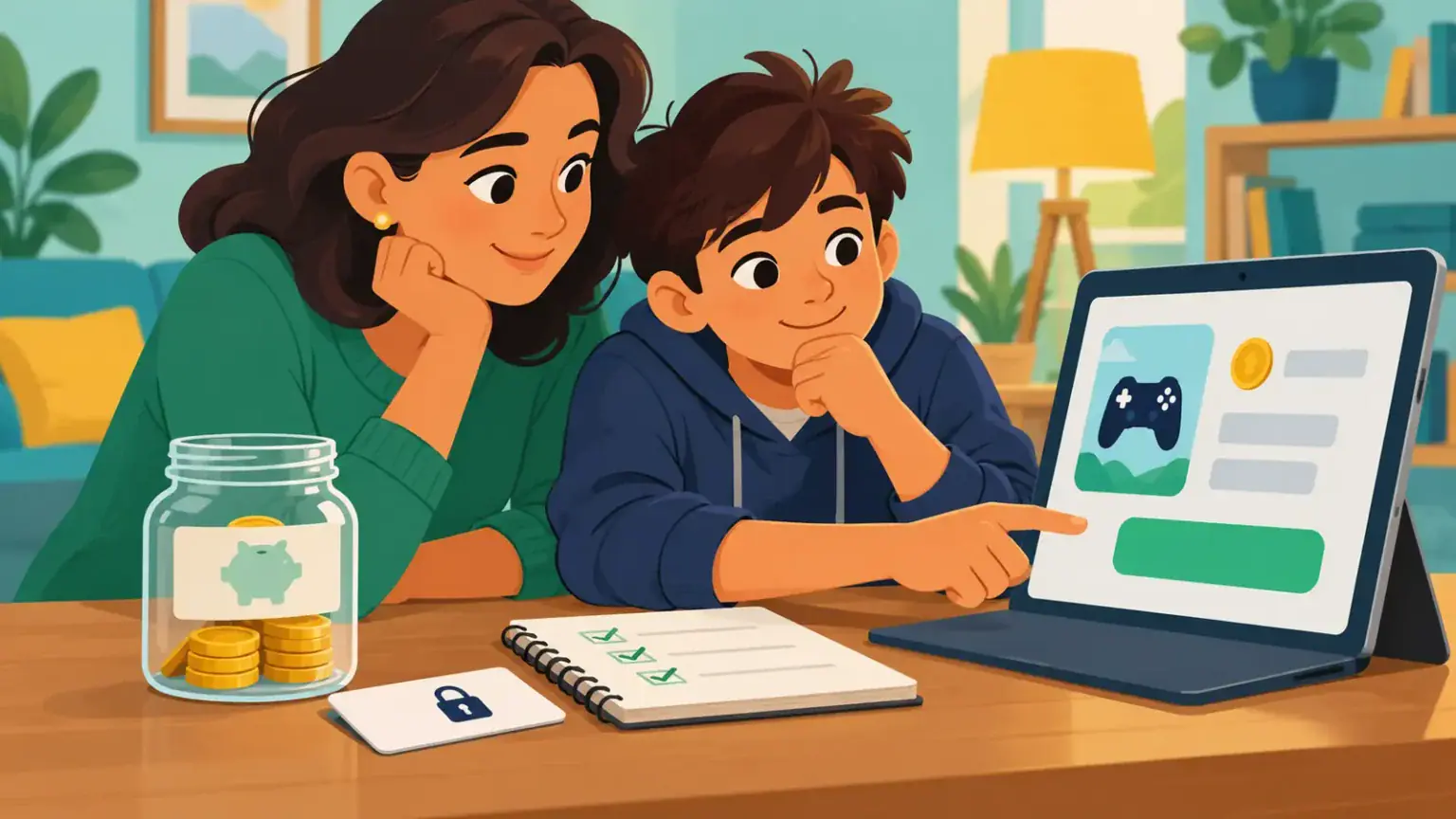
A game can be free to download and still invite spending every few minutes: a new skin, extra life, season pass, virtual currency or time-limited offer. Children may not always recognise when play has crossed into a real-money transaction. A written agreement makes the pause point clear before excitement takes over.
The agreement should combine conversation with technical safeguards. A promise alone is easy to forget; a password alone does not teach how offers are designed.
Open without accusation
Say: “Games can make purchases feel like part of play. Let’s agree on when spending is allowed, who approves it, and what we do if a purchase happens by mistake.” Review the exact games and stores your child uses, because settings differ.
Seven decisions to put in writing
- Permission: Is approval required for every purchase, even with saved allowance or a gift card?
- Limit: Is the amount zero, a monthly cap, or a case-by-case budget? State the real currency, not only virtual coins.
- Pause: How long should the child wait before buying? A 24-hour pause can reduce pressure from countdowns.
- Account: Which adult owns or supervises the account? Never share a store password in a chat.
- Purchase settings: Require authentication, turn off one-click buying where possible, and review saved payment methods.
- Risky mechanics: Decide whether random-reward purchases, loot boxes or chance-based packs are allowed.
- Mistakes: Agree to tell an adult immediately so the family can check receipts and the platform’s refund process.
A sample agreement
“Real-money game purchases need adult approval before checkout. Our monthly limit is ____. We look at the price in real currency, what the item does, and whether it expires. Store authentication stays on, and payment details are not shared. If a purchase happens by mistake, tell an adult straight away; we will solve it without hiding it.”
If your household chooses a zero-spend rule, say it plainly: “We do not spend real money inside games. You may enjoy content earned through play, and you can ask if an offer is confusing.”
Teach the five-question pause
Before any approved purchase, ask:
- What is the price in real money?
- Is this a permanent item, a consumable or access that expires?
- Is the offer random, or do you know exactly what you receive?
- Would you still want it tomorrow?
- What else could this money buy or save toward?
This is not a test the child must pass. It is a decision routine you practise together until they can use it independently.
Adapt it by age
Ages 6–9: Keep purchasing locked behind adult authentication. Point out the difference between game coins and money charged to an account. Avoid attaching a reusable payment method to a child’s unsupervised device when a safer setup is available.
Ages 10–12: Compare bundles and subscriptions in real currency. Discuss countdown timers, “best value” labels and influencer promotions. Let the child bring offers to you without being mocked.
Teenagers: Agree on whether earnings, allowance, gift cards and family payment methods have different rules. Discuss recurring subscriptions, account resale scams and the fact that digital items may be locked to an account or disappear when a game closes.
If an unexpected purchase happens
First, stop further charges: change purchase settings or remove the payment method if needed. Save the receipt and contact the platform or app store through its official support route. Refund rules vary, so do not promise a refund. Then review what happened: Was authentication off? Was the price unclear? Did a younger sibling use the account? Fix the weak point.
Use consequences that relate to the problem—repaying an agreed amount from discretionary funds, pausing purchases while settings are repaired, or requiring shared checkout—rather than banning all disclosure with an explosive response.
Add this page to EdCaptain’s family screen agreement. The guide to child account security and phishing can strengthen passwords and scam awareness, while the gaming switch-off plan covers a different common pressure point.
Review when games or devices change
Revisit the agreement after a new console, phone, game, gift card or bank account. Check transaction history together at an agreed interval. The purpose is not surveillance for its own sake; it is to keep real money visible inside an environment designed to make spending feel frictionless.