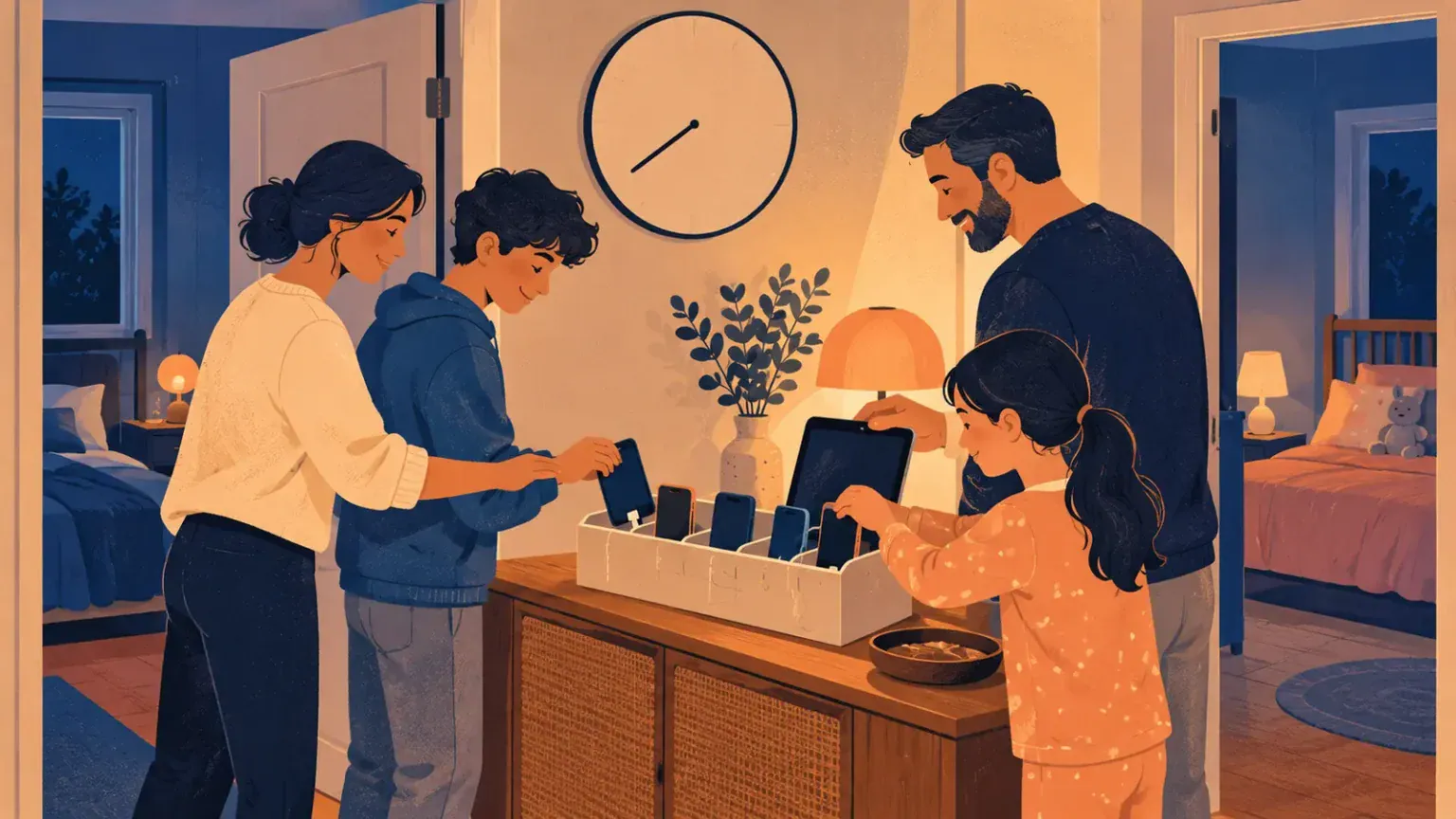
“No phones in bedrooms” sounds simple until someone needs an alarm, a teenager is waiting for a late message, a parent works on call, or the charging cable lives beside the bed. A useful agreement handles those details before everyone is tired.
The aim is not to prove that screens are bad. It is to make sleep easier to protect by putting devices, alerts and late-night decisions in a predictable place.
Write the agreement together
Start at a neutral time: “We want everyone to get enough rest and not have notifications pulling at us overnight. Let’s choose where devices charge, what time they arrive, and what exceptions we genuinely need.”
Children are more likely to understand a rule they can see. Adults should be included too, even if work or caregiving creates different exceptions. Fair does not always mean identical, but exceptions should be explained rather than quietly ignored.
The six parts of a workable plan
- Which devices? Name phones, tablets, smartwatches, handheld consoles and school devices. Decide whether e-readers or audio players stay.
- Where? Choose a ventilated, accessible charging station outside sleeping spaces. Do not place devices under pillows or bedding.
- When? Set a check-in time linked to the bedtime routine, such as after the final message and before teeth brushing.
- What settings? Agree on Do Not Disturb, overnight contacts, notification muting and automatic updates.
- What replaces the device? Provide an alarm clock, book, music option, water and any accessibility support needed.
- What happens after a miss? Use a calm reset, not a surprise punishment: return the device, solve the barrier and try again the next night.
A sample agreement
“On school nights, phones, tablets and gaming devices go to the kitchen charging shelf at 9:00 p.m. Alarms are set before charging. Calls from starred family contacts can come through. Devices return after the morning routine. If someone needs an exception for work, travel, illness, accessibility or a planned event, we agree on it before bedtime.”
Adjust the time to the child’s age, school schedule and sleep needs. The agreement is a household tool, not a universal bedtime prescription.
Adapt it by age
Ages 6–9: Keep the sequence visual and adult-led: save the game, send a final message, dock the device, choose a book. A charging basket beside the parent’s routine can help.
Ages 10–12: Let the child help select the location and test an alarm clock. Discuss why streaks, group chats and game events make stopping hard instead of treating difficulty as defiance.
Teenagers: Include privacy and social realities. Decide how friends know the offline time and whether one emergency contact can bypass silence. Avoid reading messages as part of routine enforcement unless there is a specific safety concern and your family’s privacy expectations are clear.
Plan for common objections
“I need it for my alarm.” Test a separate clock for a week. If an accessibility feature is essential, design a more limited overnight setup rather than removing needed support.
“My friends will be angry.” Help draft a status or message: “I’m offline after 9; I’ll answer in the morning.”
“You keep your phone.” Explain the actual exception and reduce unnecessary use: “I am on call tonight, so my phone stays audible across the room. On other nights it charges outside too.”
“I forgot.” Add an environmental cue—a reminder, labelled cable or docking step in a visual routine—before adding consequences.
Review after one week
Ask: Did the location work? Were alarms reliable? Did anyone need an unplanned exception? Did mornings become harder because a school device was forgotten? Change the system without abandoning the purpose.
This agreement can be one section of EdCaptain’s broader family screen agreement. If switching off games is the main barrier, use the plan for reducing gaming shutdown arguments to build warnings and save points into the routine.
Consistency matters more than a dramatic first night. A visible charging home, realistic exceptions and adult modelling turn an abstract rule into a repeatable family habit.