“How was school?” is a caring question, but it arrives when many children are hungry, tired or still shifting out of school mode. “Fine” may be the shortest route to quiet, not a sign that your child has nothing to share. Move the conversation away from pickup, offer one small prompt and make passing genuinely acceptable.
- Land before you ask
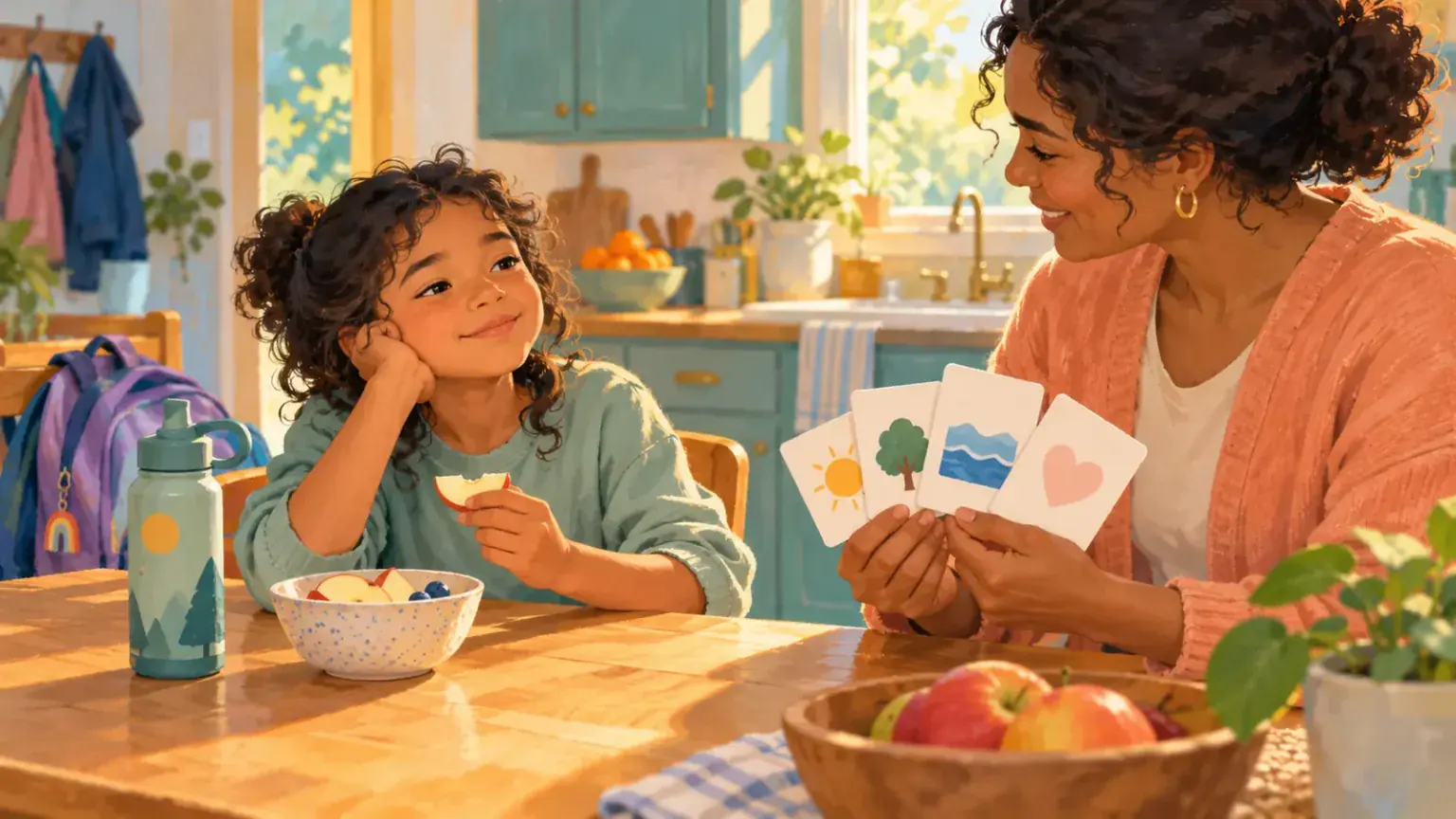
- Five reusable cards
- 1. What felt easiest today?
- 2. What took more energy than people could see?
- 3. Who or what helped?
- 4. If today were weather, what would it be?
- 5. Is there anything tomorrow-you needs from us?
- Three ways to answer without talking
- How to keep an answer open
- When a short answer needs follow-up
- Make the routine sustainable
- Sources and further reading
Land before you ask
Start with greeting, food or water, the toilet, a change of clothes and a few minutes without demands. The after-school landing routine can help separate arrival from conversation. Later, say, “I have one card if you feel like it.” Do not pull the whole deck when the first answer is short.
Five reusable cards
1. What felt easiest today?
This is often simpler than asking for the best moment. A young child can point to a picture for play, food, friend or work. Older children may name a class, journey or tiny relief. Reflect the answer—“Math felt clear today”—without immediately asking why.
2. What took more energy than people could see?
This gives language for waiting, noise, concentrating or managing feelings. Make “nothing” an acceptable answer. If a child mentions a difficult situation, ask, “Do you want listening, ideas or help?”
3. Who or what helped?
The answer may be a friend, teacher, routine, object or the child’s own strategy. Avoid turning it into a gratitude requirement. “My headphones helped” is as useful as naming a person.
4. If today were weather, what would it be?
Offer sun, cloud, wind and rain pictures, or let a child invent “foggy with one thunderclap.” Metaphor can communicate without forcing details. Do not interpret the weather for them.
5. Is there anything tomorrow-you needs from us?
Answers might include finding a book, signing a form, ten quiet minutes or nothing. Be honest about what you can do: “I can help check the bag; I cannot change the test date.”
Three ways to answer without talking
A child may point to a card, draw for two minutes or place it face down to pass. A non-speaking child can use objects, AAC, signs, eye gaze or yes/no choices. Do not require eye contact. Side-by-side moments—walking, cooking or driving—may feel easier than sitting face-to-face.
How to keep an answer open
Use one reflection before another question: “You were proud that you kept trying,” or “Lunch felt lonely.” The CDC describes active listening as giving attention and reflecting words or feelings. A reflection can be wrong; if your child corrects you, thank them and try again.
Avoid cross-examination: “Who? When? Why didn’t you tell the teacher?” If safety may be involved, calmly gather what you need and explain the next step. Otherwise, let the story unfold. For broader guidance, see start smaller when conversations feel difficult and the family meal conversation cards.
When a short answer needs follow-up
Repeated distress, fear of school, unexplained injuries, bullying concerns or major changes in sleep, eating or mood deserve attention. Tell your child what you will do and involve the school or a qualified professional as appropriate. Do not promise secrecy you cannot keep when someone may be unsafe.
Keep the cards available for a week, then ask which one should stay. A successful check-in is not measured by word count. It is the child learning that home contains a listener who can wait.
Make the routine sustainable
Use only one card on an ordinary day and let the adult answer it too. Rotate cards rather than asking all five. If pickup happens with several children, offer private time later so no one must share in front of siblings. Review the routine after a week: keep the prompts that invite connection and retire those that feel like homework. A child who passes today should still receive the same warmth, snack and welcome.