
By EdCaptain editorial desk · Published
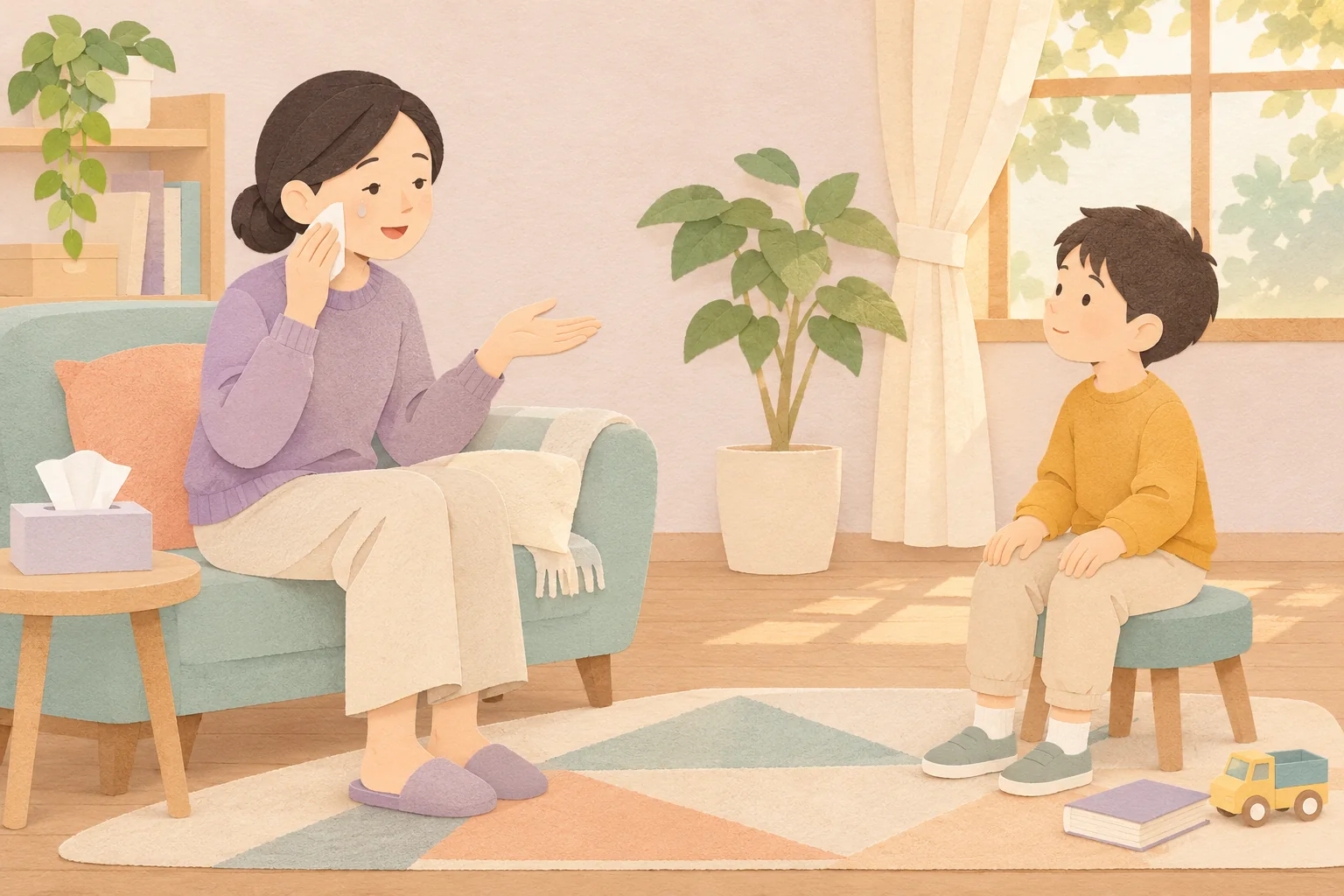
You thought you had a quiet moment, but your child appears in the doorway. “Why are you crying?” You may not know how much to explain, or worry that seeing your tears has already frightened them.
For children aged 3–12, start with what is happening and what they need to know next. You can acknowledge sadness without telling the whole adult story. These example scripts are options to adapt, not a test of how calmly you should be able to speak.
Say what they can already see
“You noticed my tears. I’m feeling sad right now.” If you are not sure what you feel, try: “I’m having a difficult moment, and I’m still working out the words.” There is no need to insist you are fine when your face and voice say otherwise.
Choose a small, true explanation. “I’m missing someone today,” or “I heard disappointing news about work,” may be enough. Do not invent a harmless reason to cover something your child needs an accurate explanation for, such as a death or a change in who will care for them.
In guidance following distressing events, UNICEF recommends honest, age-appropriate conversations while avoiding oversharing adult fears. That is a useful boundary here: explain the part the child needs, then take the fuller conversation to another adult.
A short script for an ordinary difficult moment
Use only the parts that are true:
“I’m crying because I’m sad about something that happened today. You haven’t done anything to cause this. I can look after you while I feel sad. I’m going to sit quietly for a moment, and I’ll talk to another grown-up about what I need. You don’t have to stop my tears.”
If you cannot safely manage care at that moment, replace the middle sentence with the actual plan: “Your aunt is here and will make lunch with you while I speak to someone.” Name a person who has agreed, rather than announcing help you have not arranged.
Finish with one practical detail: “We’re still going to collect your library books this afternoon,” or “Today’s plan has changed; your uncle will collect you.” Predictability can be more useful than a long explanation about why everything will eventually be all right.
Answer the question beneath “Why?”
- “Was it me?” If it was unrelated, say so plainly. If a difficult interaction involved the child, separate the event from responsibility for your feelings: “We had a hard moment earlier. I am responsible for how I respond and for getting support. You don’t have to make me feel better.” Address any harmful behaviour separately, without using your tears as the consequence.
- “Are you sick?” Explain what you actually know. “These tears are because I’m sad; I’m not crying from an injury.” If you are unwell, give a truthful explanation of the care and arrangements the child will notice. Avoid promising that nobody will ever become ill.
- “Who will look after me?” Answer concretely: who is present, who will collect them, and what happens at bedtime. If you do not know yet, say you are arranging it and return with the answer.
- “Can I help?” “A hug would be lovely if you want one. You don’t have to stay with me or keep checking whether I’m okay.” It is also fine to decline touch kindly: “I’d like a little space, and I’m glad you asked.”
If your crying followed shouting or a frightening argument, acknowledge that behaviour too. Our script after a child hears adults arguing helps keep the adult disagreement and its repair with adults.
Keep adult support separate from a child’s kindness
A spontaneous cuddle is different from a child being asked to listen to every worry, mediate an adult relationship or watch for the next episode. Avoid “You’re the only person I can talk to,” “Be strong for me,” or asking them to promise they will never leave you.
You can accept kindness without assigning a role. Thank them once, then make your own call, arrange support and return to caring for them. Do not ask whether they still love you to settle your own guilt.
The NHS advises caregivers to seek support from trusted adults and recognises that struggling does not make someone a bad parent. If you need practical cover, ask for a specific task. EdCaptain’s guide to getting more support for parenting stress can help you decide what to describe when asking.
Use the amount of language your child can manage
Ages 3–5: Keep it brief: “I’m sad and having a cry. You didn’t cause it. I’m here with you.” Show the next familiar action, such as sitting together with a book. A child may return to play or ask again later; neither response requires a lecture.
Ages 6–9: Offer a short reason and check the main worry: “What were you wondering when you saw me?” Correct a particular misunderstanding rather than supplying lots of extra details.
Ages 10–12: Explain a little more when useful, but keep adult disputes, private messages and decisions with adults. “I can tell you what affects our plans. I’m discussing the private details with another adult.” They can ask questions without becoming your adviser.
At every stage, allow a written question, signing, pictures or a communication aid. Use direct words if “a hard day” is too vague. Give processing time, and do not require eye contact, reassurance or a hug as proof that the conversation worked.
Return to the child’s experience
Later, try: “When you saw me crying, was there anything you were worried about?” Accept a short answer or a wish not to talk. Explain that they may speak with another trusted adult; family privacy should not mean keeping a worrying experience secret.
If you brushed them off, correct that: “I said ‘go away’ sharply. I needed a pause, but I should have told you what was happening.” Say what you will try next time and keep that plan realistic.
Seek professional advice if your distress is persistent, worsening or affecting everyday care, or if your child’s worry is disrupting sleep, school or usual activities. Crying alone does not identify a diagnosis. If anyone may be harmed or you cannot keep yourself or your child safe, bring in a safe adult and seek urgent local help. Do not leave a child to manage the emergency.
Sources and further reading
- UNICEF: honest conversations and adult support after distressing events
- NHS Every Mind Matters: supporting children and looking after yourself
Read our editorial policy and health information guidance.