A home-learning plan does not need seven subjects in neat rows every day. School timetables are built for buildings, groups and staffing. At home, a useful week protects a few priorities, makes room for family life and shows what to do when the plan stops working.
- Start with local responsibilities
- Choose three weekly anchors
- Plan blocks, not a minute-by-minute day
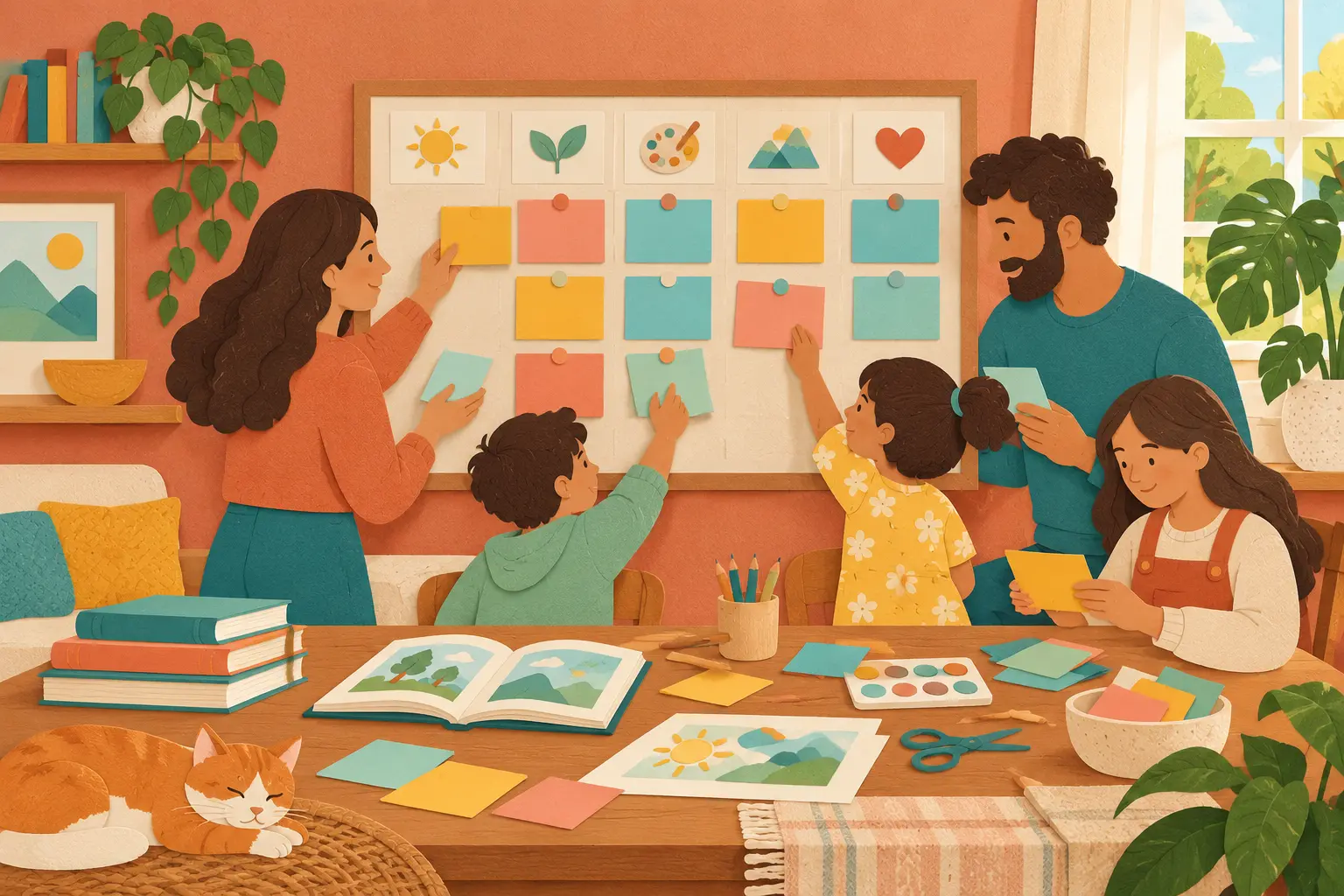
- Use a simple weekly board
- Plan for different ages together
- Include accessible participation
- Create a minimum day
- Make social learning visible
- Review evidence, not appearances
- Notice when the plan is too heavy
- Close the week together
- Budget the adult’s attention
- Sources and further reading
Start with local responsibilities
If your child is formally home educated, check the current law, registration process, curriculum expectations and assessment duties where you live. Requirements vary widely. A flexible routine does not remove the adult’s responsibility to provide a suitable education.
Choose three weekly anchors
- Literacy: reading, conversation and meaningful writing.
- Mathematical thinking: number, measure, data, shape or problem-solving.
- Inquiry: science, history, geography, art, technology or a child-led project.
Add movement, social connection and practical life across the week. An anchor is a direction, not a worksheet quota.
Plan blocks, not a minute-by-minute day
Try one focused block in the morning, a practical or outdoor block later, and independent reading or creative work when energy is lower. A preschooler may engage for ten minutes; an older child may work for forty. Stop before attention collapses and return later.
Use a simple weekly board
- Write the three priorities.
- Add fixed appointments, work hours and care responsibilities.
- Place the hardest task in the child’s most alert period.
- Keep one block empty for unfinished work or an unexpected interest.
- Choose a short Friday review.
A child can move task cards between today, later and done. This gives choice without making the child responsible for the whole programme.
Plan for different ages together
Siblings can share a theme while working at different levels. During a garden study, one child sorts leaves, another measures growth and a teen researches soil or writes a report. Shared openings and endings reduce adult switching; the middle task stays individual.
Include accessible participation
Use audio, speech-to-text, large print, movement breaks, visual schedules or hands-on materials as needed. A shorter task the child can genuinely access is better evidence of learning than a long task completed by the adult.
Create a minimum day
Illness, work pressure and difficult nights happen. Decide in advance what still counts: perhaps shared reading, one practical maths conversation and outdoor movement. A minimum day prevents a disrupted morning from becoming a week of guilt.
Make social learning visible
Include regular contact with peers and other trusted adults through clubs, libraries, sports, community activities or cooperative learning. Social connection should not be treated as a reward earned only after worksheets. Check supervision, access and safeguarding just as you would for any activity.
Review evidence, not appearances
Ask what the child can now explain, apply or create. A crowded folder may show activity without understanding. Keep one example, a photo of a model, a reading note or the child’s explanation, then choose the next step.
Notice when the plan is too heavy
Repeated avoidance, tears, unfinished work or adult exhaustion may mean the task, timing, support or overall load needs changing. It does not automatically mean the child is lazy. Reduce friction before adding consequences.
Close the week together
Ask: What became easier? What remains confusing? What should we continue, stop or try differently? Adults make sure essential learning is covered, while children contribute useful information about pace and method.
Use EdCaptain’s guides on helping with maths, sorting games, and an everyday play box.
Budget the adult’s attention
Mark which blocks require direct teaching, which need a quick check-in and which the child can manage independently. Put adult-intensive work where it does not collide with meetings, care or cooking. A beautiful plan that assumes constant supervision will fail in an ordinary household.
Prepare a small independent basket with known books, puzzles, drawing materials or review cards. Independent time should use familiar skills; it is not the moment to introduce a difficult new concept without support.