By EdCaptain editorial desk · Published
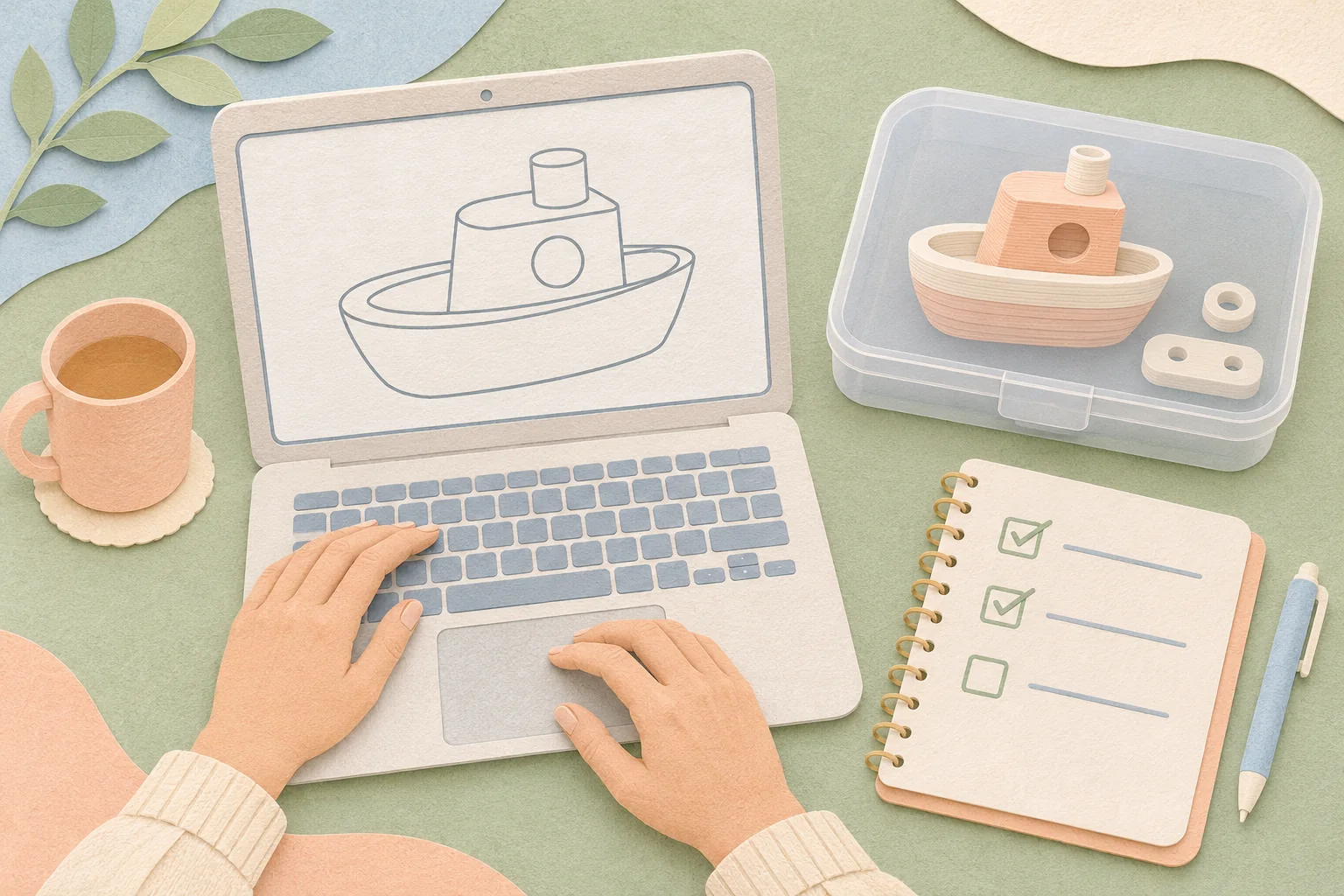
A relative sends a link to a printable toy: choose a colour, ask the library to make it, and collect it next week. The pictures look smooth and the comments say the design prints beautifully. Before promising it to your child, separate two questions: can this file produce an object, and is that particular object suitable for play?
Those are different decisions. A successful print, a popular download or a friendly maker’s recommendation does not by itself answer the safety question. This guide is for adult caregivers deciding whether to proceed, rather than instructions for children to operate a printer.
Start with the job the object will do
Save the design link and ask what the object is actually intended for. Is it a display model, a prototype for discussing an idea, or a toy meant to be handled repeatedly? A picture of a child beside it does not settle that question.
Write down the planned use in ordinary words: “This would be squeezed and dropped during play,” rather than simply “a cute animal”. Note whether it could reach a younger sibling or a child who mouths objects. This helps you ask specific questions instead of searching for a general “safe” label.
Do not assume that calling an object educational changes how children will use it. Our safer toy buying guide explains why abilities, age guidance and everyone sharing the space matter.
Ask what evidence belongs to this finished print
In its 2022 lifecycle evaluation of 3D printers, US Consumer Product Safety Commission staff tested selected printed children’s products. Some released small parts during performance testing. The report highlights the importance of printing parameters and materials. It is a staff technical report, not a Commission approval of downloadable designs.
The practical implication is to ask about the object you would receive. Evidence about one design, material or production method may not establish the safety of a changed version. A material’s name alone cannot stand in for evidence about the assembled toy.
Send the maker or service a short message:
“We are considering this as a child’s toy, not a display piece. What intended age and use are documented? What safety assessment or testing covers the finished object made with your materials and settings? Are there assembly, cleaning or inspection instructions?”
If the answer is “people print these all the time”, the question remains open. Ask the supplier to explain what any certificate or test report actually covers, including the version and relevant market. Product requirements differ between countries; consult your local product-safety authority when the evidence or obligations are unclear.
Keep printing-process safety separate
A carefully managed printing room does not automatically make every output a suitable toy. Equally, choosing a promising design does not remove the hazards of making it.
NIOSH’s guidance for safer 3D printing describes potential exposure to particles and chemicals, hot surfaces and moving parts. Hazards can arise before, during and after printing, including cleaning and maintenance. Schools, libraries and makerspaces need risk management and appropriate controls.
Before booking a session, ask who operates the equipment, where printing and finishing occur, and what visitor rules apply. Do not treat the absence of a strong smell as a safety clearance. Follow the venue’s restrictions rather than asking a child to help with resin, hot parts or finishing tools. This article does not provide a ventilation specification or certify a household setup.
Make the pause concrete
Use a brief record with four entries:
- Design: the exact file, creator, version and stated purpose.
- Production: the identified maker, material and any changes proposed.
- Evidence: the intended age, instructions and explanation of what safety checks cover.
- Decision: proceed only with adequate information, seek clarification, or choose another route.
Check the file’s licence too. Permission to download is not necessarily permission to modify, redistribute or sell it. Ask the creator or service if the terms are unclear; keep any required attribution with the project. Permission to use a design and evidence that an object is suitable for play are separate matters.
If key information is missing, do not give the print to a child to “see how it holds up”. A household inspection or supervised trial cannot establish chemical safety or reproduce formal product testing. CPSC’s general toy guidance also says to follow age and safety information and keep small parts away from children under three.
Explain the decision without dismissing the idea
You can say, “Making something from a file is interesting. I still need to check whether this version can be a toy. We haven’t agreed to print it for playing with yet.” If you already promised, acknowledge that: “I said yes before checking. That was my mistake, and I need to pause.”
A design can remain an interesting image to discuss without becoming a physical plaything. There is no obligation to print it. If the family wants a toy now, choose an age-appropriate option with identifiable safety information rather than rushing to justify the download.
For an existing toy that has broken, use our repair, recall or retire guide. Do not assume a downloadable replacement part restores the original product’s safety; ask its manufacturer about an approved remedy.
Sources and further reading
- CPSC staff: Lifecycle Evaluation of 3D Printers — selected printed products and production-related limitations.
- NIOSH: Safe 3D Printing is for Everyone, Everywhere — process hazards and risk management.
- CPSC: Toys — age and small-parts precautions.
- EdCaptain editorial policy.