Ask a child what makes them unique, and most will struggle to answer beyond “I don’t know.” My Identification Card gives them an actual document to fill in, name, favourite food, special talent, what makes them happy, and turns an abstract question into something concrete enough to actually complete.
What you need
Paper and a pencil or crayon. A stamp pad or washable ink, optional, for the fingerprint section.
How to play
Draw or print a simple card template together with these fields: name, nickname, place and date of birth, where they live, favourite food and drink, a special talent, favourite school subject, what makes them happy, what makes them sad, and, at the bottom, space for a fingerprint.
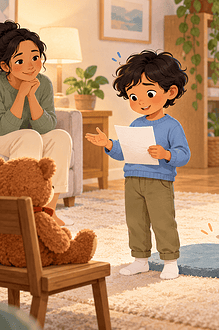
Help your child fill it in themselves, in their own words, including the “ideal profession” question, what they would like to become one day, answered however fancifully they like. Once the card is filled in, press their thumb onto a stamp pad or some washable ink and print their fingerprint in the space provided.
Talk about the fingerprint specifically: ask your child to look closely at the pattern, and point out that nobody else in the world, not even an identical twin, has exactly the same one. If you have more than one child, compare fingerprints side by side, a simple, visual way to make the idea of uniqueness concrete rather than abstract.
Why it works
A young child can say “I am unique” without it meaning very much to them, it is just a phrase they have heard. Filling in a card with their own specific answers, their own favourite food, their own idea of what makes them happy, turns an abstract idea into something they have actually produced and can look back at. The fingerprint section does something similar at a physical level: a child who sees, with their own eyes, that their fingerprint pattern belongs to nobody else on earth tends to actually feel the idea of being one of a kind, rather than just repeating it back.
A note on comparing cards
If you do this with more than one child, or in a group, it is worth guiding the follow-up conversation gently: the point is noticing what is different and what is shared, not ranking whose answers are better. “You both love the colour blue, but your favourite foods are completely different” is the kind of comparison worth drawing out.
A filled-in identification card is a small thing to hold in your hands, a single page, a few lines of a child’s own handwriting, a smudged thumbprint. But it is also a genuinely useful anchor to come back to as a child grows: filling in a new one every year or two and comparing it to the last gives a child, and you, a real, visible record of how much of them stays the same and how much quietly changes.