Age guide: 3–8 years. Adapt suggestions to your child’s interests, communication and support needs.
The teddy has lost its crown. Your child studies it for a moment, then goes back to colouring. Should you turn this into a lesson about feelings? You can offer a small invitation without turning the afternoon into a test.
Learning to notice another person’s experience happens in ordinary moments. A useful beginning is curiosity: “I wonder what happened,” rather than an announcement that you know exactly how someone feels.
1. Notice something you can actually see
Try: “Your brother stopped playing when the tower fell.” That is an observation. “He is furious with you” is an interpretation, and it may be wrong.
Ask a gentle question if the person is available: “Would you like company?” They can answer with words, a gesture or another communication method. Give them time.
2. Offer feeling words as possibilities
“Disappointed?” or “Maybe worried?” can help a child find language without deciding the answer for them. UNICEF’s communication guidance encourages listening to children’s feelings and helping them name what they experience.
Begin with your own child, too. “You wanted another turn” may make more sense than a demand to think about everyone else while they are upset. Feeling understood gives them an example of what considerate attention can look like.
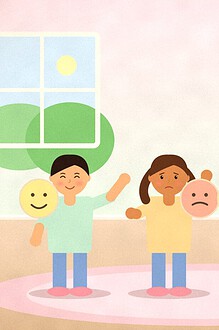
3. Remember that faces do not tell the whole story
A smile can mean different things. A quiet child may be comfortable, tired, concentrating or unsure. Children and adults also express feelings in different ways.
- Do not require eye contact as proof that a child cares.
- Let a child point, draw, speak or use their usual communication support.
- Avoid asking them to perform the “correct” expression.
- Accept “I don’t know” as a reasonable answer.
4. Connect noticing with one useful choice
If someone wants help, make the next step small: find a dropped pencil, make room on the bench or ask an adult for assistance. If they prefer space, respecting that is also considerate.
You can offer: “Would you like to bring the spare paper, or shall I?” Your child can watch you help without being pushed into a public performance.
5. End the conversation while it is still a conversation
One question can be enough. Constantly asking how every character or passer-by feels can become tiring, especially for a child already working hard to manage their own day.
Later, notice a real action: “You asked whether she wanted help before picking up her things.” Keep it warm and specific. There is no need to declare your child the kindest person in the room.
Try next
- “But I’m still using it”: sharing without the tug-of-war
- When a friend is sad: small ways your child can offer comfort