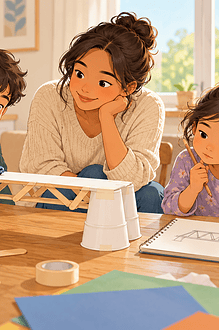


A cardboard tube can be a telescope, a pretend trumpet or the start of a bridge. In So Many Uses, the fun is finding possibilities beyond an object’s usual job.
Get ready
Choose one clean, safe object such as a cardboard tube, a large empty box or a soft scarf used under supervision. You also need optional paper and pencils. Allow about 15–30 minutes for two or more players, or play as a conversation with one child.
How to play
- Show the object and name its usual use. Offer one imaginary alternative, then leave space for the children’s ideas.
- Invite players or pairs to suggest as many different uses as they can. Three minutes is an optional challenge, not a requirement.
- Write, sketch or record the ideas in a way the group can use. A child can describe an idea while another person draws it.
- Take turns sharing. Ask “How would that work in your pretend world?” rather than rejecting an idea because it sounds unusual.
- Choose one idea to explore with a sketch or a safe model. You do not have to physically try every suggested use.
- Try another object, or stop after a particularly satisfying idea.
Keep the experimenting safe
Adults choose the objects and manage any cutting. Avoid glass, batteries, medicines, cords, sharp tools and small parts. Don’t blow through pen barrels, put objects in mouths, climb on unstable constructions or repurpose something in a way that could cause injury. An imagined use can stay on paper.
Make room for different thinkers
- Offer extra thinking time before anyone speaks.
- Let children show an idea with gestures or a drawing.
- For a cooperative version, build one shared list without scores.
- If the group enjoys points, count distinct ideas rather than judging which child is most creative.
One question to finish
Ask, “Which idea surprised you, and what made you think of it?” Sometimes one person’s suggestion gives another person a new starting point. Notice that connection without insisting that the game proves anything about a child’s future ability.
Watch the activity
Watch the original activity demonstration. Use the flexible participation and safety options above when you play.