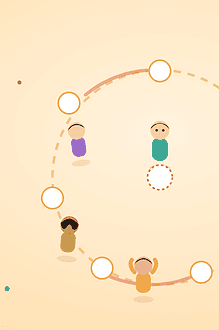
There are six objects on the table, and one is the secret choice. Can your team find it by asking questions that rule things out? Curious Mania is a short question game you can make with things you already have.
Get ready
Choose four to six familiar, safe objects, such as a large wooden spoon, a book, a soft toy and a broad cup. Use pictures or drawings if easier. An adult checks the materials, keeping small parts and hazardous objects away from younger children.
Allow about 10–15 minutes for two or more players. Everyone needs access to the same objects or descriptions. You can play around a table or with a shared picture.
Ask, narrow down and guess
- One player secretly chooses an object. A partner can help them remember it without revealing the answer.
- The others ask a question that can be answered yes or no: “Is it something we use while eating?”
- Look together at which choices remain. You can move picture cards aside rather than relying on memory.
- Ask another question or make a guess. If a question is unclear, rephrase it together instead of treating it as a wrong answer.
- Reveal the object when the group is ready. Discuss which question was most useful.
- Take turns choosing the mystery object. You can pass or work with a partner.
Try a sample round
Imagine the secret object is a spoon. “Is it soft?” rules out some choices. “Do we use it in the kitchen?” narrows the group again. Depending on the objects you selected, more than one answer may still fit. That is an invitation for another question.
Change the challenge
- Start with only two objects for a simpler round.
- Use function, sound or safe tactile exploration as well as appearance. Do not make colour or sight essential to every clue.
- For a cooperative challenge, see how a team can improve its questions over several rounds without comparing individual children.
Allow time for speaking, signing, pointing, pictures or a communication aid. You do not need a timer or penalties for guesses. Stop when people have enjoyed a few satisfying mysteries.
For a different version, try What Do I See?, where the person choosing the object gives clues instead of answering the group’s questions.