By EdCaptain editorial desk · Published
A bookmark can be beautiful and still slip out, disappear between the pages or feel awkward to pick up. That makes it a useful small design challenge: can your child make one for a particular reader, rather than simply decorating the shape they like best?
This activity is for ages 6–12, with adult help for cutting and handling materials as needed. Allow roughly half an hour, or split it into two short sessions. The aim is to practise asking, making and revising. It does not require a perfect result or promise a particular developmental benefit.
Invite a reader, not a judge
Choose a willing family member or another person you know well. They can sit alongside the child for a few minutes. Explain: “You are helping us find out what works for you. You do not have to like every version.” If they do not need or want a bookmark, choose someone else or let the child design for their own reading.
Cooper Hewitt, Smithsonian Design Museum’s guidance on understanding users highlights asking questions and considering the people who will use a design. Here, the reader’s own explanation matters more than an adult guessing what they need.
Gather a small, safe set of materials
- A few sheets of ordinary paper; optional thin, flexible card.
- A pencil and coloured pencils.
- A ruler, if useful, rather than essential.
- Age-appropriate blunt-tip scissors, with supervision or adult cutting.
- A spare family paperback that its owner agrees can be used for testing.
Keep the design flat and light. Skip magnets, metal clips, staples, beads, cords, craft knives and glued-on decorations. Do not stick anything to a page or draw inside the book. Avoid borrowed, fragile or treasured books for the experiment. Store scissors and offcuts away from younger children.
Set out two or three paper sizes, leaving room to work. An adult can cut broad strips in advance. If paper folding or cutting is difficult, the child can point to a shape, dictate an idea or direct an adult’s hands without losing control of the design.
Try the challenge in five rounds
- Ask the reader to show the problem. “How do you usually save your place?” and “What is annoying about that?” are enough to begin. They might want to find the page quickly, see the marker above the book or pick it up more easily. Listen without deciding that a certain colour or shape must solve it.
- Agree on two things to check. For example: the marker stays at the chosen page when the book is gently closed and set down, and the reader can find and remove it comfortably. Ask the reader whether those checks fit their need. Do not make an accessibility claim on their behalf.
- Sketch or describe two possibilities. One could be a simple strip with a wider top; another might be a shorter, broader piece. The child can draw outlines, arrange paper pieces or explain aloud. Before cutting, ask which part will sit inside the book and which will remain visible.
- Make rough versions. Use plain paper first. Check the length against the actual book, leaving a visible top if that is wanted. Keep the part between pages smooth, thin and undecorated. These are trial versions, so save elaborate artwork until the shape has been tried.
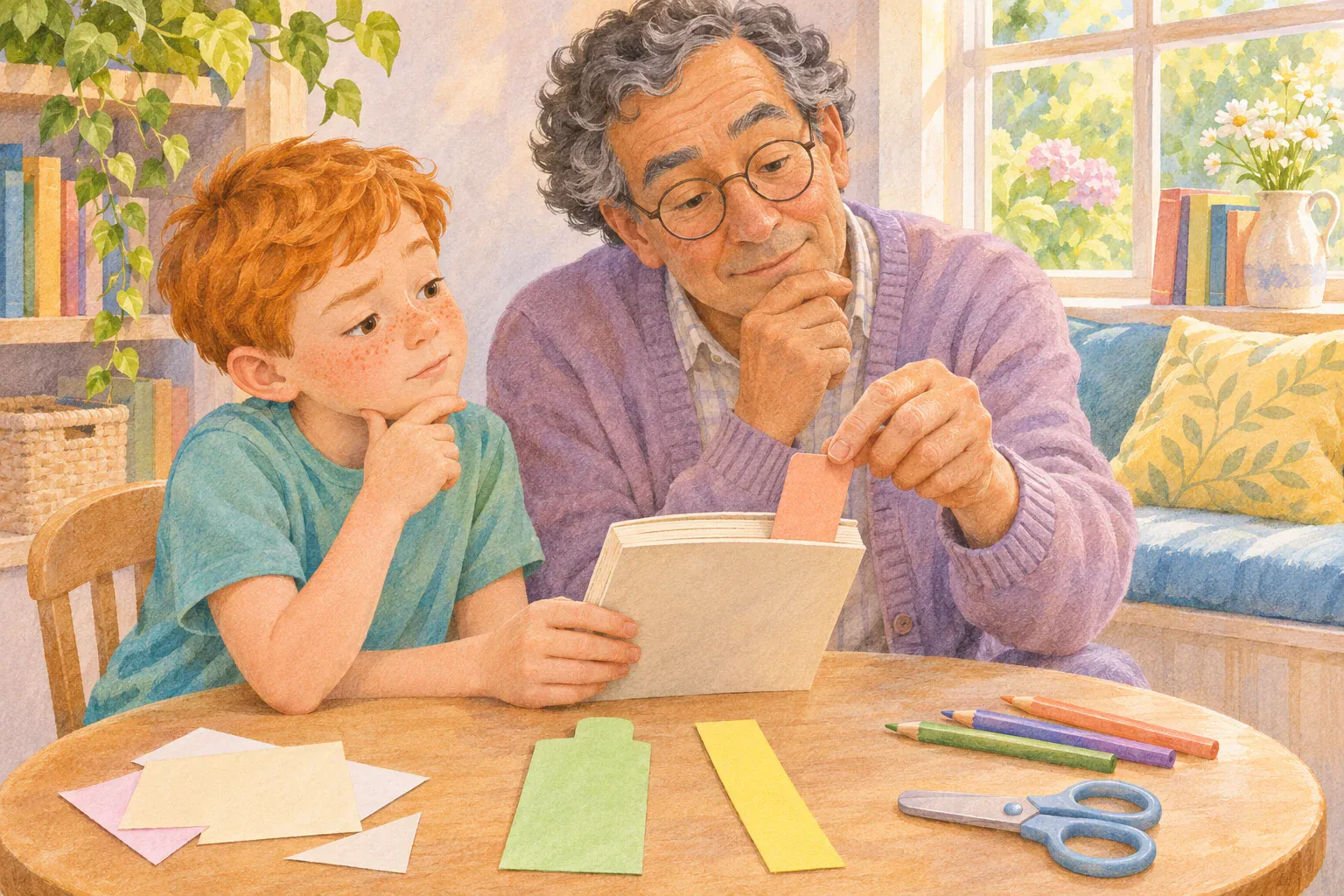
- Let the reader try, then change one feature. With permission, put each marker at the same page. The reader gently closes the book, sets it down, then tries to find the place and remove the marker. Ask what worked and what was awkward. Choose one change, make it and repeat the gentle check.
Stop a test if the marker catches, bends a page or prevents the book closing comfortably. Do not force it, shake the book or test by dropping it. A thinner piece of paper or a simpler shape may be the useful revision.
Cooper Hewitt describes a prototype as a simple first version that makes an idea available to try. You can call it “our try-it version” with a younger child. It is allowed to look unfinished.
Use the feedback without taking over
Suppose the reader says, “I can see it, but I keep losing the bit I need to hold.” Ask your child, “Which part could you change?” They might widen the top, shorten the strip or suggest another way to position it. Let the reader test the idea rather than announcing the correct answer.
If feedback is only “It’s lovely,” try, “Could you show us one thing that was easy and one thing you would change?” Our guide to kind, useful feedback offers language for describing a feature without judging the maker.
Keep the reader free to disagree. “I prefer the plain one” is information, not rejection of the child’s care. Likewise, your child can decide not to continue. If frustration grows, leave the two versions on a tray and return later; the guide to supporting tinkering when an idea fails can help adults offer support without finishing the project themselves.
Adjust the thinking, not the pressure
Ages 6–9: use one reader, two paper shapes and a single question such as “Can you find it?” An adult can record the reader’s words. Let the child choose one change and show what happened; writing a report is unnecessary.
Ages 10–12: invite the child to note the two agreed checks, predict which version may work better and record a short observation. They can compare trade-offs: a larger top is easier for this reader to notice but may protrude more than they want.
At either age, allow extra processing time, signing, communication aids, drawing or pointing. The reader can explain preferences in their usual way. Do not simulate someone else’s disability or assume that one person’s preference represents everyone.
Finish with something worth remembering
Ask: “What did you change because of what the reader told you?” Then ask whether the reader wants to keep the result. They may prefer their existing marker, and that is an acceptable outcome.
If decoration is wanted, add a light design only to the visible top, keeping the page-contact area clean. Recheck that the finished version still works. Save a sketch or two short notes if your child wants to remember the attempt; reuse the remaining paper.
NASA/JPL-Caltech’s explanation of engineering design includes testing and improving a model. In this small family project, the useful habit is returning to what happened rather than defending the first idea. A plain bookmark that suits its reader can be a satisfying result.