By EdCaptain editorial desk · Published
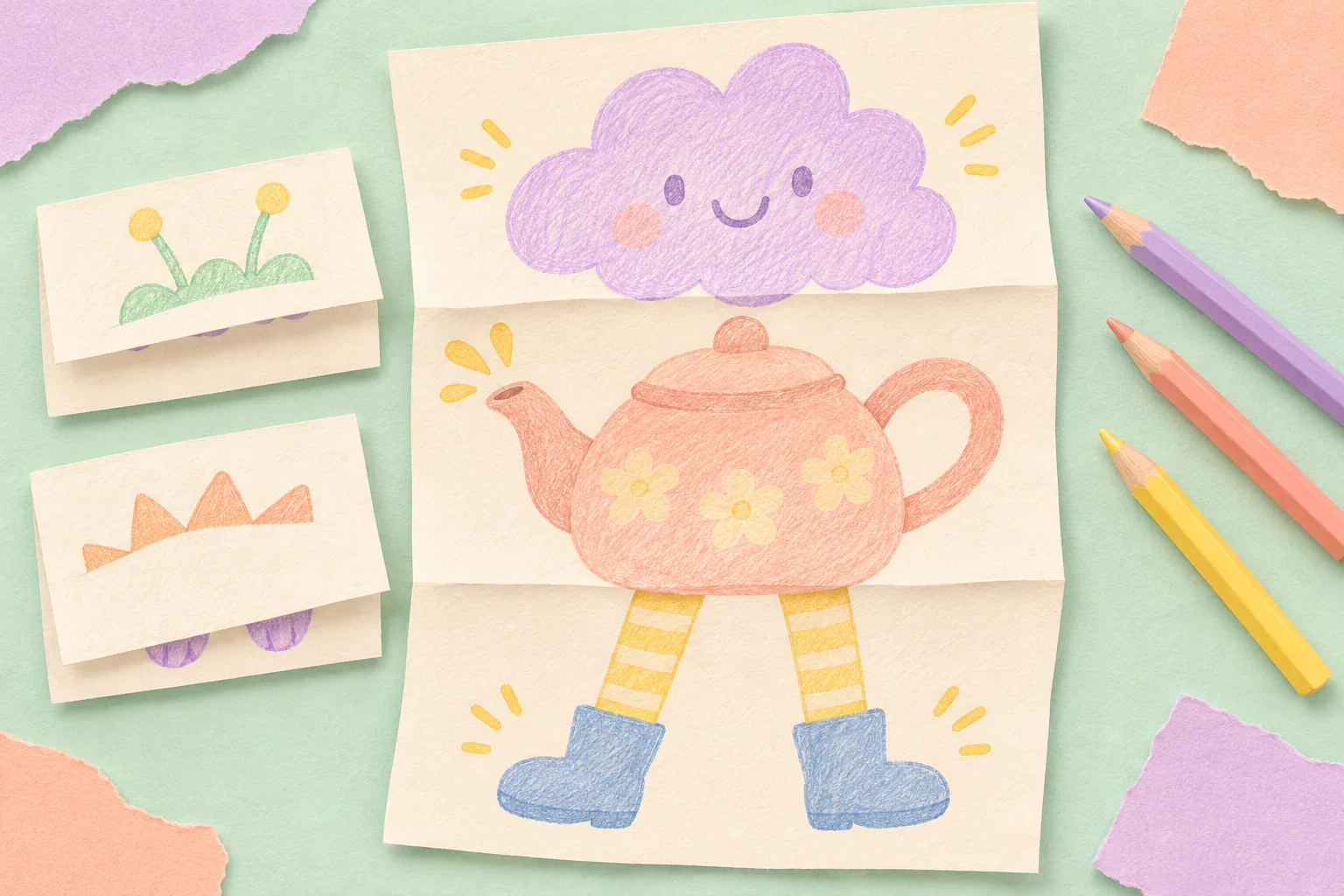
A cloud with a teapot body and striped legs is unlikely to emerge from a careful drawing lesson. It might emerge when three people share a sheet of paper without seeing what the others have added.
Exquisite Corpse is an established collaborative art game, associated with the Surrealists. MoMA describes its fold-and-pass approach; the National Gallery of Art also offers a drawing activity. The family version below is for ages 6–12, with an adult helping with folds or turns as needed. Allow about 15–25 minutes, and stop sooner if everyone has had enough.
Prepare one sheet, three spaces
You need plain A4 or letter-size paper, pencils or crayons, and two or three willing players. No printing, cutting, glue or special art supplies are necessary. Choose age-appropriate materials, keep pencil points away from faces and put small caps or broken crayon pieces out of younger siblings’ reach.
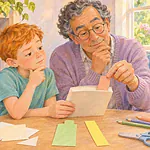
Start with a sheet held upright. Fold it across into three roughly equal sections, then open it so the creases remain visible. The top space will hold a head, the middle a body, and the bottom legs or another way of moving. Exact measurements do not matter.
Explain the plan before hiding anything: “We each add one part. We won’t know what the whole creature looks like until the end.” Agree that everyone may invent something unfamiliar, use simple shapes or pass. Nobody has to make their part match a real animal.
Play the first round
- Begin at the top. The first player draws a head in the upper section. Add two short neck lines that cross just beyond the first crease.
- Hide the drawing. Fold the completed top section behind the sheet, leaving only the small connecting marks visible in the middle space. An adult can hold or arrange the folds so the next player sees only their working area.
- Continue in the middle. The next player starts from those marks and invents a body. Extend two short lines just past the second crease, showing where the final player can connect.
- Cover and pass again. Keep both completed sections hidden. The last player uses the remaining space for legs, wheels, roots or another imagined lower section. Check that the unused side of the sheet has not been mistaken for the final panel.
- Open it together. Unfold the sheet when everyone is ready. Pause to look before anybody starts explaining or improving it.
For two players, one person can draw the first and last sections. Switch who does the middle on the next round. With three players, rotate the starting position so everyone gets a turn at each part.
If a fold slips open, there is no need to restart. Say, “That one had a preview. Shall we finish it anyway?” The surprise is part of the invitation, not a rule worth an argument.
Keep the reveal kind
Before playing, agree to laugh with one another about unexpected combinations, without mocking a person’s drawing or using real people’s bodies as the joke. “Its tiny wheels are carrying an enormous teapot!” notices the invented creature. “Your legs look terrible” targets the artist.
If someone dislikes the result, acknowledge it: “You imagined something different.” Do not insist that they find it funny. Offer to leave this page alone, try a separate drawing or stop. Ask all contributors before adding changes to the shared picture.
A child who wants every section to match may prefer an open round first, where everyone sees the whole page. You can try hidden sections another day. For support beyond this particular game, see helping a child who says “I can’t draw”.
Change the challenge, not the child
Ages 6–9: Begin with one shared sheet and large drawing spaces. Help with the folding while leaving the design decisions to the child. Offer a small starting choice if requested: “A round head or a long one?” Simple circles, zigzags and lines count as contributions.
Ages 10–12: Invite the group to choose one extra constraint, such as a creature that travels in the sky, or a different drawing texture in each section. Keep the hidden contributions unknown. Older children can also organise the passing order, without becoming responsible for supervising younger players.
At either age, give each player their own sheet if waiting is the sticking point. Everyone draws a top section at the same time, folds it and passes clockwise. Repeat for the middle and bottom. Do the first round slowly enough to check which panel is next; speed is optional.
If siblings want different kinds of creative time, these suggestions for sharing an art table while protecting separate ideas can help you arrange the space.
Make a real contribution possible
Use larger paper, a comfortable drawing tool or a non-slip surface. Position the page within easy reach. A child can choose shapes, point, use AAC or direct a partner who draws exactly what they request. Ask before taking over: “Would you like me to hold the paper or make the marks you describe?”
For a child who needs visual or tactile information, make the connecting marks bolder or add a verbal description of just those marks. A partner can describe each finished section at the reveal. If concealment makes participation difficult, keep the sheet visible and make a shared creature instead. Explain the change openly; inclusion matters more than preserving the surprise.
Give the creature a small future
Invite one optional question: “Which combination surprised you?” or “Where could this creature live?” Children can name it, invent a sound, colour it together with permission, or put it away. The activity does not need a lesson or a display.
Agree who keeps the shared page, and ask everyone before photographing or sharing it. These practical adaptations offer ways to enjoy a familiar art game; they are not a test of creativity or a treatment for drawing worries.
Sources and further reading
- MoMA: Exquisite Corpse activity sheet (PDF) — the established folding, passing and connecting-line method.
- National Gallery of Art: Exquisite Corpse with Kerry James Marshall (and friends!) — the game’s artistic context and a collaborative drawing activity.