Finding a club that will “let a child attend” is not the same as finding a place where the child can choose, contribute, make friends and take on responsibility. Good inclusion is built before the first session and adjusted with the child after real experience.
Start with the child’s interest
Ask what they want from the activity: competition, a creative project, time with friends, movement, leadership or simply trying something new. Offer real choices rather than selecting the programme that looks easiest for adults. UNICEF’s participation guidance emphasizes that children with disabilities should have choice and control and be involved in decisions that affect them.
Talk about what would make the first visit comfortable. A younger child might point to pictures—watch first, join immediately or bring a familiar person. An older child may want to contact the organiser themselves or decide exactly what the parent can share.
Ask the organiser concrete questions
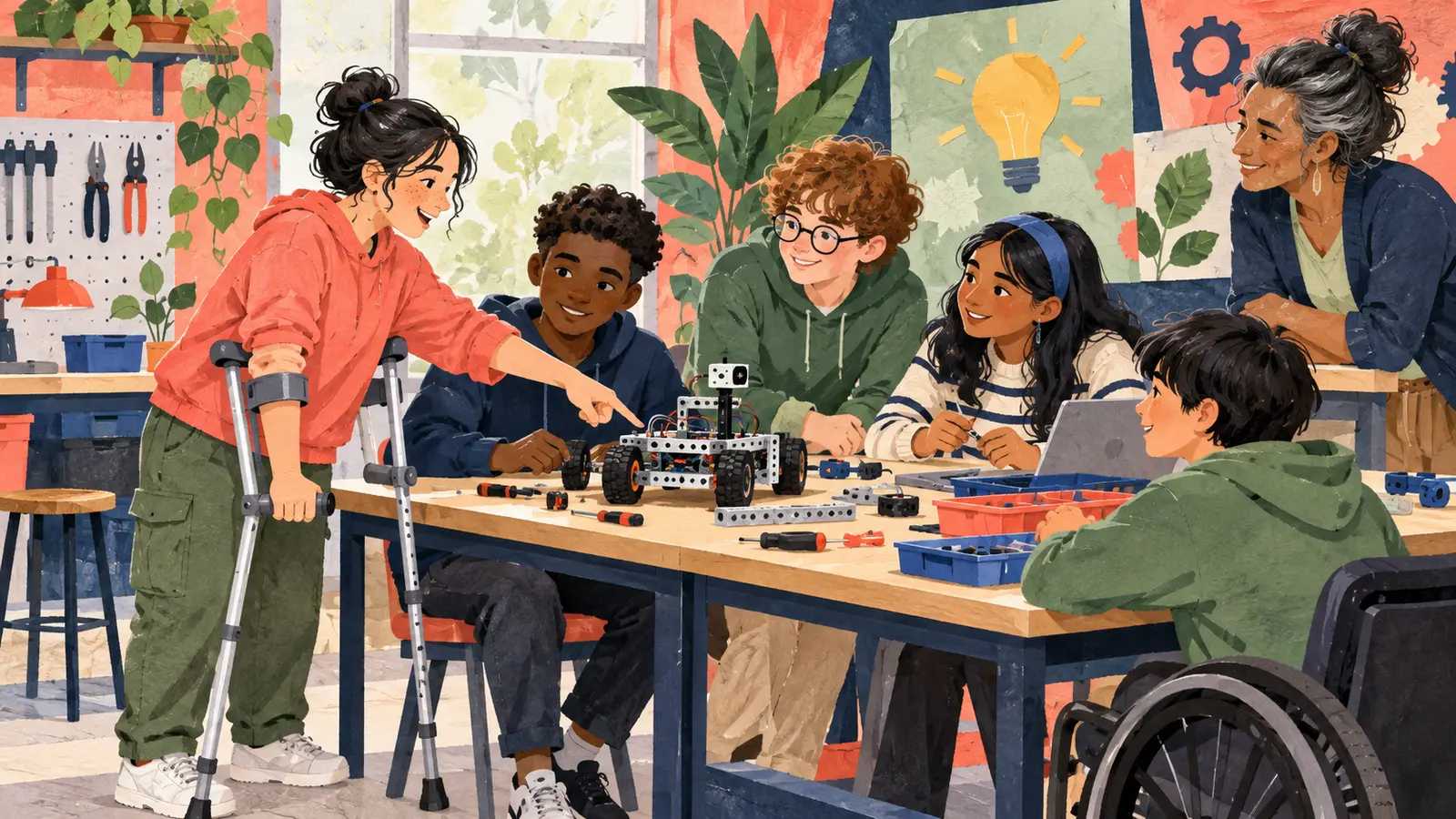
Describe the task and access need, not a long diagnosis history. Try: “Maya wants to build and present with a team. She uses forearm crutches and needs a seated work space with a clear route. How is the room arranged?” Useful questions include:
- Can the child enter, use the toilet and reach the activity areas?
- How are instructions given—spoken, demonstrated, pictured or written?
- Can activities, rules, timing or equipment be adapted without removing the meaningful challenge?
- Where can the child take a quiet break and then rejoin?
- Who is responsible for making agreed changes before the session?
UNICEF notes that access to a programme is not enough; individual supports such as assistive technology, communication help or personal assistance may still be needed for meaningful participation.
Visit the task, not just the building
A step-free entrance does not make a club fully accessible if tools are out of reach or every game depends on fast running. During a short preview, follow the sequence from arrival to departure. Let the child try the table, equipment, noise level and communication routine. For sports, the ideas in inclusive PE and sport can help adults adapt the way a goal is reached rather than benching the child.
Build a real role
Avoid permanent “helper” or spectator roles unless the child chooses them. In robotics, one child might code, assemble, test, photograph progress or present. In a nature club, participation could include navigating, identifying, recording, carrying or leading reflection. Rotate valued roles as the group does for everyone else.
Introduce supports quietly. The organiser can say to the whole group, “We use spoken directions and picture steps,” instead of announcing one child’s private information. Pairing peers can be useful when it is reciprocal, not a constant assignment to look after someone.
Review after the first two sessions
Ask specific, non-leading questions: “When did you feel part of the group?” “Was anything hard to reach or follow?” “What should adults do less?” The child may like the activity but dislike an accommodation. Change it. UNICEF’s Take Us Seriously guidance says inclusive youth spaces require ongoing effort; a one-time access check is not enough.
Look for belonging as well as attendance: Does someone greet the child? Are their ideas used? Can they say no? Do they have informal conversation time? Different ways to play can carry the same right to belong.
If the organiser refuses reasonable discussion, repeatedly isolates the child or cannot address safety, pause and document the concern. Local disability and education rules vary, so seek advice from an appropriate local advocacy or legal service if necessary. The child should not have to earn dignity by enduring exclusion.
Before committing for a full term, agree on a low-pressure trial and a review point. Leaving an unsuitable club is not a failure, and changing supports is not special treatment. The child is learning what environments help them contribute. Carry that knowledge to the next activity, and ask organisers to keep improvements that benefit future members too.
Support peer connection without assigning a minder
Ask the facilitator to use ordinary group-building structures: changing partners, shared projects and roles that require people to exchange ideas. A peer can offer practical help after asking, but should not be made responsible for another child’s access or safety. Adults must provide necessary support. Friendship has room for mutual interests, disagreement and humour; it cannot grow well when one child is permanently cast as helper and the other as recipient.