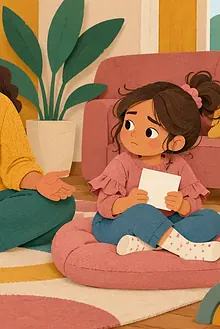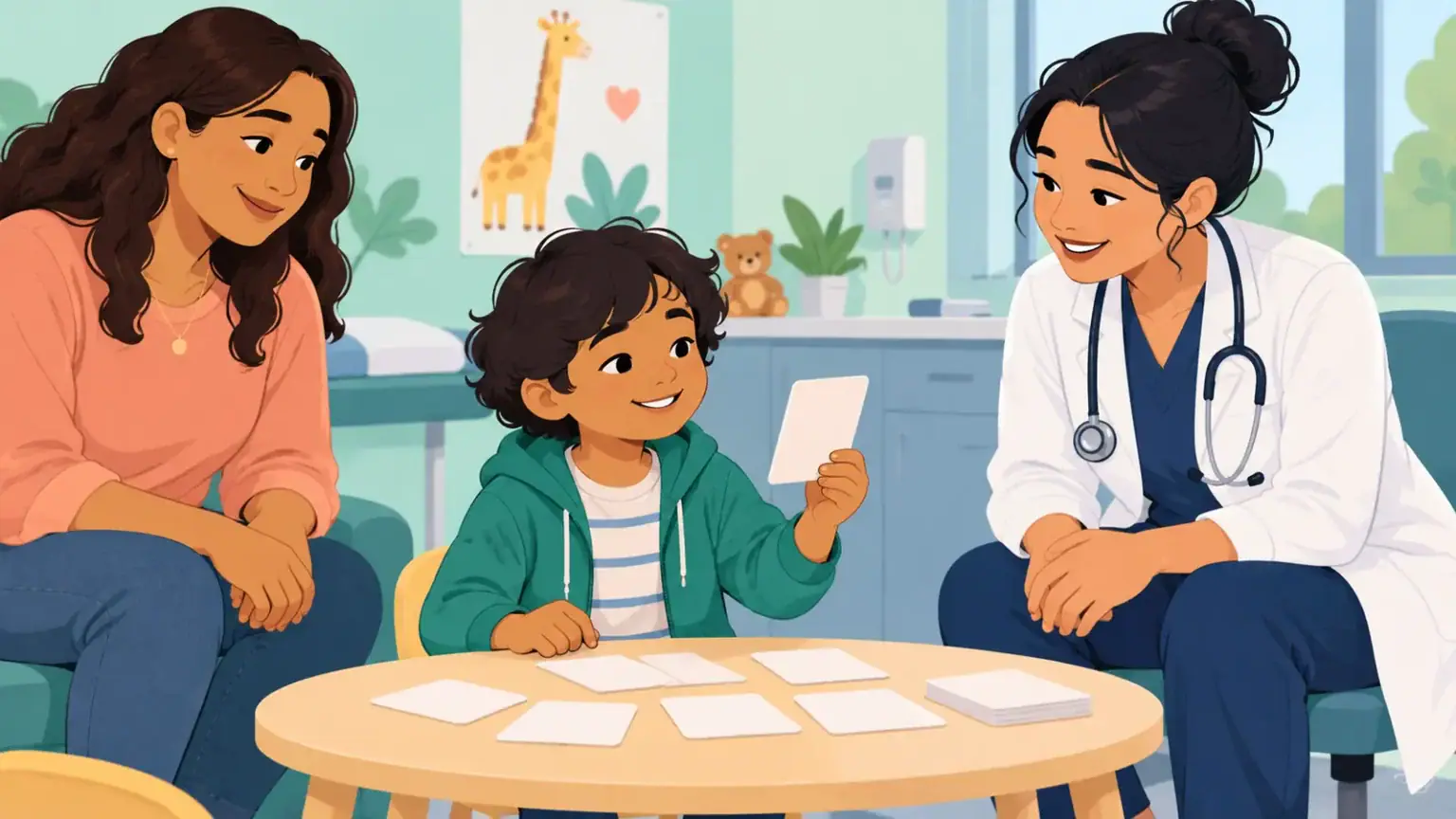
A health appointment can move quickly while adults exchange unfamiliar words. Question cards give a child a predictable way to take part without expecting them to speak on demand. The cards do not transfer medical responsibility to the child; they help the clinician hear what matters to them.
- Prepare together, not as a test
- Card 1: What do I want the clinician to know?
- Card 2: What feels different, difficult or better?
- Card 3: What do I want to ask?
- Card 4: How do I want information or care offered?
- Card 5: What happens next?
- Make room for privacy
- Adapt access
- After the visit
- If the child freezes in the room
- Sources and further reading
Prepare together, not as a test
Explain why the appointment is happening using simple truthful language. For a young child, describe what they may see, hear and feel. Avoid promises such as “nothing will hurt” unless you know that is true. Ask whether they want to bring a comfort item, communication device, headphones or a written list.
Card 1: What do I want the clinician to know?
The child may name a symptom, fear, strength, routine or goal. A preschooler can point to a body picture. A school-age child can draw. A teen may write privately. Adults can add safety-critical information without replacing the child’s voice.
Card 2: What feels different, difficult or better?
This broad wording avoids assuming everything is worse. Add time prompts if useful: morning, school, meals, movement, sleep. Do not coach a “correct” answer. If you disagree, say, “I noticed something different; may I add it after you finish?”
Card 3: What do I want to ask?
Examples include: “What will happen today?” “Why is this test needed?” “Can you explain that another way?” “What choices do I have?” Children may hand the card to the clinician instead of speaking.
Card 4: How do I want information or care offered?
Options might be: show me first, tell me step by step, use pictures, let me take a break, speak more slowly, or ask before touching. Preferences cannot always change what is medically necessary, but they can help the team make care more accessible and respectful.
Card 5: What happens next?
Before leaving, ask for the plan in understandable language: what to do, when to return, who to call and what warning signs need prompt help. Adults keep the official instructions; the child may take a simple version.
Make room for privacy
Older children and teens may be offered time with the clinician without a caregiver, depending on local law, clinical practice and the child’s situation. Explain this without suspicion: “The clinician gives young people a chance to ask private health questions.” Ask the clinic how confidentiality works and what must be shared for safety.
Adapt access
Bring AAC, an interpreter or communication supports the child already uses. Ask for written, drawn or repeated explanations. Let the child answer before helping when they can. A child may choose observer rather than speaker, especially when anxious or unwell.
HealthyChildren recommends explaining the purpose of appointments, validating feelings, preparing questions and giving children a chance to answer. For general visit preparation, see who does what in a child development assessment. For a school-health partnership, see being informed at school and health appointments. If difficult talk shuts down, start smaller.
After the visit
Ask one question: “Is there anything you heard that you want explained?” Correct misunderstandings without quizzing. Follow the clinician’s instructions and seek qualified care for medical concerns. The cards support participation; they do not diagnose or replace professional advice.
If the child freezes in the room
A child who prepared questions may still go quiet. Offer the card without apology: “You wrote something you wanted the clinician to see. Shall I hand it over?” Give processing time and avoid answering every question immediately. If the child signals no, respect that unless urgent safety information must be shared. Afterward, ask which support helped and what to change next time. Participation can grow across visits; it does not have to look confident on the first try.