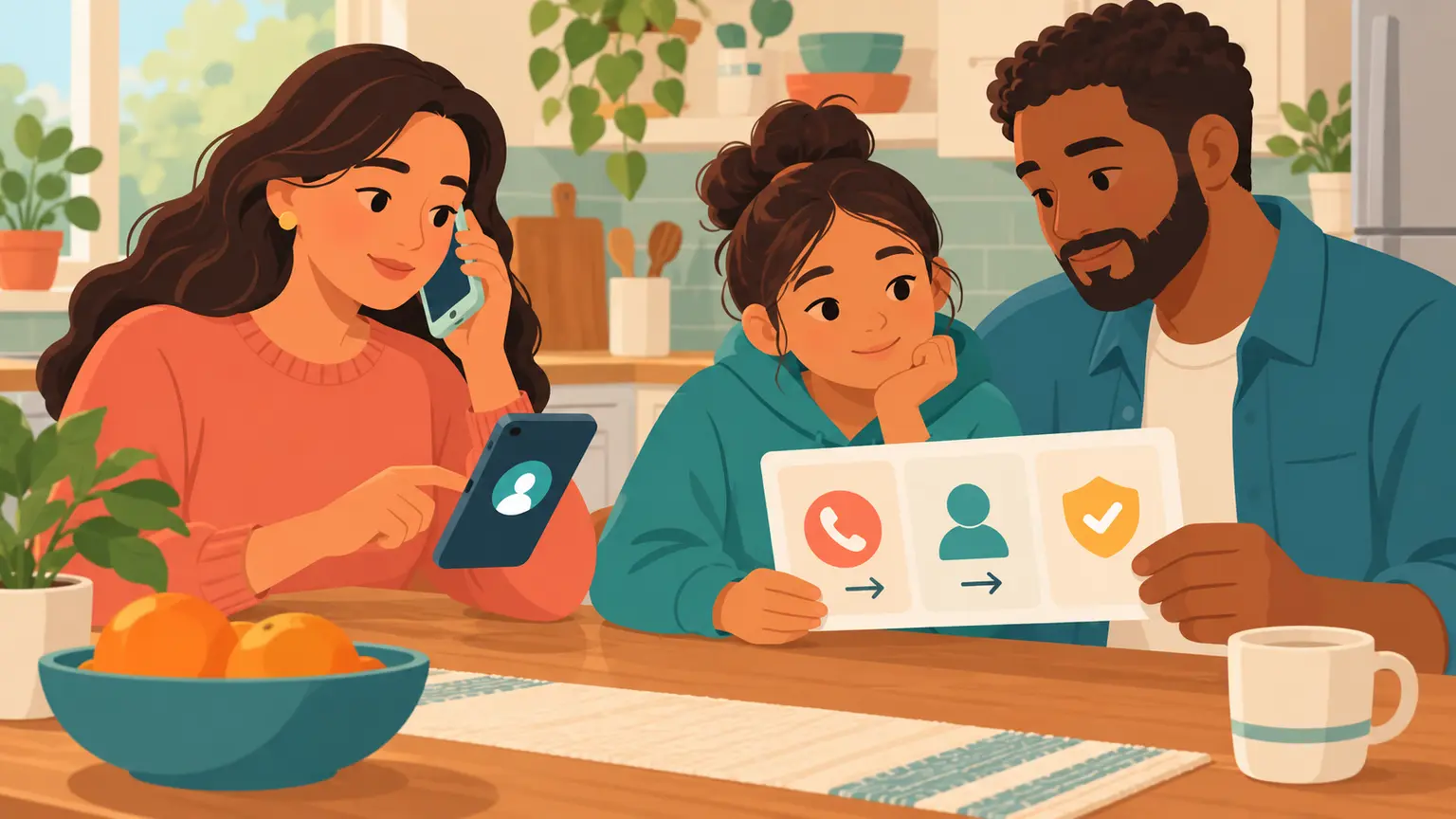
A frightened caller sounds exactly like your teenager, sibling or grandparent and says they need money now. Voice cloning makes “I recognised the voice” much weaker evidence than it once was. Families do not need to become audio detectives. They need a short verification plan that still works when everyone is upset.
- Explain the trick without creating panic
- Choose two verification routes
- Use the STOP-CHECK-CALL script
- Practise one calm scenario
- Notice payment and secrecy warnings
- Reduce easy material for impersonation
- If money or information was sent
- Keep trust intact
- Review the plan when life changes
- Include the people most likely to be targeted
- Sources and further reading
Explain the trick without creating panic
A scammer may copy a voice from a short public clip, then combine it with personal details gathered online. The result can sound convincing. The lesson is not that every voice is fake. It is that an unexpected emergency request must be checked through a second route.
Choose two verification routes
- Call the person back using a number already saved in your contacts.
- Contact another family member, school, workplace or travel companion independently.
- Ask a private question that is not visible on social media, but do not rely on a single secret forever.
A family code phrase can help, especially with younger teens, but it may be overheard or shared. Treat it as one clue, not perfect proof.
Use the STOP-CHECK-CALL script
- Stop: do not send money, gift-card numbers, passwords or identity documents.
- Check: note the caller’s claim without supplying extra details.
- Call: end the call and use a known number or a second trusted person.
A child can say, “Our family always verifies emergencies. I am hanging up and calling back.” They do not need to argue or prove it is a scam.
Practise one calm scenario
Use a fictional example, not a surprise prank. An adult pretends to call from an unknown number and asks for an urgent transfer. The child reads the script, ends the call and contacts the backup adult. Swap roles so the child can hear how pressure sounds. For children who freeze, put the three steps beside the family phone.
Notice payment and secrecy warnings
Requests for gift cards, cryptocurrency, wire transfers or payment-app transfers deserve extra caution because recovery may be difficult. So do demands to keep the emergency secret, stay on the line, or avoid contacting police, school or another relative.
Reduce easy material for impersonation
Review public voice clips, names of relatives, travel posts and school details. This does not mean deleting family life from the internet. It means deciding whether a public post gives strangers an unnecessary script. Keep account recovery protected with strong, unique passwords and multi-factor authentication.
If money or information was sent
Contact the bank or payment provider immediately through its official number, secure affected accounts, preserve call details and report through local police or consumer-protection channels. Do not pay a second person who promises guaranteed recovery.
Keep trust intact
Children should know they will not be punished for pausing an urgent request, even if the caller later turns out to be genuine. A verification plan protects real emergencies too: it gets accurate information to the right adults quickly.
Related EdCaptain guides cover first-phone readiness, AI chatbot boundaries, and account security and phishing.
Review the plan when life changes
Update backup contacts after travel, a new school or a changed phone number. Include grandparents and other relatives who may receive calls about the child. A written plan works only when every person knows it exists and feels allowed to slow an urgent request down.
Include the people most likely to be targeted
Grandparents, babysitters, co-parents and older siblings may receive the call before the main caregiver. Share the verification routes without circulating sensitive answers in a large group chat. Each person should know which saved number to use and who becomes the backup if that person cannot answer.
If the supposed emergency involves arrest, hospital care or travel, find the institution’s official public number independently. Do not call a number supplied by the caller. Record what was claimed, but avoid feeding the caller names, dates or locations they can reuse.