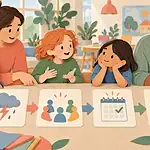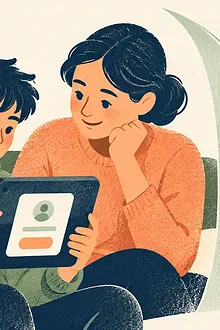
When a child says a chatbot “understands me,” laughing at them may drive the relationship underground. The warmer response is curious and clear: the conversation can feel real, but the system does not know, care for or protect the child like a person does.
- Ask before you lecture
- Explain the illusion without dismissing the feeling
- Set three firm boundaries
- Build a human safety net
- Notice signs the balance is changing
- Respond to harmful output
- Use AI together for bounded tasks
- Keep the door open
- Check the product, not only the conversation
- Sources and further reading
Ask before you lecture
Try: “What do you like about talking with it?” “Does it ever say things that feel wrong or pushy?” and “What happens when you disagree?” Listen for companionship, role-play, creative help, reassurance or escape from conflict. The purpose is to understand the role the chatbot is playing.
Explain the illusion without dismissing the feeling
AI systems are designed to produce convincing responses. They can mirror language, remember details within a service and sound supportive. They do not have feelings, loyalty, professional duty or a complete understanding of the child’s life. A child’s comfort may be genuine even though the relationship is simulated.
Set three firm boundaries
- Private details: no full names, addresses, school, passwords, identity documents, intimate images or deeply personal records.
- High-stakes advice: health, self-harm, abuse, sex, money, threats and legal problems go to a trusted human.
- Control: the child can close the app, delete a conversation where possible and tell an adult about disturbing content without punishment.
Build a human safety net
Name three people the child could contact for different situations: a caregiver, another trusted adult and a school or health professional. Make the routes specific. “Talk to someone” is less useful than “Message Auntie, ask the school counsellor at lunch, or wake me if you feel unsafe.”
Notice signs the balance is changing
Concern grows if the child withdraws from people, loses sleep, becomes distressed when access ends, hides sexual or threatening exchanges, spends money secretly or follows dangerous instructions. Do not diagnose “addiction” from one intense conversation. Look at patterns and the child’s overall functioning.
Respond to harmful output
- Stay with the child and move away from immediate danger.
- Save limited evidence if needed for reporting, without redistributing explicit material.
- Block or report the account or feature through the service.
- Change privacy and memory settings.
- Contact emergency, safeguarding or clinical support if there is immediate risk.
Never ask a child to keep testing the bot to prove it is unsafe.
Use AI together for bounded tasks
Try brainstorming fictional characters, comparing explanations or checking a draft against a known source. Ask what the chatbot might have missed and verify important claims. Keep companion-style use out of bedrooms overnight and review age requirements.
Keep the door open
The American Academy of Pediatrics warns that chatbots may provide false, sexual, violent or harmful responses and cannot replace safe human relationships. UNICEF also identifies distinct risks from relational AI. A rule works best alongside a dependable message: “You can tell me what it said, and I will help before I judge.”
Related EdCaptain guides cover building a positive digital footprint, account security and phishing, and reviewing location and app permissions.
Check the product, not only the conversation
Read the service’s minimum age, privacy policy, memory controls, data deletion options and purchase model with the child. A bot may be part of a game, social platform or paid subscription. “Private mode” may mean different things, and deleting a visible chat may not erase every stored record.
Turn off promotional notifications that imitate concern or summon the child back into a relationship. Review any character-sharing or public-profile features. If the service cannot offer age-appropriate controls and clear reporting, the family can decide it is not suitable even when the child enjoys it.
Schedule a review rather than conducting surprise checks forever. Ask whether the tool supports creativity or learning, whether human relationships remain strong and whether the child can stop comfortably. Loosen or tighten boundaries based on observed patterns, not panic after a headline.