By EdCaptain editorial desk · Published
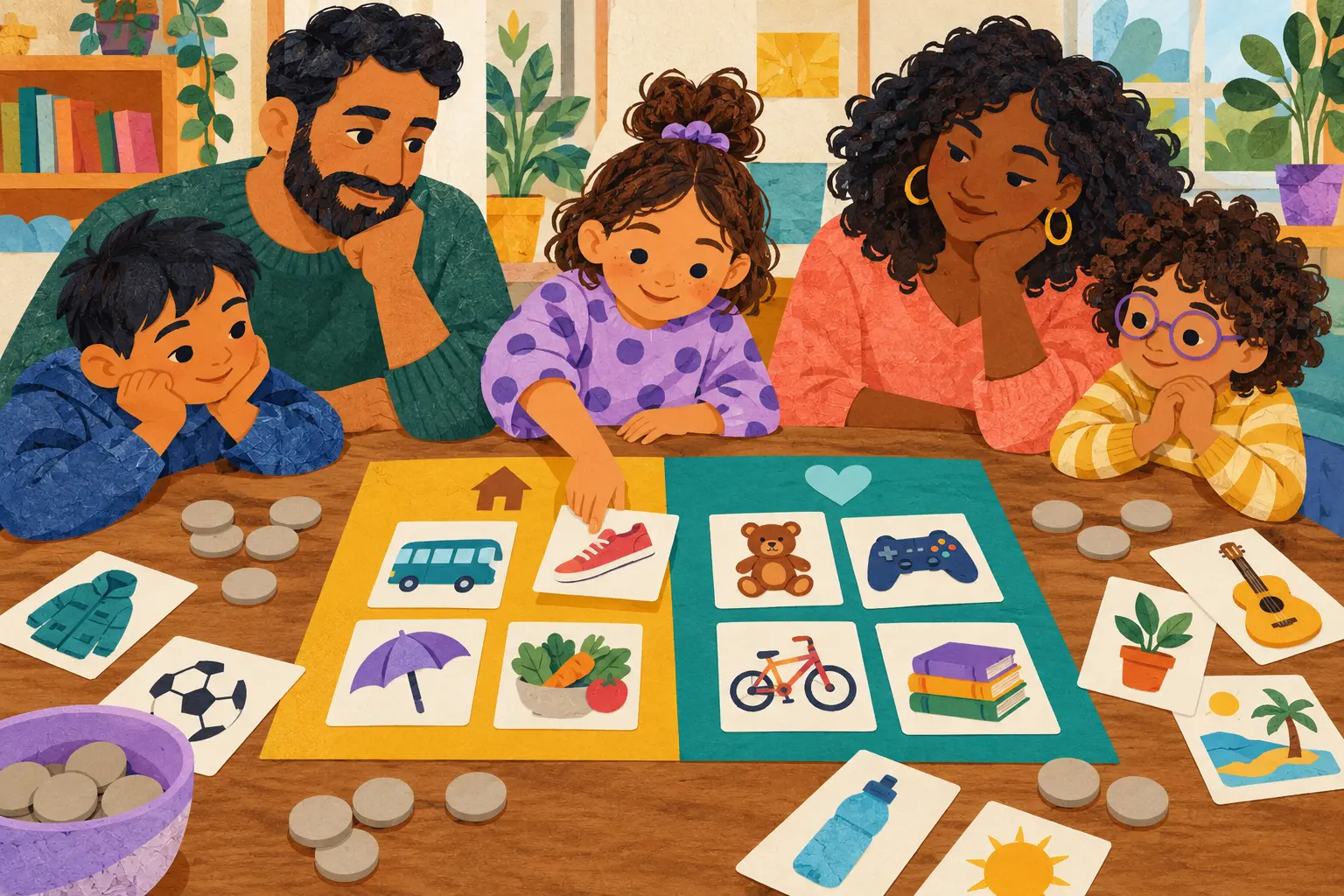
“Need or want?” sounds like a simple money lesson until someone points out that a phone may be optional for one family and essential for another person’s work, safety or access needs. A better game treats the categories as tools for planning, not labels for judging people. Children sort fictional cards, explain their reasoning and then watch some answers change when the situation changes.
Make neutral scenario cards
Create item cards such as drinking water, school shoes, a bus ticket, a birthday decoration, mobile data, medicine prescribed by a clinician, a second toy, a repair, a snack and an umbrella. Add scenario cards: “The old shoes still fit,” “The bus is the only safe route,” “The event has a free decoration option,” or “The person uses data for school.” Avoid using your family’s unpaid bills or financial stress as game material.
Start with three spaces
- Needed now: important for health, safety, basic participation or an existing responsibility.
- Wanted now: enjoyable or useful but can be delayed in this scenario.
- Need more information: the answer depends on price, alternatives, timing or the person’s circumstances.
The CFPB uses needs-and-wants games to help young people think about spending decisions. The third space makes room for uncertainty and different lives.
Play in four rounds
- Sort silently. Each player places three cards without defending the choices yet.
- Explain one card. Use “In this scenario, I think…” rather than “Everyone needs…”
- Reveal a context card. Move any item whose role has changed and explain why.
- Add a limited budget. Give the fictional household ten tokens and decide what happens now, what waits and what needs another solution.
Keep dignity in the conversation
Do not ask children to reveal what their own family can afford. Do not describe wants as greedy or needs as virtuous. People are allowed enjoyment, celebration and beauty; the financial skill is understanding trade-offs. A cheaper substitute may not meet the same accessibility, cultural or durability need.
Adapt by age
Preschoolers can sort picture cards into “must have today” and “can wait.” School-age children can use the third space and budget tokens. Teens can add recurring costs, free alternatives and the cost of delaying a repair. Children who communicate differently can point, use tactile objects or work with a partner.
End with planning questions
- What information would help us decide?
- Could we borrow, repair, share or wait?
- Who is affected if we do not buy it?
- Does the cheapest option actually meet the need?
- Can the plan include one want after essentials?
Build on the game with spend, save or wait decisions, comparing options without overthinking, and previewing likely consequences.
Three context changes to try
After the first sort, change one detail and invite everyone to reconsider. First, imagine heavy rain begins: an umbrella may move from “want” to “need” for someone walking home. Second, imagine the family already owns a working item: a replacement may become a want for now. Third, imagine a person has a disability, allergy or school requirement that makes an item essential even when it is optional for somebody else.
Let children move cards and explain their reasoning without searching for one official answer. Adults can model uncertainty: “For our family this is a need this week, but another family may plan differently.” Do not ask children to reveal private financial information or compare which household has more. For younger players, use only a few clear picture cards. Older children can add time, transport and shared responsibilities to the scenario. End by choosing one item that changed categories and naming the new fact that changed the decision. That makes context—not judgment—the centre of the game.