
By EdCaptain editorial desk · Published
A bright discount sticker can make a choice feel settled before anyone checks the details. This activity gives children two fictional purchase options and asks them to compare the cost that actually matters: price, quantity, delivery or travel, required extras, how long the item may be useful and whether the household needs that amount.
Create a fair comparison
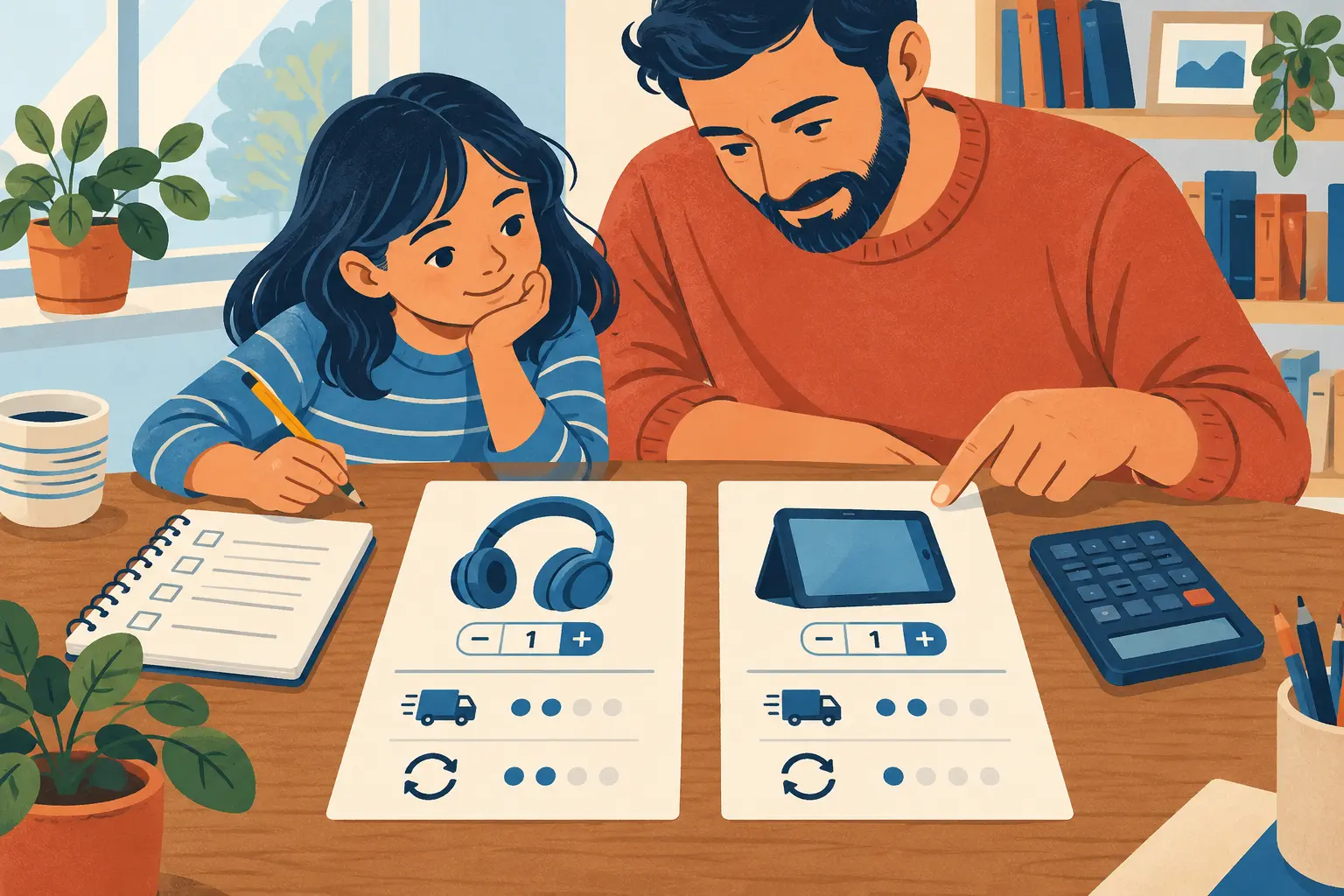
Use advertisements you invent rather than a live shopping account. One card might show eight notebooks for 800 units of pretend currency; another shows five notebooks for 575, with a delivery fee of 75. Keep the arithmetic suitable for the child. The CFPB encourages school-age children to shop around, compare prices, notice advertising pressure and estimate the amount paid at the register.
Write a real-cost line
For each option, list:
- Item price
- Delivery, tax or travel cost where applicable
- Required accessories or subscription
- Number or amount received
- Likely waste if the quantity is too large
- Return or repair conditions
Then calculate the total. Older children can divide by the number of units. Younger children can compare matched bundles with counters.
Run the decision
- State the need. “We need four notebooks this term,” not “Which advert looks best?”
- Circle comparable facts. Match size, quantity, model and time period.
- Add the extras. Include only costs that genuinely apply.
- Check usefulness. A lower unit price is not better if much of the product will expire or go unused.
- Choose and explain. The child gives one cost reason and one practical reason.
Add marketing twists
Try “buy two, get one free,” a countdown timer, a larger package, free delivery above a threshold or a subscription with a cheap first month. Ask what information the advert makes prominent and what it makes small. Do not teach that every promotion is dishonest; teach that the family still checks.
What the cheapest number misses
Quality, accessibility, safety, durability, repairability and seller reliability can matter. A family may reasonably pay more for an item that fits, lasts or can be returned. Children should not be asked to make high-value purchases or contact sellers. Use the activity as practice, then let adults keep real financial responsibility.
Adapt the mathematics
Use whole numbers and physical coins for younger children. School-age children can estimate before calculating. Teens can compare recurring monthly costs with a one-time price. A calculator is a tool, not cheating; the important part is choosing the right numbers.
Continue with a general option-comparison routine, spend, save or wait, and spotting persuasion in advertising.
A worked fictional example
Suppose Option A costs 18 tokens for three notebooks, while Option B costs 24 tokens for five. Delivery adds 4 tokens to A and nothing to B. First write the full totals: 22 and 24. Then divide by the number of notebooks if the child is ready for unit price: about 7.3 tokens each for A and 4.8 for B. Option B costs more today but less per notebook.
That calculation still does not choose the winner. If only two notebooks are needed and storage is limited, spending 24 may waste money. If five will definitely be used and the budget allows it, B may offer better value. Add one more question: what happens if the cheaper-looking item wears out quickly or cannot be returned? Keep examples fictional and within the child’s maths level. For a younger child, compare totals with counters rather than division. The skill is to identify quantity, unavoidable extra costs, usefulness and budget before reacting to a discount sign.
For another round, change the quantity or delivery fee and ask the child to predict whether the better-value option will stay the same. Then calculate again. This shows why comparison is a process, not a rule such as “always buy more.” An adult should make real purchases and keep household financial details private; the activity is practice with fictional choices.