Age guide: 3–8 years; choose age-appropriate building materials
“Triangle. Square. Circle.” Naming shapes can be useful, but it is only one part of understanding them. When your child turns a piece to make it fit or chooses a wider block for a base, there is plenty of mathematical thinking to explore.
The short answer
- Begin with what your child is trying to build.
- Describe features and position as well as names.
- Ask one useful question, then leave room to experiment.
- Let the construction remain your child’s project.
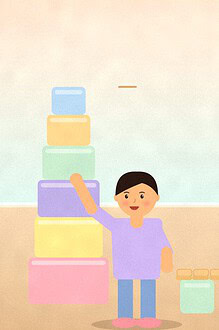
DREME’s block-play guidance encourages adults to expand on children’s observations and use the child’s building goal to guide a conversation. It does not require a special toy or an adult-designed masterpiece.
1. Ask about the plan
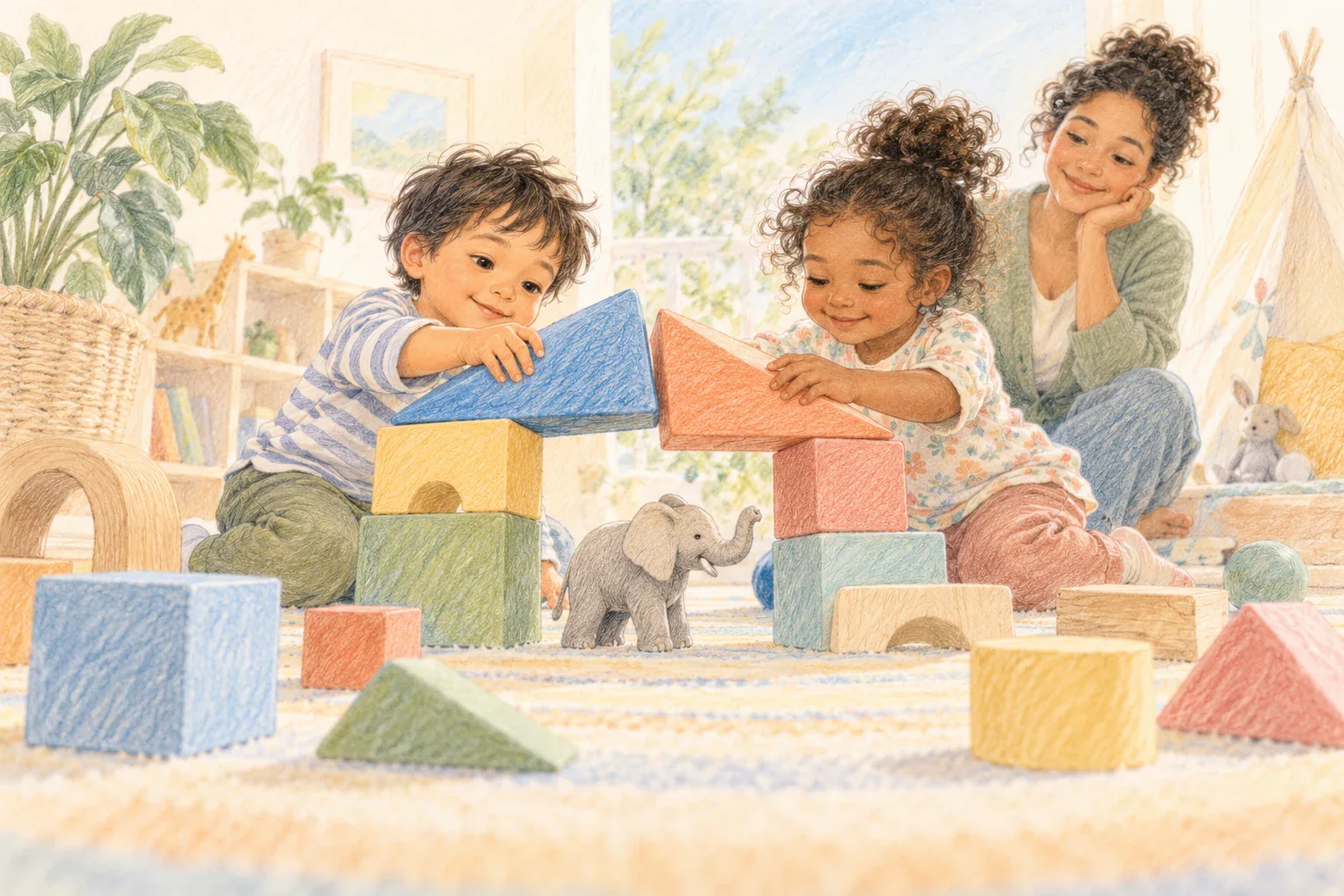
Try: “What are you making?” If the answer is a house for a toy animal, your next question can serve that goal: “How will it get through the doorway?” That is a real problem within the play.
Wait before offering a solution. A child may rotate a piece, widen the gap or change the design in a way you had not considered.
2. Use precise words naturally
Describe a long side, a curved edge, a corner or a piece placed underneath another. Keep your comments connected to what is visible. You do not have to introduce every geometry term at once.
- “You turned it and now it fits.”
- “These two pieces meet along this edge.”
- “This opening is narrower than the toy.”
- “Which piece could make the base wider?”
These prompts are examples, not a script to deliver in order.
3. Compare without making everything identical
Place two paper triangles in different orientations and talk about what they share. A triangle does not stop being a triangle when its point faces sideways. For young children, exploring that through turning and matching can be more meaningful than reciting a definition.
Keep the distinction between flat shapes and solid objects clear when it matters: a box is not itself a rectangle, although a face of the box may be rectangular.
4. Let a failed fit become information
If a roof falls, try: “What happened just before it slipped?” Help the child inspect the design. Avoid repairing it immediately unless there is a safety reason.
Choose stable, manageable materials; keep small parts away from children who may mouth them. Clear a safe building area and avoid climbing on constructions. A child can plan, point or direct your hands if manipulating pieces is difficult.
Try one change today
Replace one naming question with a question about fit, position or a feature. Then watch what your child does with the idea.
Your role is not to narrate every block. A well-timed observation and a little room to explore can keep both the maths and the pleasure of building in the picture.
Keep exploring
- Clap, tap, repeat: pattern play that needs no worksheet
- How long is the toy road? Start measuring with what you have